

 登录
登录
一、阅读理解
①Many stick puppets (木偶), dressed in traditional costumes, have fun on stage. They are able to change their facial expressions (表情) and perform difficult movements along with the music. The people who control (控制) the puppets are below them and use three rods (杆子) to move the heads and hands of the puppets.
②This is the art form of stick puppet plays popular in Xiaoyi, Shanxi Province. They were introduced to Xiaoyi during the Song Dynasty, and became the most popular during the Ming and Qing dynasties. Traditionally, stick puppets were made out of wood. They took a long time to make and were heavy to hold.
③Wang Maowei is a master of puppet - making and performing (表演) the beautiful art form on stage.
④Since his parents used to work with the Xiaoyi Shadow Puppetry and Puppet Troupe (戏班), he fell in love with the art form as a teenager. He decided to “make it a lifelong career (事业)”.
⑤When he was 17, he went to Xi'an to learn puppet - making from a master. After spending seven years there, he returned to his hometown and joined the same troupe that his parents worked with.
⑥“Traditional art in modern times is a challenge (挑战) for performers,” says Wang. “Don't stay in the same old way. It's important to keep up with the times.” So ▲. First, unlike the traditional puppets, Wang uses one rod instead of three to make the puppets work. A special tool is put inside the puppet heads—the nose, eyes and mouth can all move at the same time. He is also creative, combining (结合) traditional skills with modern technology. His puppets can perform bianlian, or face - changing, to attract more young people. His troupe now uses background music instead of local operas when performing the plays. This makes it easier for the audience to understand.
(
A. The stick puppets wear modern costumes.
B. The stick puppets can perform just one movement.
C. The stick puppets cannot change their facial expressions.
D. The stick puppets cannot move hands and heads by themselves.
(
A. many people think he is truly a puppet - making master
B. he has done everything new to the traditional art form
C. the plays are great for spreading the Chinese culture
D. he has made the puppets different from the old times
(
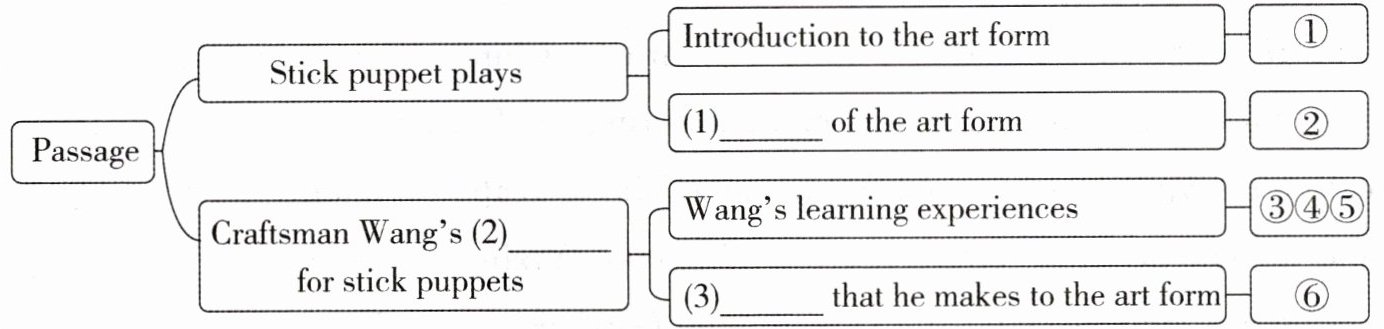
Stick puppet plays
Introduction to the art form ①
(1)
Craftsman Wang's (2)
Wang's learning experiences ③④⑤
(3)
A. (1)Birthplace; (2)story; (3)Examples
B. (1)History; (2)love; (3)Changes
C. (1)History; (2)plan; (3)Changes
D. (1)Birthplace; (2)love; (3)Examples
(
A. The History of Stick Puppet Plays
B. The Challenges of Traditional Art
C. Wang Maowei and Stick Puppet Plays
D. The Fall of Traditional Puppetry
①Many stick puppets (木偶), dressed in traditional costumes, have fun on stage. They are able to change their facial expressions (表情) and perform difficult movements along with the music. The people who control (控制) the puppets are below them and use three rods (杆子) to move the heads and hands of the puppets.
②This is the art form of stick puppet plays popular in Xiaoyi, Shanxi Province. They were introduced to Xiaoyi during the Song Dynasty, and became the most popular during the Ming and Qing dynasties. Traditionally, stick puppets were made out of wood. They took a long time to make and were heavy to hold.
③Wang Maowei is a master of puppet - making and performing (表演) the beautiful art form on stage.
④Since his parents used to work with the Xiaoyi Shadow Puppetry and Puppet Troupe (戏班), he fell in love with the art form as a teenager. He decided to “make it a lifelong career (事业)”.
⑤When he was 17, he went to Xi'an to learn puppet - making from a master. After spending seven years there, he returned to his hometown and joined the same troupe that his parents worked with.
⑥“Traditional art in modern times is a challenge (挑战) for performers,” says Wang. “Don't stay in the same old way. It's important to keep up with the times.” So ▲. First, unlike the traditional puppets, Wang uses one rod instead of three to make the puppets work. A special tool is put inside the puppet heads—the nose, eyes and mouth can all move at the same time. He is also creative, combining (结合) traditional skills with modern technology. His puppets can perform bianlian, or face - changing, to attract more young people. His troupe now uses background music instead of local operas when performing the plays. This makes it easier for the audience to understand.
(
D
)1. Which of the following is TRUE according to the passage?A. The stick puppets wear modern costumes.
B. The stick puppets can perform just one movement.
C. The stick puppets cannot change their facial expressions.
D. The stick puppets cannot move hands and heads by themselves.
(
D
)2. Which sentence can be put in “ ▲ ”?A. many people think he is truly a puppet - making master
B. he has done everything new to the traditional art form
C. the plays are great for spreading the Chinese culture
D. he has made the puppets different from the old times
(
B
)3. Which group of words are the most suitable for the mind - map?Stick puppet plays
Introduction to the art form ①
(1)
History
of the art form ②Craftsman Wang's (2)
History
for stick puppetsWang's learning experiences ③④⑤
(3)
Changes
that he makes to the art form ⑥A. (1)Birthplace; (2)story; (3)Examples
B. (1)History; (2)love; (3)Changes
C. (1)History; (2)plan; (3)Changes
D. (1)Birthplace; (2)love; (3)Examples
(
C
)4. What is the best title for the passage?A. The History of Stick Puppet Plays
B. The Challenges of Traditional Art
C. Wang Maowei and Stick Puppet Plays
D. The Fall of Traditional Puppetry
答案
【文章大意】本文是一篇说明文,主要介绍了山西省孝义市流行的木偶戏艺术形式,以及木偶制作者王茂伟的经历。
1. D 判断正误题。根据“The people who control the puppets are below them and use three rods to move the heads and hands of the puppets.”可知,这些木偶是被操纵的,不能自己移动头和手,故选 D。
2. D 补全文章题。根据“It's important to keep up with the times.”和“First, unlike the traditional puppets...”可知,他对木偶做出了一些改变,使之不同于传统的木偶。故选 D。
3. B 篇章结构题。根据第二段可知,本段介绍了木偶戏的历史;第三到五段介绍了王茂伟对木偶戏的热爱;第六段介绍了他对木偶戏做出的一些改变。故选 B。
4. C 标题归纳题。本文主要介绍了木偶戏艺术以及木偶制作者王茂伟的经历,故选 C。
1. D 判断正误题。根据“The people who control the puppets are below them and use three rods to move the heads and hands of the puppets.”可知,这些木偶是被操纵的,不能自己移动头和手,故选 D。
2. D 补全文章题。根据“It's important to keep up with the times.”和“First, unlike the traditional puppets...”可知,他对木偶做出了一些改变,使之不同于传统的木偶。故选 D。
3. B 篇章结构题。根据第二段可知,本段介绍了木偶戏的历史;第三到五段介绍了王茂伟对木偶戏的热爱;第六段介绍了他对木偶戏做出的一些改变。故选 B。
4. C 标题归纳题。本文主要介绍了木偶戏艺术以及木偶制作者王茂伟的经历,故选 C。
解析
【分析】
拿到这篇阅读理解,首先我们先通读全文梳理整体脉络:文章分为两大板块,第一部分介绍山西孝义杖头木偶戏的基础相关信息,第二部分介绍木偶戏传承人王茂伟的相关经历与创新。接下来逐个题目对应思考:
1. 第1题是细节判断正误题,只需要把每个选项和原文对应内容逐一比对,排除和原文描述矛盾的错误选项,就能得到正确答案;
2. 第2题是语句回填题,重点看空格前后的逻辑:前文提到传统艺术不能守旧要与时俱进,后文列举了大量王对木偶做出的改动,要选能承上启下、衔接前后内容的句子,排除逻辑不匹配的选项;
3. 第3题是篇章结构思维导图匹配题,我们只需要把三个空分别对应到原文的对应段落,提炼段落核心含义,就能匹配出正确的词汇组合;
4. 第4题是标题归纳题,要选择能覆盖全文两大核心内容的选项,排除只涉及局部内容、完全不符合原文的片面选项即可。
【解析】
1. 细节判断:
选项A:原文第一段明确提到木偶穿着传统服饰,和“现代服饰”描述矛盾,错误;
选项B:原文第一段提到木偶可以完成高难度动作,和“只能表演一个动作”描述矛盾,错误;
选项C:原文第一段提到木偶可以改变面部表情,和“不能改变表情”描述矛盾,错误;
选项D:原文第一段说明木偶需要人在下方用三根杆操控头和手,无法自主移动头手,描述正确,因此选D。
2. 语句回填:
空格前文提到王认为传统艺术不能守旧、要与时俱进,后文列举了他将操控杆从三根改为一根、加入变脸功能、替换现代背景音乐等一系列改动,说明空格处要引出“他对木偶做出改动,和旧木偶不同”的内容:
选项A“很多人认为他是木偶制作大师”和下文列举改动的内容不衔接,错误;
选项B“他对传统艺术做了所有全新改动”表述过于绝对,不符合原文内容,错误;
选项C“木偶戏利于传播中国文化”和上下文逻辑无关,错误;
选项D“他让木偶和旧时的木偶不同”可以完美承上启下,衔接前后内容,因此选D。
3. 思维导图匹配:
空(1)对应原文第②段,内容介绍杖头木偶戏传入孝义的朝代、发展的兴盛时期、传统制作材质,核心是介绍这门艺术的发展历史,对应填History;
空(2)对应原文③④⑤段,内容介绍王茂伟年少就爱上这门艺术、立志将其作为终身事业、专门赴西安求学,核心是他对杖头木偶的热爱,对应填love;
空(3)对应原文第⑥段,内容介绍他对传统木偶戏做出的各类创新调整,核心是他给这门艺术带来的变化,对应填Changes,三个词汇对应选项B。
4. 标题归纳:
全文既介绍了杖头木偶戏的相关基础信息,也介绍了传承人王茂伟的学习经历和创新成果:
选项A只涉及木偶戏的历史,内容片面;
选项B只提到传统艺术的挑战,完全没有覆盖全文核心;
选项C“王茂伟和杖头木偶戏”可以覆盖全文两大核心板块,符合要求;
选项D提到传统木偶戏衰落,原文完全没有相关内容,错误。因此选C。
【答案】
1.D 2.D 3.B 4.C
【知识点】
细节理解,篇章结构梳理,主旨大意归纳
【点评】
本题以非遗杖头木偶戏为命题载体,考点设置梯度合理,既考察学生快速定位原文细节的能力,也考察学生对全文行文逻辑的梳理能力,同时渗透了对中国传统民间艺术的文化科普。做题时要注意逻辑衔接类题目必须贴合上下文内容,标题选择类题目要避免以偏概全,确保选项能覆盖全文的核心内容。
【难度系数】
0.7
拿到这篇阅读理解,首先我们先通读全文梳理整体脉络:文章分为两大板块,第一部分介绍山西孝义杖头木偶戏的基础相关信息,第二部分介绍木偶戏传承人王茂伟的相关经历与创新。接下来逐个题目对应思考:
1. 第1题是细节判断正误题,只需要把每个选项和原文对应内容逐一比对,排除和原文描述矛盾的错误选项,就能得到正确答案;
2. 第2题是语句回填题,重点看空格前后的逻辑:前文提到传统艺术不能守旧要与时俱进,后文列举了大量王对木偶做出的改动,要选能承上启下、衔接前后内容的句子,排除逻辑不匹配的选项;
3. 第3题是篇章结构思维导图匹配题,我们只需要把三个空分别对应到原文的对应段落,提炼段落核心含义,就能匹配出正确的词汇组合;
4. 第4题是标题归纳题,要选择能覆盖全文两大核心内容的选项,排除只涉及局部内容、完全不符合原文的片面选项即可。
【解析】
1. 细节判断:
选项A:原文第一段明确提到木偶穿着传统服饰,和“现代服饰”描述矛盾,错误;
选项B:原文第一段提到木偶可以完成高难度动作,和“只能表演一个动作”描述矛盾,错误;
选项C:原文第一段提到木偶可以改变面部表情,和“不能改变表情”描述矛盾,错误;
选项D:原文第一段说明木偶需要人在下方用三根杆操控头和手,无法自主移动头手,描述正确,因此选D。
2. 语句回填:
空格前文提到王认为传统艺术不能守旧、要与时俱进,后文列举了他将操控杆从三根改为一根、加入变脸功能、替换现代背景音乐等一系列改动,说明空格处要引出“他对木偶做出改动,和旧木偶不同”的内容:
选项A“很多人认为他是木偶制作大师”和下文列举改动的内容不衔接,错误;
选项B“他对传统艺术做了所有全新改动”表述过于绝对,不符合原文内容,错误;
选项C“木偶戏利于传播中国文化”和上下文逻辑无关,错误;
选项D“他让木偶和旧时的木偶不同”可以完美承上启下,衔接前后内容,因此选D。
3. 思维导图匹配:
空(1)对应原文第②段,内容介绍杖头木偶戏传入孝义的朝代、发展的兴盛时期、传统制作材质,核心是介绍这门艺术的发展历史,对应填History;
空(2)对应原文③④⑤段,内容介绍王茂伟年少就爱上这门艺术、立志将其作为终身事业、专门赴西安求学,核心是他对杖头木偶的热爱,对应填love;
空(3)对应原文第⑥段,内容介绍他对传统木偶戏做出的各类创新调整,核心是他给这门艺术带来的变化,对应填Changes,三个词汇对应选项B。
4. 标题归纳:
全文既介绍了杖头木偶戏的相关基础信息,也介绍了传承人王茂伟的学习经历和创新成果:
选项A只涉及木偶戏的历史,内容片面;
选项B只提到传统艺术的挑战,完全没有覆盖全文核心;
选项C“王茂伟和杖头木偶戏”可以覆盖全文两大核心板块,符合要求;
选项D提到传统木偶戏衰落,原文完全没有相关内容,错误。因此选C。
【答案】
1.D 2.D 3.B 4.C
【知识点】
细节理解,篇章结构梳理,主旨大意归纳
【点评】
本题以非遗杖头木偶戏为命题载体,考点设置梯度合理,既考察学生快速定位原文细节的能力,也考察学生对全文行文逻辑的梳理能力,同时渗透了对中国传统民间艺术的文化科普。做题时要注意逻辑衔接类题目必须贴合上下文内容,标题选择类题目要避免以偏概全,确保选项能覆盖全文的核心内容。
【难度系数】
0.7
