

 登录
登录
B
Summer means hot weather, more outdoor activities and all kinds of fruit and vegetables. 6.
Eat and drink healthily
What is healthy to eat in summer? Fresh(新鲜的) and healthy food, like fish, tofu and so on. They can make you strong. 7.
What is healthy to drink? Water, of course. Don't drink too many sports drinks. There is lots of sugar in them.
Keep cool and enjoy sports
Summer is a great time to enjoy outdoor activities. Do water sports like swimming and other water sports. 8.
Get enough sleep
The day is long and the night is short in summer. 9.
10.
Summer makes us get outside more, but it can make us get sunburned easily. If you go outside, keep away from the sun when it's the strongest. It's usually from 11:00 am to 3 pm. If you have to stay in the sun for a long time, you can bring your sunscreen(防晒霜), a big hat and a jacket with you.
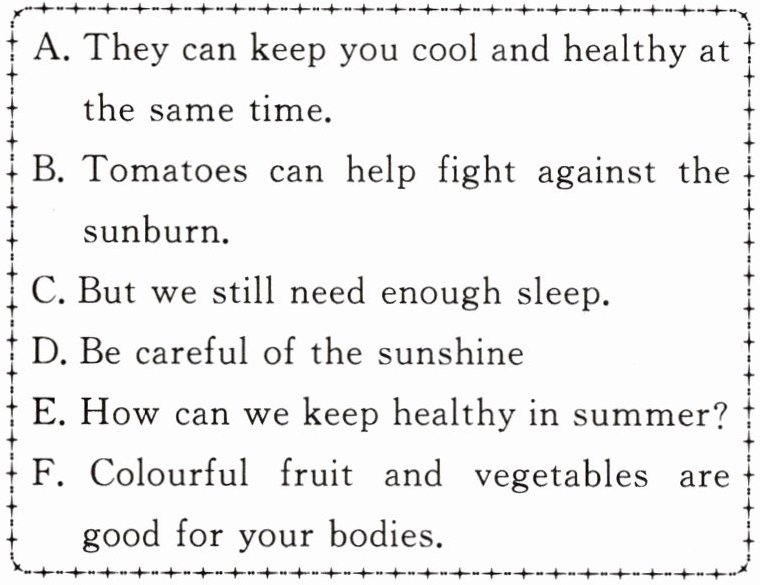
Summer means hot weather, more outdoor activities and all kinds of fruit and vegetables. 6.
E
Here are some good ideas.Eat and drink healthily
What is healthy to eat in summer? Fresh(新鲜的) and healthy food, like fish, tofu and so on. They can make you strong. 7.
F
For example, blueberries(蓝莓) are good for your brain and eyes. The more colours, the better.What is healthy to drink? Water, of course. Don't drink too many sports drinks. There is lots of sugar in them.
Keep cool and enjoy sports
Summer is a great time to enjoy outdoor activities. Do water sports like swimming and other water sports. 8.
A
Get enough sleep
The day is long and the night is short in summer. 9.
C
Students need sleep when they are tired. Students usually need at least 9 hours of sleep every night.10.
D
Summer makes us get outside more, but it can make us get sunburned easily. If you go outside, keep away from the sun when it's the strongest. It's usually from 11:00 am to 3 pm. If you have to stay in the sun for a long time, you can bring your sunscreen(防晒霜), a big hat and a jacket with you.
答案
B篇 本文介绍了四种在夏季保持健康的方法。
6.E 7.F 8.A 9.C 10.D
6.E 7.F 8.A 9.C 10.D
解析
【分析】
首先通读全文,明确文章主旨是介绍夏季保持健康的方法,需结合每个空缺处的上下文逻辑,匹配对应的选项:
1. 第6空:空后提到“Here are some good ideas(这里有一些好主意)”,说明空缺处应引出关于夏季健康的问题,对应E选项。
2. 第7空:前文讨论夏季健康食物,后文举例蓝莓并提到“颜色越多越好”,空缺处需承接“多彩果蔬对身体有益”的内容,对应F选项。
3. 第8空:前文讲夏季做水上运动,空缺处需说明水上运动的好处,对应A选项。
4. 第9空:前文提到夏季昼长夜短,后文强调需要足够睡眠,空缺处需转折引出睡眠的重要性,对应C选项。
5. 第10空:后文内容围绕防晒展开,空缺处需作为该部分的小标题,对应D选项。
【解析】
1. 第6空:空后“Here are some good ideas”是对问题的回答,E选项“How can we keep healthy in summer?”(我们如何在夏季保持健康?)符合引出建议的逻辑,故选E。
2. 第7空:前文讲夏季健康食物,后文举例蓝莓并提到“颜色越多越好”,F选项“Colourful fruit and vegetables are good for your bodies”(多彩的果蔬对身体有益)衔接上下文,故选F。
3. 第8空:前文介绍水上运动,A选项“They can keep you cool and healthy at the same time”(它们能同时让你凉爽又健康)说明水上运动的好处,承接上文,故选A。
4. 第9空:前文提到夏季昼长夜短,后文强调需要足够睡眠,C选项“But we still need enough sleep”(但我们仍需要足够的睡眠)转折引出睡眠的重要性,故选C。
5. 第10空:后文内容围绕防晒展开,D选项“Be careful of the sunshine”(注意阳光)作为该部分的小标题,契合下文内容,故选D。
【答案】
6.E 7.F 8.A 9.C 10.D
【知识点】
英语阅读理解七选五、上下文逻辑衔接
【点评】
本题为说明文类七选五题型,围绕夏季健康的话题展开,考查学生对文章结构、上下文逻辑关系的理解,难度适中,需结合语境匹配对应句子。
【难度系数】
0.6
首先通读全文,明确文章主旨是介绍夏季保持健康的方法,需结合每个空缺处的上下文逻辑,匹配对应的选项:
1. 第6空:空后提到“Here are some good ideas(这里有一些好主意)”,说明空缺处应引出关于夏季健康的问题,对应E选项。
2. 第7空:前文讨论夏季健康食物,后文举例蓝莓并提到“颜色越多越好”,空缺处需承接“多彩果蔬对身体有益”的内容,对应F选项。
3. 第8空:前文讲夏季做水上运动,空缺处需说明水上运动的好处,对应A选项。
4. 第9空:前文提到夏季昼长夜短,后文强调需要足够睡眠,空缺处需转折引出睡眠的重要性,对应C选项。
5. 第10空:后文内容围绕防晒展开,空缺处需作为该部分的小标题,对应D选项。
【解析】
1. 第6空:空后“Here are some good ideas”是对问题的回答,E选项“How can we keep healthy in summer?”(我们如何在夏季保持健康?)符合引出建议的逻辑,故选E。
2. 第7空:前文讲夏季健康食物,后文举例蓝莓并提到“颜色越多越好”,F选项“Colourful fruit and vegetables are good for your bodies”(多彩的果蔬对身体有益)衔接上下文,故选F。
3. 第8空:前文介绍水上运动,A选项“They can keep you cool and healthy at the same time”(它们能同时让你凉爽又健康)说明水上运动的好处,承接上文,故选A。
4. 第9空:前文提到夏季昼长夜短,后文强调需要足够睡眠,C选项“But we still need enough sleep”(但我们仍需要足够的睡眠)转折引出睡眠的重要性,故选C。
5. 第10空:后文内容围绕防晒展开,D选项“Be careful of the sunshine”(注意阳光)作为该部分的小标题,契合下文内容,故选D。
【答案】
6.E 7.F 8.A 9.C 10.D
【知识点】
英语阅读理解七选五、上下文逻辑衔接
【点评】
本题为说明文类七选五题型,围绕夏季健康的话题展开,考查学生对文章结构、上下文逻辑关系的理解,难度适中,需结合语境匹配对应句子。
【难度系数】
0.6
C
meat, person, many, poem, winter,
thousand, heat, different, because,
other, popular
Ancient Chinese people had hot pot as early as the Shang Dynasty. At that time, people boiled food and soup in bronze cauldrons(青铜坩埚). The cauldron had two parts—one was the pot to cook food in soup, the 11.
one 12.
During the Han Dynasty(206 BC—220 AD), people divided a pot into several parts to enjoy 13.
Huoguo, the Chinese name for hot pot, was mentioned by Yuan Mei, a 16.
Hot pot also became a famous royal(宫廷的) dish, called reguo. It's said that Emperor Qianlong of the Qing Dynasty loved hot pot so 19.
D
meat, person, many, poem, winter,
thousand, heat, different, because,
other, popular
Ancient Chinese people had hot pot as early as the Shang Dynasty. At that time, people boiled food and soup in bronze cauldrons(青铜坩埚). The cauldron had two parts—one was the pot to cook food in soup, the 11.
other
part was a layer or a space inside the cauldron to hold firewood(柴火). But at that time, the cauldron was only forone 12.
person
to eat from.During the Han Dynasty(206 BC—220 AD), people divided a pot into several parts to enjoy 13.
different
flavours(口味). In the Tang Dynasty, having hot pot was 14. popular
with lots of people. If people held a big family feast(宴席), they would prepare a bigger hot pot. People of the Song Dynasty(960—1279) had hot pot to welcome the start of 15. winter
in November.Huoguo, the Chinese name for hot pot, was mentioned by Yuan Mei, a 16.
poet
and foodie(美食家) in the Qing Dynasty(1644—1911), in a book about all kinds of food. At that time, hot pot was more popular than many other dishes. People put all kinds of 17. meat
and vegetables into pots. People love mutton most 18. because
it can make people warm in winter.Hot pot also became a famous royal(宫廷的) dish, called reguo. It's said that Emperor Qianlong of the Qing Dynasty loved hot pot so 19.
much
that he had it for almost every meal. He once held a big hot pot feast, inviting more than five 20. thousand
people to enjoy about 1,550 hot pots.D
答案
C篇 本文讲述了火锅的起源和古时候人们对火锅的喜爱。
11. other 12. person 13. different 14. popular
15. winter 16. poet 17. meat 18. because 19. much
20. thousand
11. other 12. person 13. different 14. popular
15. winter 16. poet 17. meat 18. because 19. much
20. thousand
解析
【分析】
首先通读全文,明确文章围绕火锅的历史展开,结合给出的词汇、上下文语境及固定搭配,逐个分析每个空的逻辑:11题对应表两者中另一个的固定搭配;12题结合“仅供一个”的语境确定;13题根据“分成多部分”和“口味”的关联选择;14题用表受欢迎的固定搭配;15题结合“十一月”和“迎接……开始”的语境;16题需对应袁枚的职业;17题找与蔬菜并列的食物;18题引导原因;19题用表程度的固定搭配;20题处理数字相关的词汇形式。
【解析】
11. 固定搭配“one...the other...”表示两者中的另一个,此处指青铜坩埚的两个部分,故填other;
12. 结合语境,当时的青铜坩埚仅供一个人使用,故填person;
13. 汉代将锅分成几个部分,目的是享受不同的口味,different修饰flavours,故填different;
14. 固定搭配“be popular with”意为“受……欢迎”,此处指唐代火锅受很多人喜爱,故填popular;
15. 宋代十一月吃火锅迎接冬天的开始,winter符合语境,故填winter;
16. 袁枚是清代的诗人,poem对应的职业名词为poet,故填poet;
17. 与vegetables并列的食物类词汇是meat,故填meat;
18. 后半句解释人们最爱羊肉的原因,用because引导原因状语从句,故填because;
19. 固定搭配“so much”表示程度“非常”,此处指乾隆非常喜欢火锅,故填much;
20. 具体数字five后thousand用原形,故填thousand。
【答案】
11. other 12. person 13. different 14. popular 15. winter 16. poet 17. meat 18. because 19. much 20. thousand
【知识点】
完形填空、词汇运用、固定搭配
【点评】
本题以火锅的历史为话题,考查学生对词汇的掌握、上下文语境的理解及固定搭配的运用,整体难度适中,需结合文章内容准确匹配词汇。
【难度系数】
0.5
首先通读全文,明确文章围绕火锅的历史展开,结合给出的词汇、上下文语境及固定搭配,逐个分析每个空的逻辑:11题对应表两者中另一个的固定搭配;12题结合“仅供一个”的语境确定;13题根据“分成多部分”和“口味”的关联选择;14题用表受欢迎的固定搭配;15题结合“十一月”和“迎接……开始”的语境;16题需对应袁枚的职业;17题找与蔬菜并列的食物;18题引导原因;19题用表程度的固定搭配;20题处理数字相关的词汇形式。
【解析】
11. 固定搭配“one...the other...”表示两者中的另一个,此处指青铜坩埚的两个部分,故填other;
12. 结合语境,当时的青铜坩埚仅供一个人使用,故填person;
13. 汉代将锅分成几个部分,目的是享受不同的口味,different修饰flavours,故填different;
14. 固定搭配“be popular with”意为“受……欢迎”,此处指唐代火锅受很多人喜爱,故填popular;
15. 宋代十一月吃火锅迎接冬天的开始,winter符合语境,故填winter;
16. 袁枚是清代的诗人,poem对应的职业名词为poet,故填poet;
17. 与vegetables并列的食物类词汇是meat,故填meat;
18. 后半句解释人们最爱羊肉的原因,用because引导原因状语从句,故填because;
19. 固定搭配“so much”表示程度“非常”,此处指乾隆非常喜欢火锅,故填much;
20. 具体数字five后thousand用原形,故填thousand。
【答案】
11. other 12. person 13. different 14. popular 15. winter 16. poet 17. meat 18. because 19. much 20. thousand
【知识点】
完形填空、词汇运用、固定搭配
【点评】
本题以火锅的历史为话题,考查学生对词汇的掌握、上下文语境的理解及固定搭配的运用,整体难度适中,需结合文章内容准确匹配词汇。
【难度系数】
0.5
