

 登录
登录
二、根据要求完成下列各题,每空一词。
1. I'd like to have a sweet now.(改为否定句)
I
2. Don't eat or drink in class.(改为同义句)
No
3. We have to be polite to others.(改为一般疑问句并作肯定回答)
—
— Yes,
4. She can play basketball with her friends on Sundays.(改为一般疑问句并作否定回答)
—
— No,
5. Sally is having lunch in the dining hall at the moment.(对画线部分提问)
1. I'd like to have a sweet now.(改为否定句)
I
wouldn’t
like
to have a sweet now.2. Don't eat or drink in class.(改为同义句)
No
eating
or drinking
in class.3. We have to be polite to others.(改为一般疑问句并作肯定回答)
—
Do
you
have
to
be polite to others?— Yes,
we
do
.4. She can play basketball with her friends on Sundays.(改为一般疑问句并作否定回答)
—
Can
she play
basketball with her friends on Sundays?— No,
she
can’t
.5. Sally is having lunch in the dining hall at the moment.(对画线部分提问)
Where
is
Sally having
lunch at the moment?答案
1. wouldn’t like
2. eating; drinking
3. Do you have to; we do
4. Can; play; she can’t
5. Where is; having
2. eating; drinking
3. Do you have to; we do
4. Can; play; she can’t
5. Where is; having
解析
【分析】
本题为英语句型转换题,需根据不同句型的语法规则逐一解答:1. 针对would like的否定形式,直接在would后加否定词;2. 祈使句的否定结构可转换为“No + 动名词”的同义表达;3. have to的一般疑问句需借助助动词调整句式;4. 含情态动词can的句子变一般疑问句需提前情态动词;5. 对地点提问用where,结合现在进行时结构调整疑问句式。
【解析】
1. 原句中I'd like是I would like的缩写,变否定句时直接在would后加not,缩写为wouldn't,故答案为wouldn’t like。
2. 祈使句否定形式Don't eat or drink表示“不要在课堂上吃喝”,其同义表达为“No + 动名词”结构,故填eating; drinking。
3. 含有实义短语have to的句子变一般疑问句需借助助动词do,原句主语we变为you,故开头为Do you have to;肯定回答对应主语we,用Yes, we do。
4. 含情态动词can的句子变一般疑问句时,将can提前至句首;否定回答为“No, 主语+can't”,故填Can; play; she can’t。
5. 画线部分为地点状语,用where提问;原句为现在进行时(is having),变疑问句时将be动词is提前,故填Where is; having。
【答案】
1. wouldn’t like
2. eating; drinking
3. Do you have to; we do
4. Can; play; she can’t
5. Where is; having
【知识点】
句型转换;情态动词用法;祈使句转换
【点评】
本题为初中英语基础句型转换题,涵盖否定句、同义句、一般疑问句、对划线部分提问等常见题型,主要考查学生对常用英语句型及相关语法规则的掌握,是英语学习中必须熟练掌握的基础内容。
【难度系数】
0.7
本题为英语句型转换题,需根据不同句型的语法规则逐一解答:1. 针对would like的否定形式,直接在would后加否定词;2. 祈使句的否定结构可转换为“No + 动名词”的同义表达;3. have to的一般疑问句需借助助动词调整句式;4. 含情态动词can的句子变一般疑问句需提前情态动词;5. 对地点提问用where,结合现在进行时结构调整疑问句式。
【解析】
1. 原句中I'd like是I would like的缩写,变否定句时直接在would后加not,缩写为wouldn't,故答案为wouldn’t like。
2. 祈使句否定形式Don't eat or drink表示“不要在课堂上吃喝”,其同义表达为“No + 动名词”结构,故填eating; drinking。
3. 含有实义短语have to的句子变一般疑问句需借助助动词do,原句主语we变为you,故开头为Do you have to;肯定回答对应主语we,用Yes, we do。
4. 含情态动词can的句子变一般疑问句时,将can提前至句首;否定回答为“No, 主语+can't”,故填Can; play; she can’t。
5. 画线部分为地点状语,用where提问;原句为现在进行时(is having),变疑问句时将be动词is提前,故填Where is; having。
【答案】
1. wouldn’t like
2. eating; drinking
3. Do you have to; we do
4. Can; play; she can’t
5. Where is; having
【知识点】
句型转换;情态动词用法;祈使句转换
【点评】
本题为初中英语基础句型转换题,涵盖否定句、同义句、一般疑问句、对划线部分提问等常见题型,主要考查学生对常用英语句型及相关语法规则的掌握,是英语学习中必须熟练掌握的基础内容。
【难度系数】
0.7
阅读短文,从方框中选择适当的词并用其正确形式填空,使短文通顺、意思完整。每空限填一词,每词限用一次。
fit, interest, succeed, practise, encourage, twice,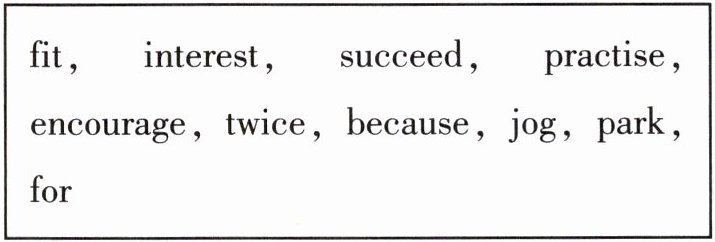 ecause, jog, park, for
My friend Alice is a lovely girl. She likes doing exercise very much. She likes 1. , swimming and jumping rope, but she doesn't like playing ball games. She is a little busy, so she jogs 2. a week. She usually goes jogging in the park near her home. She thinks jogging is good 3. her. She also keeps 4. by swimming and jumping rope. She often goes swimming at weekends. And she spends about twenty minutes 5. jumping rope every day.
These days, Alice is 6. in skateboarding. I am good at it. So I help her to practise it at a special 7. once a week. Sometimes, it is really difficult for her to do some tricks, but I 8. her. Now she can do lots of difficult tricks. She feels great when she 9. .
Sometimes, Alice uses an exercise app to work out with me 10. the app can show our progress every day. We have fun when we exercise together.
fit, interest, succeed, practise, encourage, twice,
ecause, jog, park, forMy friend Alice is a lovely girl. She likes doing exercise very much. She likes 1. , swimming and jumping rope, but she doesn't like playing ball games. She is a little busy, so she jogs 2. a week. She usually goes jogging in the park near her home. She thinks jogging is good 3. her. She also keeps 4. by swimming and jumping rope. She often goes swimming at weekends. And she spends about twenty minutes 5. jumping rope every day.
These days, Alice is 6. in skateboarding. I am good at it. So I help her to practise it at a special 7. once a week. Sometimes, it is really difficult for her to do some tricks, but I 8. her. Now she can do lots of difficult tricks. She feels great when she 9. .
Sometimes, Alice uses an exercise app to work out with me 10. the app can show our progress every day. We have fun when we exercise together.
答案
1. jogging
2. twice
3. for
4. fit
5. practising
6. interested
7. park
8. encourage
9. succeeds
10. because
2. twice
3. for
4. fit
5. practising
6. interested
7. park
8. encourage
9. succeeds
10. because
解析
【分析】
首先通读短文,理解短文围绕Alice的锻炼习惯展开。解题时,需结合每个空格的语境、语法结构,从方框词汇中选合适的词,再根据句子要求调整词形(如动名词、第三人称单数、形容词形式等),确保每词限用一次,使短文通顺完整。
【解析】
1. 空格前是“likes”,固定搭配“like doing sth”(喜欢做某事),结合语境“她喜欢慢跑、游泳和跳绳”,选动词“jog”,变为动名词“jogging”。
2. 空格后是“a week”,固定搭配“twice a week”(每周两次),结合语境“她有点忙,所以每周慢跑两次”,选“twice”。
3. 空格前是“is good”,固定短语“be good for”(对……有益),结合语境“她认为慢跑对她有益”,选“for”。
4. 空格前是“keeps”,固定搭配“keep fit”(保持健康),结合语境“她通过游泳和跳绳保持健康”,选“fit”。
5. 空格前是“spends about twenty minutes”,固定搭配“spend time (in) doing sth”(花费时间做某事),结合语境“每天花约20分钟练习跳绳”,选动词“practise”,变为动名词“practising”。
6. 空格后是“in skateboarding”,固定短语“be interested in”(对……感兴趣),结合语境“Alice对滑板感兴趣”,选名词“interest”,变为形容词“interested”。
7. 空格前是“a special”,结合语境“在特殊的公园练习”,选名词“park”。
8. 空格所在句子是一般现在时,主语是“I”,结合语境“我鼓励她”,选动词“encourage”,用原形。
9. 空格所在从句主语是“she”,一般现在时,结合语境“当她成功时”,选动词“succeed”,变为第三人称单数“succeeds”。
10. 空格后是前面行为的原因,选连词“because”。
【答案】
1. jogging 2. twice 3. for 4. fit 5. practising 6. interested 7. park 8. encourage 9. succeeds 10. because
【知识点】
动词短语;固定搭配;词形变化
【点评】
本题为选词填空基础题型,考查常用词汇、固定短语及词形变化,需结合语境准确选择调整词汇,难度适中,适合初中阶段学生练习。
【难度系数】
0.6
首先通读短文,理解短文围绕Alice的锻炼习惯展开。解题时,需结合每个空格的语境、语法结构,从方框词汇中选合适的词,再根据句子要求调整词形(如动名词、第三人称单数、形容词形式等),确保每词限用一次,使短文通顺完整。
【解析】
1. 空格前是“likes”,固定搭配“like doing sth”(喜欢做某事),结合语境“她喜欢慢跑、游泳和跳绳”,选动词“jog”,变为动名词“jogging”。
2. 空格后是“a week”,固定搭配“twice a week”(每周两次),结合语境“她有点忙,所以每周慢跑两次”,选“twice”。
3. 空格前是“is good”,固定短语“be good for”(对……有益),结合语境“她认为慢跑对她有益”,选“for”。
4. 空格前是“keeps”,固定搭配“keep fit”(保持健康),结合语境“她通过游泳和跳绳保持健康”,选“fit”。
5. 空格前是“spends about twenty minutes”,固定搭配“spend time (in) doing sth”(花费时间做某事),结合语境“每天花约20分钟练习跳绳”,选动词“practise”,变为动名词“practising”。
6. 空格后是“in skateboarding”,固定短语“be interested in”(对……感兴趣),结合语境“Alice对滑板感兴趣”,选名词“interest”,变为形容词“interested”。
7. 空格前是“a special”,结合语境“在特殊的公园练习”,选名词“park”。
8. 空格所在句子是一般现在时,主语是“I”,结合语境“我鼓励她”,选动词“encourage”,用原形。
9. 空格所在从句主语是“she”,一般现在时,结合语境“当她成功时”,选动词“succeed”,变为第三人称单数“succeeds”。
10. 空格后是前面行为的原因,选连词“because”。
【答案】
1. jogging 2. twice 3. for 4. fit 5. practising 6. interested 7. park 8. encourage 9. succeeds 10. because
【知识点】
动词短语;固定搭配;词形变化
【点评】
本题为选词填空基础题型,考查常用词汇、固定短语及词形变化,需结合语境准确选择调整词汇,难度适中,适合初中阶段学生练习。
【难度系数】
0.6
