

 登录
登录
三、根据汉语意思写单词,补全英语句子。
1. 布朗先生和布朗太太来自美国。
2. 怀特小姐是一名舞蹈演员,她跳舞跳得非常好。
3. 我们的新语文老师是王女士。
Our new Chinese teacher is
4. 我最喜欢的运动是棒球。
My
1. 布朗先生和布朗太太来自美国。
Mr
and Mrs
Brown are from America.2. 怀特小姐是一名舞蹈演员,她跳舞跳得非常好。
Miss
White is a dancer. She dances very well.3. 我们的新语文老师是王女士。
Our new Chinese teacher is
Ms/Miss
Wang.4. 我最喜欢的运动是棒球。
My
favourite
sport
is baseball.答案
1. Mr; Mrs 2. Miss 3. Ms/Miss 4. favourite sport
解析
【分析】
本题考查英语中对不同性别的人的称呼以及常用名词短语的应用,解题时需根据汉语意思,回忆对应的英语称呼或短语,结合句子结构填写正确内容。
【解析】
1. 汉语“布朗先生和布朗太太”对应的英语称呼分别是“Mr”(先生)和“Mrs”(夫人),符合句子结构,故填Mr;Mrs。
2. 汉语“怀特小姐”对应英语称呼“Miss”(用于未婚女性),符合句子语境,故填Miss。
3. 汉语“王女士”可对应英语称呼“Ms”(可用于已婚或未婚女性)或“Miss”(未婚小姐),均符合要求,故填Ms/Miss。
4. 汉语“最喜欢的运动”对应的英语短语是“favourite sport”,符合句子结构,故填favourite sport。
【答案】
1. Mr; Mrs 2. Miss 3. Ms/Miss 4. favourite sport
【知识点】
英语称呼用语;名词短语
【点评】
本题为基础词汇应用类题目,考查日常英语中人物称呼及常用短语,难度较低,适合基础阶段学生巩固词汇。
【难度系数】
0.3
本题考查英语中对不同性别的人的称呼以及常用名词短语的应用,解题时需根据汉语意思,回忆对应的英语称呼或短语,结合句子结构填写正确内容。
【解析】
1. 汉语“布朗先生和布朗太太”对应的英语称呼分别是“Mr”(先生)和“Mrs”(夫人),符合句子结构,故填Mr;Mrs。
2. 汉语“怀特小姐”对应英语称呼“Miss”(用于未婚女性),符合句子语境,故填Miss。
3. 汉语“王女士”可对应英语称呼“Ms”(可用于已婚或未婚女性)或“Miss”(未婚小姐),均符合要求,故填Ms/Miss。
4. 汉语“最喜欢的运动”对应的英语短语是“favourite sport”,符合句子结构,故填favourite sport。
【答案】
1. Mr; Mrs 2. Miss 3. Ms/Miss 4. favourite sport
【知识点】
英语称呼用语;名词短语
【点评】
本题为基础词汇应用类题目,考查日常英语中人物称呼及常用短语,难度较低,适合基础阶段学生巩固词汇。
【难度系数】
0.3
四、看图,根据句型和短语提示说一说,写一写。
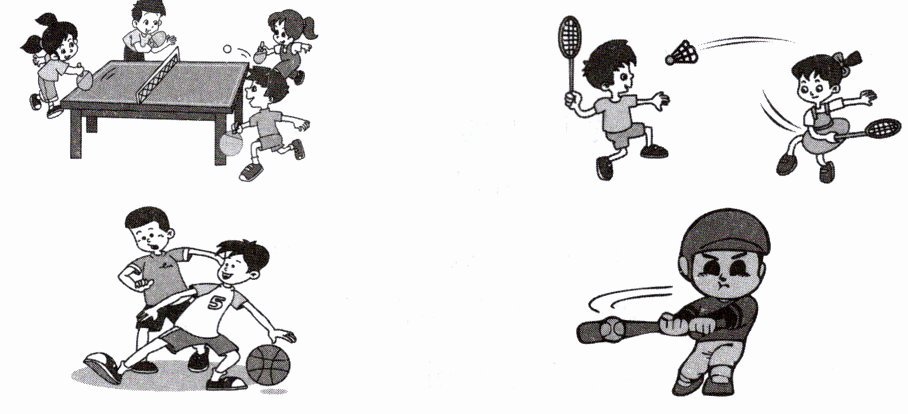
句型提示:A: What are they doing?/What is he doing?
B: ...
短语提示:play ping-pong play badminton play basketball play baseball
1. A:
B:
2. A:
B:
3. A:
B:
4. A:
B:
句型提示:A: What are they doing?/What is he doing?
B: ...
短语提示:play ping-pong play badminton play basketball play baseball
1. A:
What are they doing?
B:
They are playing ping-pong.
2. A:
What are they doing?
B:
They are playing badminton.
3. A:
What are they doing?
B:
They are playing basketball.
4. A:
What is he doing?
B:
He is playing baseball.
答案
1. A: What are they doing?
B: They are playing ping-pong.
2. A: What are they doing?
B: They are playing badminton.
3. A: What are they doing?
B: They are playing basketball.
4. A: What is he doing?
B: He is playing baseball.
B: They are playing ping-pong.
2. A: What are they doing?
B: They are playing badminton.
3. A: What are they doing?
B: They are playing basketball.
4. A: What is he doing?
B: He is playing baseball.
解析
【分析】
先观察每幅图的人物数量和对应的运动项目,匹配给出的短语;再根据句型提示,多人活动用“What are they doing?”提问,单人活动用“What is he doing?”提问,回答时使用现在进行时结构“主语+be+playing+运动项目”,确保主谓一致。
【解析】
1. 第一幅图是多人打乒乓球,对应短语play ping-pong,所以A问“What are they doing?”,B回答“They are playing ping-pong.”;
2. 第二幅图是多人打羽毛球,对应短语play badminton,所以A问“What are they doing?”,B回答“They are playing badminton.”;
3. 第三幅图是多人打篮球,对应短语play basketball,所以A问“What are they doing?”,B回答“They are playing basketball.”;
4. 第四幅图是单人打棒球,对应短语play baseball,所以A问“What is he doing?”,B回答“He is playing baseball.”。
【答案】
1. A: What are they doing?
B: They are playing ping-pong.
2. A: What are they doing?
B: They are playing badminton.
3. A: What are they doing?
B: They are playing basketball.
4. A: What is he doing?
B: He is playing baseball.
【知识点】
现在进行时、动词短语搭配
【点评】
本题结合图片考查现在进行时的日常交际问答,需要准确观察图中人物数量和运动项目,掌握现在进行时的句型结构,是基础的英语应用练习。
【难度系数】
0.6
先观察每幅图的人物数量和对应的运动项目,匹配给出的短语;再根据句型提示,多人活动用“What are they doing?”提问,单人活动用“What is he doing?”提问,回答时使用现在进行时结构“主语+be+playing+运动项目”,确保主谓一致。
【解析】
1. 第一幅图是多人打乒乓球,对应短语play ping-pong,所以A问“What are they doing?”,B回答“They are playing ping-pong.”;
2. 第二幅图是多人打羽毛球,对应短语play badminton,所以A问“What are they doing?”,B回答“They are playing badminton.”;
3. 第三幅图是多人打篮球,对应短语play basketball,所以A问“What are they doing?”,B回答“They are playing basketball.”;
4. 第四幅图是单人打棒球,对应短语play baseball,所以A问“What is he doing?”,B回答“He is playing baseball.”。
【答案】
1. A: What are they doing?
B: They are playing ping-pong.
2. A: What are they doing?
B: They are playing badminton.
3. A: What are they doing?
B: They are playing basketball.
4. A: What is he doing?
B: He is playing baseball.
【知识点】
现在进行时、动词短语搭配
【点评】
本题结合图片考查现在进行时的日常交际问答,需要准确观察图中人物数量和运动项目,掌握现在进行时的句型结构,是基础的英语应用练习。
【难度系数】
0.6
