

 登录
登录
七、首字母填空(共10小题;每小题1分,计10分)
Major Snow(大雪), the 21st of China's 24 Solar Terms, usually starts around December 7. True to its name, it is 81. c
In the north, temperatures often fall 83. b
However, in the 86. s
Culturally, enjoying plum blossoms(蜡梅) is also a beloved activity. Plum blossoms come out bravely in the cold and become 89. o
Major Snow(大雪), the 21st of China's 24 Solar Terms, usually starts around December 7. True to its name, it is 81. c
colder
with a higher chance of snow than Minor Snow(小雪). The temperature will fall fast. Moreover, during Major Snow, the weather is quite 82. ddifferent
across China.In the north, temperatures often fall 83. b
below
$-10° \mathrm{C}$ and turn rivers into ice. Heavy snow covers the countryside, painting a white landscape of "thousands of miles frozen". People here take part in winter outdoor 84. aactivities
: skating on frozen rivers, having snowball fights and even 85. mmaking
snowmen.However, in the 86. s
south
of China, snowfall is rare. People seldom enjoy snow and feel chilly. So warm foods like mutton soup or hot pot are 87. ppopular
among people, as they can drive away the cold and give much energy. Farmers in the south of China think that the light snow is very useful because 88. ssnow
can protect crops from freezing and kill pests. So as a famous Chinese saying goes, "A timely snow promises a good harvest."Culturally, enjoying plum blossoms(蜡梅) is also a beloved activity. Plum blossoms come out bravely in the cold and become 89. o
one
of the "Three Friends of Winter" along with pine and bamboo. As an important part of Chinese culture, Major Snow not only shows the natural changes of seasons but also carries that people can get along well with 90. nnature
. It reminds people to slow down, cherish warm moments with loved ones, and prepare for the cold.答案
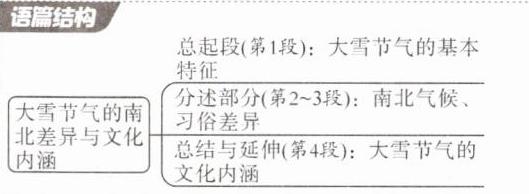
七、[文章大意]本文是一篇说明文。文章介绍了中国二十四节气中大雪节气的时间、气候特点,以及南北方不同的气候表现、人们的活动与饮食习俗,还介绍了大雪节气的文化内涵与相关传统。
81. colder [解析]考查形容词比较级。句意:正如它的名字,和小雪相比它有更高的降雪概率。根据前文“True to its name, it is ... with a higher chance of snow than Minor Snow(小雪). The temperature will fall fast. ”及首字母“c”可知,大雪节气与更高的降雪概率相关,因此更冷。故填colder。
82. different [解析]考查形容词。句意:而且,大雪期间,全中国的天气大不相同。根据后文介绍的南北方气候与活动的明显差异可知,此处指大雪期间中国各地天气差异显著,再结合首字母“d”可知,此处应用different表示“不同的”。故填different。→be different from表示“与……不同”
83. below [解析]考查介词。句意:在北方,气温常常下降到零下10℃以下,河流结冰。根据“temperatures often fall ... -10℃ and turn rivers into ice”并结合首字母“b”可知,此处指气温常降到零下10℃以下。介词below用于表示温度、数值等“低于”某一标准。故填below。
84. activities [解析]考查名词。句意:这里的人们参加冬季户外活动:在结冰的河上滑冰,打雪仗,甚至堆雪人。根据后文“skating on frozen rivers, having snowball fights”可知,此处指冬季户外活动;再结合首字母“a”,且前面无不定冠词可知,此处应用可数名词activity的复数形式activities。故填activities。
85. making [解析]考查动名词。句意同上。根据“skating on frozen rivers, having snowball fights and even ... snowmen”并结合首字母“m”可知,此处应用固定搭配make snowmen表示“堆雪人”,且与前文skating on frozen rivers、having snowball fights为并列的动名词短语。故填making。
86. south [解析]考查名词。句意:然而,在中国的南方,降雪是很罕见的。根据前文“In the north”再结合首字母“s”可知,此处对应描述中国南方的情况。south表示“南方”。故填south。
87. popular [解析]考查形容词。句意:所以温暖的食物,像羊汤或火锅受人们欢迎,因为它们可以驱寒并提供很多能量。根据“So warm foods like mutton soup or hot pot are ... among people”并结合首字母“p”可知,此处表示温暖的食物受人欢迎。popular意为“受欢迎的”。故填popular。
88. snow [解析]考查名词。句意:中国南方的农民认为小雪很有用,因为雪可以保护庄稼免受冰冻,并可杀死害虫。根据前文“Farmers in the south of China think that the light snow is very useful because ... can protect crops from freezing and kill pests. ”并结合首字母“s”可知,此处指雪可以保护庄稼免受冰冻,并可杀死害虫。故填snow。
89. one [解析]考查数词。句意:蜡梅在寒冷中勇敢绽放,和松树、竹并称为“岁寒三友”。根据“become ... of the ‘Three Friends of Winter’”并结合首字母“o”可知,此处表示腊梅是“岁寒三友”之一。固定搭配one of ...表示“……之一”。故填one。
90. nature [解析]考查名词。句意:作为中国文化重要的一部分,大雪不仅展示了季节的自然变化,而且承载着人们与自然和谐相处的含义。根据“carries that people can get along well with ...”并结合首字母“n”可知,此处表示“人们可以与自然和谐相处”。nature表示“自然”,符合文中人与自然和谐相处的内涵。故填nature。
