

 登录
登录
C
Today money matters in everyone's life. People use money to buy food, clothes, books and many other things they need or want. When they work, they usually get paid in money.
Most of the money today is made of metal (金属) or paper. But people used all kinds of things as money in the past. One of the first kinds of money was shells. Shells were not the only things used as money. In China, cloth and knives were used. In the Philippine Islands, rice was used as money for a long time. Elephant tusks(象牙), monkey tails and salt were used as money in parts of Africa.
The first metal coins were made in China. They were round and had a square hole in the centre. People strung (串) them together and carried them from place to place. Different countries have used different metals and designs for their money. For example, the first coins in England were made of tin(锡) and the front of the coin was the head of the queen. Later some countries began to make coins of gold and silver.
But even gold and silver were not easy to carry. Gradually, people began to use paper money.
9. What is most of the money made of today?
A. Shells or paper.
B. Metal or paper.
C. Tails or metal.
D. Shells or tails.
10. In Philippine Islands, what was used as money for a long time?
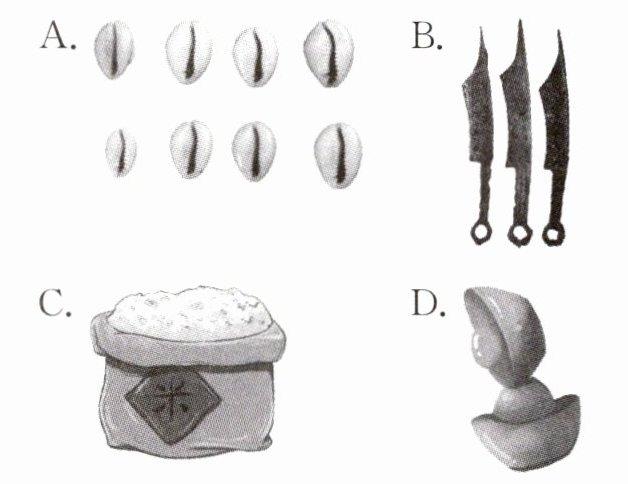
11. Where were the first metal coins made?
A. In China.
B. In England.
C. In Sweden.
D. In Russia.
Today money matters in everyone's life. People use money to buy food, clothes, books and many other things they need or want. When they work, they usually get paid in money.
Most of the money today is made of metal (金属) or paper. But people used all kinds of things as money in the past. One of the first kinds of money was shells. Shells were not the only things used as money. In China, cloth and knives were used. In the Philippine Islands, rice was used as money for a long time. Elephant tusks(象牙), monkey tails and salt were used as money in parts of Africa.
The first metal coins were made in China. They were round and had a square hole in the centre. People strung (串) them together and carried them from place to place. Different countries have used different metals and designs for their money. For example, the first coins in England were made of tin(锡) and the front of the coin was the head of the queen. Later some countries began to make coins of gold and silver.
But even gold and silver were not easy to carry. Gradually, people began to use paper money.
9. What is most of the money made of today?
A. Shells or paper.
B. Metal or paper.
C. Tails or metal.
D. Shells or tails.
10. In Philippine Islands, what was used as money for a long time?
11. Where were the first metal coins made?
A. In China.
B. In England.
C. In Sweden.
D. In Russia.
答案
9.B 10.C 11.A
【语篇解读】本文是一篇说明文,介绍了货币的发展历史:从古代的贝壳、大米等实物货币,到金属硬币,再到现代金属和纸币的演变过程。
9. B 根据“Most of the money today is made of metal or paper.”可知,如今,大部分货币都是由金属或纸张制成的。
10. C 根据“In the Philippine Islands, rice was used as money for a long time.”可知,在菲律宾群岛,大米长期以来被用作货币。
11. A 根据“The first metal coins were made in China.”可知,第一枚金属硬币是在中国制造的。
【语篇解读】本文是一篇说明文,介绍了货币的发展历史:从古代的贝壳、大米等实物货币,到金属硬币,再到现代金属和纸币的演变过程。
9. B 根据“Most of the money today is made of metal or paper.”可知,如今,大部分货币都是由金属或纸张制成的。
10. C 根据“In the Philippine Islands, rice was used as money for a long time.”可知,在菲律宾群岛,大米长期以来被用作货币。
11. A 根据“The first metal coins were made in China.”可知,第一枚金属硬币是在中国制造的。
解析
【分析】本题为英语阅读理解的细节类题目,需通过定位文章对应句子解答各小题。第9题需查找现代货币的制作材料,定位相关语句;第10题需查找菲律宾长期用作货币的物品,结合插图判断;第11题需查找第一枚金属硬币的制造地,定位对应语句即可。
【解析】9. 根据文章第二段第一句“Most of the money today is made of metal or paper.”,可知答案为B。10. 根据文章第二段“In the Philippine Islands, rice was used as money for a long time.”,结合插图,选项C为米袋,对应大米,故选C。11. 根据文章第三段第一句“The first metal coins were made in China.”,可知答案为A。
【答案】9.B 10.C 11.A
【知识点】英语阅读理解、细节理解题
【点评】本题主要考查对文章细节信息的提取,难度较低,只要仔细阅读文章,定位关键语句就能得出答案。
【难度系数】0.8
【解析】9. 根据文章第二段第一句“Most of the money today is made of metal or paper.”,可知答案为B。10. 根据文章第二段“In the Philippine Islands, rice was used as money for a long time.”,结合插图,选项C为米袋,对应大米,故选C。11. 根据文章第三段第一句“The first metal coins were made in China.”,可知答案为A。
【答案】9.B 10.C 11.A
【知识点】英语阅读理解、细节理解题
【点评】本题主要考查对文章细节信息的提取,难度较低,只要仔细阅读文章,定位关键语句就能得出答案。
【难度系数】0.8
