

 登录
登录
Ⅰ. 长处与短处 学生们在讨论会上踊跃发言,提到了自己喜欢的学校的地方,也提到了学校应该改进的地方。让我们一起来补全并梳理这些信息吧!
Millie: There 1.
Kate: Nature is good for us. But there are also plenty of insects in the garden, 4.
Annie: You're right. I 5.
Millie: The flea market(跳蚤市场) in our school is 7.
Simon: Well. I think we need a Mood(情绪) Room in school. We can relax, share 9.
Daniel: That 10.
新考法 思维导图

Millie: There 1.
are
(be) a lot of flowers and plants in the garden which is surrounded by four teaching 2. buildings
(building). I really like the school garden. It's nice 3. to see
(see) different kinds of flowers in different seasons.Kate: Nature is good for us. But there are also plenty of insects in the garden, 4.
especially
(especial) in summer. I don't like insects. They may even come into the classrooms!Annie: You're right. I 5.
noticed
(notice) that there were weeds(杂草) in the garden yesterday. The weeds can be really tall after raining and even cover the short plants. 6. So
I think the garden needs to be out of weeds and insects sometimes.Millie: The flea market(跳蚤市场) in our school is 7.
amazing
(amaze). We are free to set up stalls(摊位) and sell things that we no longer need, such as clothes and toys, instead of throwing them 8. away/out
. But the problem is that we can only have it once a term. We should have it once a month!Simon: Well. I think we need a Mood(情绪) Room in school. We can relax, share 9.
how
we feel and get our mood better there. We also need a counselor(顾问) to listen to our bad feelings.Daniel: That 10.
sounds
(sound) great. I know a lot of students sometimes just feel sad. We should help them and our school can provide a place for them to set with the feelings.新考法 思维导图
答案
1. are 2. buildings 3. to see 4. especially 5. noticed 6. So 7. amazing 8. away/out 9. how 10. sounds
Good Parts: 1. The school garden.
2. The flea market.
Bad Parts: 1. The insects in the garden.
2. The weeds in the garden.
3. Students can only have a flea market once a term.
4. There is no Mood Room.
【语篇解读】本文是一篇对话,几位学生围绕学校的花园、跳蚤市场和情绪室等设施展开讨论,提出各自的看法和建议。
Good Parts: 1. The school garden.
2. The flea market.
Bad Parts: 1. The insects in the garden.
2. The weeds in the garden.
3. Students can only have a flea market once a term.
4. There is no Mood Room.
【语篇解读】本文是一篇对话,几位学生围绕学校的花园、跳蚤市场和情绪室等设施展开讨论,提出各自的看法和建议。
解析
【分析】本题分为英语语法填空和学校优缺点梳理两部分。语法填空需结合句子时态、词性、固定句型、固定搭配等知识点,分析每个空格的语法成分和所需形式;优缺点梳理需从对话文本中提取学生提到的学校优点和待改进问题,对应思维导图结构。
【解析】1. 语法填空:
(1) there be句型,主语为复数,一般现在时,填are;
(2) 数词four后接可数名词复数,填buildings;
(3) 固定句型It's + adj + to do sth,填to see;
(4) 修饰介词短语用副词,填especially;
(5) 时间状语yesterday提示用一般过去时,填noticed;
(6) 前后句为因果关系,填So;
(7) 修饰事物用形容词amazing,填amazing;
(8) 固定搭配throw away/out,填away/out;
(9) 宾语从句中作方式状语,填how;
(10) 主语that为单数,一般现在时,填sounds。
2. 优缺点梳理:从对话中提取,长处为学校花园、跳蚤市场;短处为花园的昆虫、花园的杂草、跳蚤市场一学期仅一次、无情绪室。
【答案】语法填空:1. are 2. buildings 3. to see 4. especially 5. noticed 6. So 7. amazing 8. away/out 9. how 10. sounds;Good Parts:1. The school garden. 2. The flea market. Bad Parts:1. The insects in the garden. 2. The weeds in the garden. 3. Students can only have a flea market once a term. 4. There is no Mood Room.
【知识点】英语语法、名词用法、信息提取
【点评】本题结合基础英语知识运用与文本信息梳理,贴近校园生活,考查学生的英语基础能力和信息整合能力,题型新颖。
【难度系数】0.5
【解析】1. 语法填空:
(1) there be句型,主语为复数,一般现在时,填are;
(2) 数词four后接可数名词复数,填buildings;
(3) 固定句型It's + adj + to do sth,填to see;
(4) 修饰介词短语用副词,填especially;
(5) 时间状语yesterday提示用一般过去时,填noticed;
(6) 前后句为因果关系,填So;
(7) 修饰事物用形容词amazing,填amazing;
(8) 固定搭配throw away/out,填away/out;
(9) 宾语从句中作方式状语,填how;
(10) 主语that为单数,一般现在时,填sounds。
2. 优缺点梳理:从对话中提取,长处为学校花园、跳蚤市场;短处为花园的昆虫、花园的杂草、跳蚤市场一学期仅一次、无情绪室。
【答案】语法填空:1. are 2. buildings 3. to see 4. especially 5. noticed 6. So 7. amazing 8. away/out 9. how 10. sounds;Good Parts:1. The school garden. 2. The flea market. Bad Parts:1. The insects in the garden. 2. The weeds in the garden. 3. Students can only have a flea market once a term. 4. There is no Mood Room.
【知识点】英语语法、名词用法、信息提取
【点评】本题结合基础英语知识运用与文本信息梳理,贴近校园生活,考查学生的英语基础能力和信息整合能力,题型新颖。
【难度系数】0.5
Ⅱ. 帮助同学 Simon 注意到身边一些同学的焦虑情绪·他在讨论会上和大家讨论了这个问题。同学们想出了一些应对焦虑的办法。让我们一起来看看吧!(有两项多余)
Everyone has worries. 1.
Try to find out what you're worried about. 2.
3.
☆4.
☆How do I get ready for a class? Do I go over my notes even when there isn't a test?
☆Do I have a good place to do my homework?
☆Do I try different ways of studying?
If you have had a fight with a friend and you worry about it, you could write down all the things you can do: write a note to him or her, invite him or her to a basketball game, say sorry to him or her, etc. Once you have a list of things you could do, you can choose the one that gets your friend back.
Ask for help. When you're worried, you can find someone to talk to. 5.
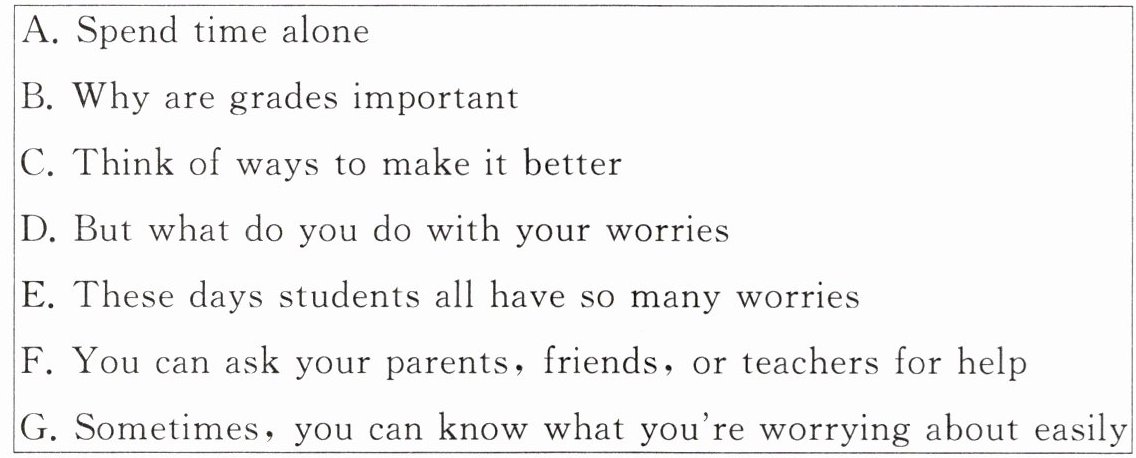
Everyone has worries. 1.
D
? Whether your worries are big or small, you can take these three steps to solve them:Try to find out what you're worried about. 2.
G
. Other times, you might not find it easily. Try to find it out first. If you can't, you can ask others for help.3.
C
. There is always something you can do to help you feel less worried. For example, talking with your parents or friends, listening to music, taking a walk or reading a story may help you feel better. Grades at school are often top worries for kids. If you're worried about grades, ask yourself these questions:☆4.
B
? What do grades mean to me?☆How do I get ready for a class? Do I go over my notes even when there isn't a test?
☆Do I have a good place to do my homework?
☆Do I try different ways of studying?
If you have had a fight with a friend and you worry about it, you could write down all the things you can do: write a note to him or her, invite him or her to a basketball game, say sorry to him or her, etc. Once you have a list of things you could do, you can choose the one that gets your friend back.
Ask for help. When you're worried, you can find someone to talk to. 5.
F
.答案
1.D 2.G 3.C 4.B 5.F
【语篇解读】本文是一篇说明文,主要介绍了我们每个人都会有担心或焦虑的时候,如何来正确处理这些不好的情绪。作者在短文中给了我们一些实用的建议。
1. D 解析:根据空格后的问号可知,空格处应该填写一个疑问句,有B和D两个选项进行备选,再根据“Whether your worries are big or small, you can take these three steps to solve them”可知,上文应该是对如何处理担忧进行提问,选项D“但是你怎么处理你的担忧呢”与之相符。故选D。
2. G 解析:根据“Other times, you might not find it easily.”可知,其他时候,你可能并不能很容易地发现你所担忧的事,推测有些时候,你能发现,选项G“有时候,你很容易就知道自己在担心什么”与之相符。故选G。
3. C 解析:根据空格所在位置可知,空处应该填写一个小标题。第一个小标题“Try to find out what you're worried about.”以动词原形开头,所以此空有A和C两个选项备选,再根据“There is always something you can do to help you feel less worried.”可知,总有一些你能做的帮助减少焦虑的事。选项C“想办法让它变得更好”与之相符。故选C。
4. B 解析:根据空格处后的问号可知,空格处应该是一个疑问句,再根据“What do grades mean to me?”可知,这里提到了分数,推测空格前也有关于分数的表述,选项B“分数为什么重要”与之相符。故选B。
5. F 解析:根据小标题“Ask for help.”和“When you're worried, you can find someone to talk to.”可知,当你忧虑的时候,要寻求帮助,选项F“你可以向你的父母、朋友或老师寻求帮助”与之相符。故选F。
【语篇解读】本文是一篇说明文,主要介绍了我们每个人都会有担心或焦虑的时候,如何来正确处理这些不好的情绪。作者在短文中给了我们一些实用的建议。
1. D 解析:根据空格后的问号可知,空格处应该填写一个疑问句,有B和D两个选项进行备选,再根据“Whether your worries are big or small, you can take these three steps to solve them”可知,上文应该是对如何处理担忧进行提问,选项D“但是你怎么处理你的担忧呢”与之相符。故选D。
2. G 解析:根据“Other times, you might not find it easily.”可知,其他时候,你可能并不能很容易地发现你所担忧的事,推测有些时候,你能发现,选项G“有时候,你很容易就知道自己在担心什么”与之相符。故选G。
3. C 解析:根据空格所在位置可知,空处应该填写一个小标题。第一个小标题“Try to find out what you're worried about.”以动词原形开头,所以此空有A和C两个选项备选,再根据“There is always something you can do to help you feel less worried.”可知,总有一些你能做的帮助减少焦虑的事。选项C“想办法让它变得更好”与之相符。故选C。
4. B 解析:根据空格处后的问号可知,空格处应该是一个疑问句,再根据“What do grades mean to me?”可知,这里提到了分数,推测空格前也有关于分数的表述,选项B“分数为什么重要”与之相符。故选B。
5. F 解析:根据小标题“Ask for help.”和“When you're worried, you can find someone to talk to.”可知,当你忧虑的时候,要寻求帮助,选项F“你可以向你的父母、朋友或老师寻求帮助”与之相符。故选F。
解析
【分析】
本题为英语七选五题型,主旨是介绍应对焦虑的方法。解题思路为:先通读全文把握核心话题,再结合空格前后的语境、句子类型(如疑问句、小标题)、上下文逻辑关系逐一匹配选项。例如第1空后为问号,结合下文“解决担忧的步骤”可锁定疑问类选项;第2空后有“Other times”,对应表“有时”的选项;第3空为小标题,结合下文“做减少焦虑的事”匹配选项;第4空后围绕“分数”展开,匹配相关疑问;第5空对应“求助”主题,匹配相关选项。
【解析】
1. 第1空:空格后为问号,需选疑问句,结合下文“无论担忧大小,可采取三步解决”,可知上文是询问处理担忧的方式,选项D“但是你怎么处理你的担忧呢”符合,故选D。
2. 第2空:空格后提到“其他时候你可能不容易发现担忧的事”,对应“有时你容易知道自己在担心什么”,选项G符合,故选G。
3. 第3空:为小标题,结合下文“总有能做的事减少焦虑”,选项C“想办法让它变得更好”符合,故选C。
4. 第4空:空格后围绕“分数的意义”展开,需选与分数相关的疑问句,选项B“分数为什么重要”符合,故选B。
5. 第5空:对应小标题“Ask for help”,结合“找人倾诉”,选项F“你可以向父母、朋友或老师求助”符合,故选F。
【答案】
1.D 2.G 3.C 4.B 5.F
【知识点】
英语阅读理解(七选五)、语篇逻辑推理、语境匹配
【点评】
本文是介绍应对焦虑方法的说明文,考查学生对语篇上下文逻辑的理解,需结合句子类型、语境线索解题,是中等难度的语篇类题目。
【难度系数】
0.5
本题为英语七选五题型,主旨是介绍应对焦虑的方法。解题思路为:先通读全文把握核心话题,再结合空格前后的语境、句子类型(如疑问句、小标题)、上下文逻辑关系逐一匹配选项。例如第1空后为问号,结合下文“解决担忧的步骤”可锁定疑问类选项;第2空后有“Other times”,对应表“有时”的选项;第3空为小标题,结合下文“做减少焦虑的事”匹配选项;第4空后围绕“分数”展开,匹配相关疑问;第5空对应“求助”主题,匹配相关选项。
【解析】
1. 第1空:空格后为问号,需选疑问句,结合下文“无论担忧大小,可采取三步解决”,可知上文是询问处理担忧的方式,选项D“但是你怎么处理你的担忧呢”符合,故选D。
2. 第2空:空格后提到“其他时候你可能不容易发现担忧的事”,对应“有时你容易知道自己在担心什么”,选项G符合,故选G。
3. 第3空:为小标题,结合下文“总有能做的事减少焦虑”,选项C“想办法让它变得更好”符合,故选C。
4. 第4空:空格后围绕“分数的意义”展开,需选与分数相关的疑问句,选项B“分数为什么重要”符合,故选B。
5. 第5空:对应小标题“Ask for help”,结合“找人倾诉”,选项F“你可以向父母、朋友或老师求助”符合,故选F。
【答案】
1.D 2.G 3.C 4.B 5.F
【知识点】
英语阅读理解(七选五)、语篇逻辑推理、语境匹配
【点评】
本文是介绍应对焦虑方法的说明文,考查学生对语篇上下文逻辑的理解,需结合句子类型、语境线索解题,是中等难度的语篇类题目。
【难度系数】
0.5
