

 登录
登录
Ⅰ. 根据句意及汉语提示或首字母提示写出单词
1. People in Germany are happy because they can see many famous football players in the coming football (比赛).
2. Lunch gives us (能量) for the whole afternoon, but it's not good to eat too much.
3. It's great that many kids begin to do housework at the ______ (周末).
4. Many people think dogs are f and they are people's friends.
5. —Can you help do the i?
—Sure. Jim, this is Mary.
1. People in Germany are happy because they can see many famous football players in the coming football (比赛).
2. Lunch gives us (能量) for the whole afternoon, but it's not good to eat too much.
3. It's great that many kids begin to do housework at the ______ (周末).
4. Many people think dogs are f and they are people's friends.
5. —Can you help do the i?
—Sure. Jim, this is Mary.
答案
1. match/matches 2. energy 3. weekend 4. friendly 5. introduction
解析
【分析】
本题考查英语词汇的运用,需结合句子语境、汉语提示或首字母提示,同时注意单词的正确形式(如单复数、词性等)来填写合适的单词。
【解析】
1. 句意:德国人很高兴,因为他们能在即将到来的足球比赛中看到很多著名足球运动员。“比赛”对应的英文单词是match,此处用单数或复数形式均可,故填match/matches;
2. 句意:午餐为我们整个下午提供能量,但吃太多不好。“能量”是不可数名词,对应英文energy,直接填写即可;
3. 句意:很多孩子在周末开始做家务,这很棒。“周末”对应英文weekend,固定搭配at the weekend表示“在周末”,故填weekend;
4. 句意:很多人认为狗是友好的,它们是人类的朋友。根据首字母f及句意,此处需填形容词“友好的”,即friendly;
5. 句意:——你能帮忙做介绍吗?——当然,吉姆,这是玛丽。根据首字母i及对话语境,此处需填名词“介绍”,即introduction。
【答案】
1. match/matches 2. energy 3. weekend 4. friendly 5. introduction
【知识点】
词汇运用;名词;形容词
【点评】
本题考查基础词汇的语境运用,结合提示填写单词,难度较低,主要考查学生对常见词汇的拼写和基本语境的理解。
【难度系数】
0.8
本题考查英语词汇的运用,需结合句子语境、汉语提示或首字母提示,同时注意单词的正确形式(如单复数、词性等)来填写合适的单词。
【解析】
1. 句意:德国人很高兴,因为他们能在即将到来的足球比赛中看到很多著名足球运动员。“比赛”对应的英文单词是match,此处用单数或复数形式均可,故填match/matches;
2. 句意:午餐为我们整个下午提供能量,但吃太多不好。“能量”是不可数名词,对应英文energy,直接填写即可;
3. 句意:很多孩子在周末开始做家务,这很棒。“周末”对应英文weekend,固定搭配at the weekend表示“在周末”,故填weekend;
4. 句意:很多人认为狗是友好的,它们是人类的朋友。根据首字母f及句意,此处需填形容词“友好的”,即friendly;
5. 句意:——你能帮忙做介绍吗?——当然,吉姆,这是玛丽。根据首字母i及对话语境,此处需填名词“介绍”,即introduction。
【答案】
1. match/matches 2. energy 3. weekend 4. friendly 5. introduction
【知识点】
词汇运用;名词;形容词
【点评】
本题考查基础词汇的语境运用,结合提示填写单词,难度较低,主要考查学生对常见词汇的拼写和基本语境的理解。
【难度系数】
0.8
Ⅱ. 用方框中所给单词的正确形式填空
be, classmate, other, stay, greet
1. My sister Mandy enjoys
2. After class, some of us play in the playground, and
3. In China and some other countries, people shake hands
4. Here
5. They're my new
be, classmate, other, stay, greet
1. My sister Mandy enjoys
staying
with kids and she is very nice to them.2. After class, some of us play in the playground, and
others
just have a rest in the classroom.3. In China and some other countries, people shake hands
to greet
each other.4. Here
are
some photos of my school. They are very beautiful.5. They're my new
classmates
. We're good friends now.答案
1. staying 解析:enjoy doing sth. 为固定用法,后接动名词形式。
2. others 解析:some ... others ... 固定搭配,表示一些人……另一些人……。
3. to greet 解析:用动词不定式表目的,握手是为了互相问候。
4. are 解析:here be 遵循就近原则,后面 photos 是复数,be 动词用are。
5. classmates 解析:主语为They,可数名词用复数形式。
2. others 解析:some ... others ... 固定搭配,表示一些人……另一些人……。
3. to greet 解析:用动词不定式表目的,握手是为了互相问候。
4. are 解析:here be 遵循就近原则,后面 photos 是复数,be 动词用are。
5. classmates 解析:主语为They,可数名词用复数形式。
解析
【分析】
先理解每个句子的句意,结合方框内单词的含义,根据英语的固定搭配、语法规则(如非谓语、主谓一致、名词复数等)确定每个空的正确形式:第1题需用enjoy的固定搭配;第2题用固定结构some...others...;第3题用不定式表目的;第4题用here be的就近原则;第5题用名词复数。
【解析】
1. 固定搭配enjoy doing sth.意为“喜欢做某事”,故将方框中的动词stay变为动名词staying;
2. 固定结构some...others...表示“一些……另一些……”,对应方框中的other,需变为代词others;
3. 此处用动词不定式表目的,握手的目的是互相问候,故用方框中的动词greet的不定式形式to greet;
4. here be句型遵循就近原则,后面的主语photos是复数,故be动词用方框中的be的复数形式are;
5. 主语是they(复数),方框中的可数名词classmate需用复数形式classmates。
【答案】
1. staying 2. others 3. to greet 4. are 5. classmates
【知识点】
固定搭配、非谓语动词、主谓一致
【点评】
本题是初中英语基础词汇变形题,主要考察常见的固定搭配、语法规则,属于基础题型,难度不大,需熟练掌握相关知识点。
【难度系数】
0.7
先理解每个句子的句意,结合方框内单词的含义,根据英语的固定搭配、语法规则(如非谓语、主谓一致、名词复数等)确定每个空的正确形式:第1题需用enjoy的固定搭配;第2题用固定结构some...others...;第3题用不定式表目的;第4题用here be的就近原则;第5题用名词复数。
【解析】
1. 固定搭配enjoy doing sth.意为“喜欢做某事”,故将方框中的动词stay变为动名词staying;
2. 固定结构some...others...表示“一些……另一些……”,对应方框中的other,需变为代词others;
3. 此处用动词不定式表目的,握手的目的是互相问候,故用方框中的动词greet的不定式形式to greet;
4. here be句型遵循就近原则,后面的主语photos是复数,故be动词用方框中的be的复数形式are;
5. 主语是they(复数),方框中的可数名词classmate需用复数形式classmates。
【答案】
1. staying 2. others 3. to greet 4. are 5. classmates
【知识点】
固定搭配、非谓语动词、主谓一致
【点评】
本题是初中英语基础词汇变形题,主要考察常见的固定搭配、语法规则,属于基础题型,难度不大,需熟练掌握相关知识点。
【难度系数】
0.7
1. —Do you often use social media apps(社交软件)?
—Yes. We often use them to talk
A.for; with
B.about; at
C.to; at
D.about; with
—Yes. We often use them to talk
about
English study with
our classmates.A.for; with
B.about; at
C.to; at
D.about; with
答案
1. D 解析:固定搭配 talk about 谈论;talk with sb. 和某人交流。
解析
【分析】本题考查动词talk的固定短语搭配,解题时需回忆talk的常用搭配:talk about表示“谈论关于……”,后接谈论的内容;talk with sb.表示“和某人交谈”,后接交谈的对象。结合句子语境,第一个空后是谈论的内容“English study”,第二个空后是交谈的对象“our classmates”,据此可选出正确选项。
【解析】talk about是固定短语,意为“谈论关于……”,用于引出谈论的内容;talk with sb.是固定短语,意为“和某人交流”,用于引出交谈的对象。句中第一个空对应谈论的内容“English study”,故用about;第二个空对应交谈的对象“our classmates”,故用with,因此答案为D。
【答案】D
【知识点】动词短语搭配;介词用法
【点评】本题考查英语基础动词短语搭配,难度较低,需学生积累常见动词短语,结合语境分析即可解答。
【难度系数】0.7
【解析】talk about是固定短语,意为“谈论关于……”,用于引出谈论的内容;talk with sb.是固定短语,意为“和某人交流”,用于引出交谈的对象。句中第一个空对应谈论的内容“English study”,故用about;第二个空对应交谈的对象“our classmates”,故用with,因此答案为D。
【答案】D
【知识点】动词短语搭配;介词用法
【点评】本题考查英语基础动词短语搭配,难度较低,需学生积累常见动词短语,结合语境分析即可解答。
【难度系数】0.7
2. Millie's eyes
A.is; is
B.are; is
C.are; are
D.is; are
are
dark brown and her hair is
black.A.is; is
B.are; is
C.are; are
D.is; are
答案
2. B 解析:eyes 是复数名词,be 动词用 are;hair 表头发时为不可数名词,be 动词用 is。
解析
【分析】
本题考查be动词的主谓一致用法,解题思路是先判断每个空对应的主语的单复数,再确定be动词的正确形式:第一个空的主语是eyes,为复数名词,be动词需用复数形式;第二个空的主语是hair,表“头发”时为不可数名词,be动词需用单数形式,据此匹配选项即可。
【解析】
第一个空的主语Millie's eyes是复数名词,be动词应使用are;第二个空的主语her hair表示“头发”,属于不可数名词,be动词应使用is,结合选项可知正确答案为B。
【答案】
B
【知识点】
主谓一致、名词的数
【点评】
本题考查基础的主谓一致知识点,核心是区分可数/不可数名词对应的be动词形式,属于英语语法中的基础题型,难度较低。
【难度系数】
0.8
本题考查be动词的主谓一致用法,解题思路是先判断每个空对应的主语的单复数,再确定be动词的正确形式:第一个空的主语是eyes,为复数名词,be动词需用复数形式;第二个空的主语是hair,表“头发”时为不可数名词,be动词需用单数形式,据此匹配选项即可。
【解析】
第一个空的主语Millie's eyes是复数名词,be动词应使用are;第二个空的主语her hair表示“头发”,属于不可数名词,be动词应使用is,结合选项可知正确答案为B。
【答案】
B
【知识点】
主谓一致、名词的数
【点评】
本题考查基础的主谓一致知识点,核心是区分可数/不可数名词对应的be动词形式,属于英语语法中的基础题型,难度较低。
【难度系数】
0.8
3. The boy
A.wears; wears
B.wears; in
C.with; in
D.with; wears
with
glasses is Daniel. He often wears
a blue shirt.A.wears; wears
B.wears; in
C.with; in
D.with; wears
答案
3. D 解析:with glasses 作后置定语,意为戴眼镜的;第二空缺少谓语动词,主语为第三人称单数,用 wears。
解析
【分析】
首先分析第一空:句子已有谓语动词is,不能再用谓语动词wears,需用介词短语作定语修饰the boy,“戴眼镜的”用with glasses,因此排除A、B选项;再分析第二空:句子缺少谓语动词,主语he是第三人称单数,一般现在时中谓语动词要用第三人称单数形式wears,介词in不能作谓语,排除C选项,故选择D。
【解析】
第一空:句中已有谓语动词is,需用介词短语with glasses作后置定语修饰the boy,表“戴眼镜的”,排除A、B;第二空:句子缺少谓语,主语he为第三人称单数,一般现在时中谓语动词用wears,介词in无法作谓语,排除C,因此选D。
【答案】
D
【知识点】
介词的用法;一般现在时动词第三人称单数
【点评】
本题考查介词作定语和一般现在时谓语动词的基础用法,是英语单项选择的常见基础题型,需明确介词和动词在句子中的不同功能。
【难度系数】
0.6
首先分析第一空:句子已有谓语动词is,不能再用谓语动词wears,需用介词短语作定语修饰the boy,“戴眼镜的”用with glasses,因此排除A、B选项;再分析第二空:句子缺少谓语动词,主语he是第三人称单数,一般现在时中谓语动词要用第三人称单数形式wears,介词in不能作谓语,排除C选项,故选择D。
【解析】
第一空:句中已有谓语动词is,需用介词短语with glasses作后置定语修饰the boy,表“戴眼镜的”,排除A、B;第二空:句子缺少谓语,主语he为第三人称单数,一般现在时中谓语动词用wears,介词in无法作谓语,排除C,因此选D。
【答案】
D
【知识点】
介词的用法;一般现在时动词第三人称单数
【点评】
本题考查介词作定语和一般现在时谓语动词的基础用法,是英语单项选择的常见基础题型,需明确介词和动词在句子中的不同功能。
【难度系数】
0.6
4. —Hey, Tom! It's not
—Sorry, Mrs King. I won't do that again.
A.rude
B.careful
C.polite
D.difficult
polite
to shout in the library.—Sorry, Mrs King. I won't do that again.
A.rude
B.careful
C.polite
D.difficult
答案
4. C 解析:在图书馆大喊是不礼貌的行为,polite 礼貌的,符合语境。
解析
【分析】
先理解对话语境:第一句指出在图书馆大喊的行为,需选择合适的形容词描述该行为的属性。逐一分析选项含义,结合图书馆需保持安静的常识,判断哪种形容词符合语境。
【解析】
根据对话语境,在图书馆大声喊叫是不礼貌的行为。选项中,A项rude意为“粗鲁的”,B项careful意为“仔细的”,C项polite意为“礼貌的”,D项difficult意为“困难的”,只有C项符合语境,故选C。
【答案】
C
【知识点】
形容词词义辨析;日常交际用语
【点评】
本题考查基础形容词的词义辨析,结合图书馆的场景语境即可轻松选出正确答案,属于基础题型。
【难度系数】
0.8
先理解对话语境:第一句指出在图书馆大喊的行为,需选择合适的形容词描述该行为的属性。逐一分析选项含义,结合图书馆需保持安静的常识,判断哪种形容词符合语境。
【解析】
根据对话语境,在图书馆大声喊叫是不礼貌的行为。选项中,A项rude意为“粗鲁的”,B项careful意为“仔细的”,C项polite意为“礼貌的”,D项difficult意为“困难的”,只有C项符合语境,故选C。
【答案】
C
【知识点】
形容词词义辨析;日常交际用语
【点评】
本题考查基础形容词的词义辨析,结合图书馆的场景语境即可轻松选出正确答案,属于基础题型。
【难度系数】
0.8
5. —
—Yes. I make
A.Do; friends
B.Are; friend
C.Does; friend
D.Are; friends
Are
you happy today?—Yes. I make
friends
with some new students.A.Do; friends
B.Are; friend
C.Does; friend
D.Are; friends
答案
5. D 解析:形容词 happy 前用 be 动词 Are;make friends 为固定搭配,意为交朋友。
解析
【分析】
这道题考查be动词的用法和固定搭配。第一步,分析第一空:空格后是形容词happy,形容词前需用be动词构成“be+形容词”的结构,主语是you,对应的be动词为Are,因此排除用助动词Do/Does的A、C选项。第二步,分析第二空:“交朋友”的固定搭配是make friends,需用friend的复数形式,排除单数形式的B选项,最终确定答案。
【解析】
1. 第一空:句中happy是形容词作表语,主语为you,需用be动词Are;助动词Do/Does后接动词原形,不符合此处结构,排除A、C。
2. 第二空:固定搭配“make friends”意为“交朋友”,需用friend的复数形式,排除单数形式的B。
综上,答案为D。
【答案】
D
【知识点】
be动词用法、固定搭配
【点评】
本题考查英语基础语法中的be动词搭配及常用固定短语,属于核心基础考点,侧重考查学生对基础知识点的掌握情况。
【难度系数】
0.8
这道题考查be动词的用法和固定搭配。第一步,分析第一空:空格后是形容词happy,形容词前需用be动词构成“be+形容词”的结构,主语是you,对应的be动词为Are,因此排除用助动词Do/Does的A、C选项。第二步,分析第二空:“交朋友”的固定搭配是make friends,需用friend的复数形式,排除单数形式的B选项,最终确定答案。
【解析】
1. 第一空:句中happy是形容词作表语,主语为you,需用be动词Are;助动词Do/Does后接动词原形,不符合此处结构,排除A、C。
2. 第二空:固定搭配“make friends”意为“交朋友”,需用friend的复数形式,排除单数形式的B。
综上,答案为D。
【答案】
D
【知识点】
be动词用法、固定搭配
【点评】
本题考查英语基础语法中的be动词搭配及常用固定短语,属于核心基础考点,侧重考查学生对基础知识点的掌握情况。
【难度系数】
0.8
6. I think Susan can be our monitor(班长), because she is always ready
A.help
B.helping
C.helps
D.to help
to help
others.A.help
B.helping
C.helps
D.to help
答案
6. D 解析:固定短语 be ready to do sth. 乐于做某事,后接动词不定式。
解析
【分析】首先观察题目,本题考查英语固定短语的用法,需回忆be ready的搭配结构:be ready后需接动词不定式,据此分析选项形式即可得出答案。
【解析】根据固定短语be ready to do sth.(乐于做某事),be ready后应接动词不定式作宾语。选项A为动词原形,B为动名词,C为动词第三人称单数形式,均不符合搭配要求;D选项to help是动词不定式,符合固定搭配要求,因此选D。
【答案】D
【知识点】固定搭配;动词不定式
【点评】本题属于基础语法题,考查常用固定短语的用法,需学生牢记常见动词搭配结构,是初中英语的基础考点。
【难度系数】0.8
【解析】根据固定短语be ready to do sth.(乐于做某事),be ready后应接动词不定式作宾语。选项A为动词原形,B为动名词,C为动词第三人称单数形式,均不符合搭配要求;D选项to help是动词不定式,符合固定搭配要求,因此选D。
【答案】D
【知识点】固定搭配;动词不定式
【点评】本题属于基础语法题,考查常用固定短语的用法,需学生牢记常见动词搭配结构,是初中英语的基础考点。
【难度系数】0.8
Ⅳ. 阅读理解
A student comes to his teacher and asks, “Sir, I have a question. How many friends should a person have?”
“It’s easy,” the teacher answers. “Get me that red apple from the highest branch(树枝) of the tree.”
The student doesn’t know why the teacher asks him to do so, but he still climbs the tree.
Later, he says, “It’s too high! I can’t get it.”
“Ask a friend. Maybe he can help,” the teacher says.
The student calls another student and stands on his shoulders(肩膀). “I still can’t get it, Sir,” the student says sadly after the first try.
“Don’t you have more friends?” the teacher asks.
The student asks more friends to come over. They stand on each other’s shoulders but it isn’t helpful. When he doesn’t know what to do, one of the friends goes home and brings a ladder(梯子), and the student finally makes it.
After getting the apple, the teacher asks, “▲”
“Yes, I do,” the student says happily. “When we have many friends, we can work out a problem together.”
“Sounds good,” the teacher says. “You need as many friends as you can. Among them, there will be at least one smart person who can think of a good idea, like getting a ladder!”
1. What worries the boy at the beginning of the story?
A. Helping others. B. Learning biology.
C. Joining clubs. D. Making friends.
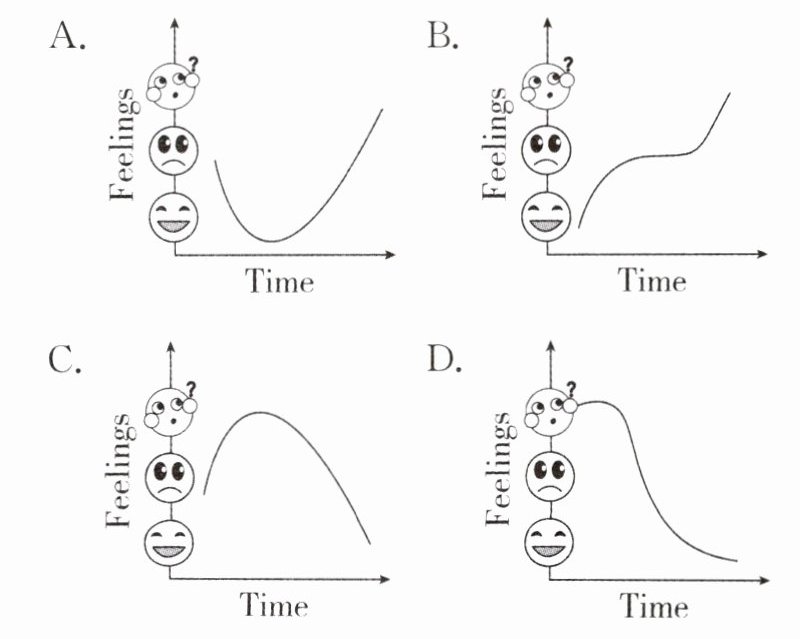
2. 新考法 图示理解 Which of the following shows the changes in the student’s feelings?
3. What does the underlined phrase “makes it” mean?
A. Brings a ladder.
B. Gets the red apple.
C. Climbs the tree.
D. Knows the answer.
4. 新考法 补全文章 Which of the following can be put in “▲”?
A. Do you still feel sad now?
B. Do you like eating apples now?
C. Do you need me to give you a ladder now?
D. Do you know the answer to the question now?
5. What can we learn from the story?
A. A friend is a second self.
B. Interest is the best teacher.
C. Many hands make light work.
D. An apple a day keeps the doctor away.
A student comes to his teacher and asks, “Sir, I have a question. How many friends should a person have?”
“It’s easy,” the teacher answers. “Get me that red apple from the highest branch(树枝) of the tree.”
The student doesn’t know why the teacher asks him to do so, but he still climbs the tree.
Later, he says, “It’s too high! I can’t get it.”
“Ask a friend. Maybe he can help,” the teacher says.
The student calls another student and stands on his shoulders(肩膀). “I still can’t get it, Sir,” the student says sadly after the first try.
“Don’t you have more friends?” the teacher asks.
The student asks more friends to come over. They stand on each other’s shoulders but it isn’t helpful. When he doesn’t know what to do, one of the friends goes home and brings a ladder(梯子), and the student finally makes it.
After getting the apple, the teacher asks, “▲”
“Yes, I do,” the student says happily. “When we have many friends, we can work out a problem together.”
“Sounds good,” the teacher says. “You need as many friends as you can. Among them, there will be at least one smart person who can think of a good idea, like getting a ladder!”
1. What worries the boy at the beginning of the story?
A. Helping others. B. Learning biology.
C. Joining clubs. D. Making friends.
2. 新考法 图示理解 Which of the following shows the changes in the student’s feelings?
3. What does the underlined phrase “makes it” mean?
A. Brings a ladder.
B. Gets the red apple.
C. Climbs the tree.
D. Knows the answer.
4. 新考法 补全文章 Which of the following can be put in “▲”?
A. Do you still feel sad now?
B. Do you like eating apples now?
C. Do you need me to give you a ladder now?
D. Do you know the answer to the question now?
5. What can we learn from the story?
A. A friend is a second self.
B. Interest is the best teacher.
C. Many hands make light work.
D. An apple a day keeps the doctor away.
答案
1.D 2.D 3.B 4.D 5.C
【语篇解读】本文是一篇记叙文,通过老师让学生摘苹果的故事,阐释了朋友数量的意义:拥有更多朋友意味着在困难时能获得更多帮助与智慧,强调了合作与集思广益的重要性。
【语篇解读】本文是一篇记叙文,通过老师让学生摘苹果的故事,阐释了朋友数量的意义:拥有更多朋友意味着在困难时能获得更多帮助与智慧,强调了合作与集思广益的重要性。
解析
【分析】
要解决这道图示理解题,需先梳理故事中学生的情绪变化逻辑:学生最初因不理解老师让摘高枝苹果的意图而困惑(对应最上方带问号的表情);独自尝试失败后感到难过(对应中间皱眉的表情);最终在朋友帮助下成功摘到苹果,变得开心(对应最下方微笑的表情)。结合时间轴(从左到右代表时间推进),情绪应从困惑(最高层级)逐步下降到难过,再到开心(最低层级),匹配该变化的图示即为答案。
【解析】
步骤1:确定情绪对应的表情层级:图中纵轴“Feelings”的三个表情,最上方是困惑(带问号)、中间是难过(皱眉)、最下方是开心(微笑)。
步骤2:对应时间轴的情绪变化:时间从左到右,学生情绪起点为困惑(曲线起始点在最高层级),尝试失败后变为难过(曲线到中间层级),成功后变为开心(曲线到最低层级),符合这一变化的是选项D的曲线。
【答案】
D
【知识点】
阅读理解、情绪分析、图示匹配
【点评】
本题结合语篇考查情绪变化的图示理解,需梳理情节与情绪的对应关系,难度适中,能考查学生的语篇理解和图文转换能力。
【难度系数】
0.5
要解决这道图示理解题,需先梳理故事中学生的情绪变化逻辑:学生最初因不理解老师让摘高枝苹果的意图而困惑(对应最上方带问号的表情);独自尝试失败后感到难过(对应中间皱眉的表情);最终在朋友帮助下成功摘到苹果,变得开心(对应最下方微笑的表情)。结合时间轴(从左到右代表时间推进),情绪应从困惑(最高层级)逐步下降到难过,再到开心(最低层级),匹配该变化的图示即为答案。
【解析】
步骤1:确定情绪对应的表情层级:图中纵轴“Feelings”的三个表情,最上方是困惑(带问号)、中间是难过(皱眉)、最下方是开心(微笑)。
步骤2:对应时间轴的情绪变化:时间从左到右,学生情绪起点为困惑(曲线起始点在最高层级),尝试失败后变为难过(曲线到中间层级),成功后变为开心(曲线到最低层级),符合这一变化的是选项D的曲线。
【答案】
D
【知识点】
阅读理解、情绪分析、图示匹配
【点评】
本题结合语篇考查情绪变化的图示理解,需梳理情节与情绪的对应关系,难度适中,能考查学生的语篇理解和图文转换能力。
【难度系数】
0.5
