

 登录
登录
中考趋势 V.阅读还原
从方框中选出能填入空白处的最佳选项。选项中有两项多余。
How to Greet People in Different Languages
文化意识 跨文化交流 Have you ever stopped to think about how many people are saying "Hello" to greet each other today, and in how many different languages? If you want to say "Hello" to everyone on the planet, you would have to learn at least 7,000 languages and greet at least 7,800,000,000 people.
Sounds hard to learn to say so many "Hellos"? Don't worry! It seems that nowadays the English word "Hello" is getting accepted in more and more cultures.
Fun, isn't it? And we don't need to pronounce those different local greeting words. With a hearty smile, it can be well understood and appreciated(欣赏).
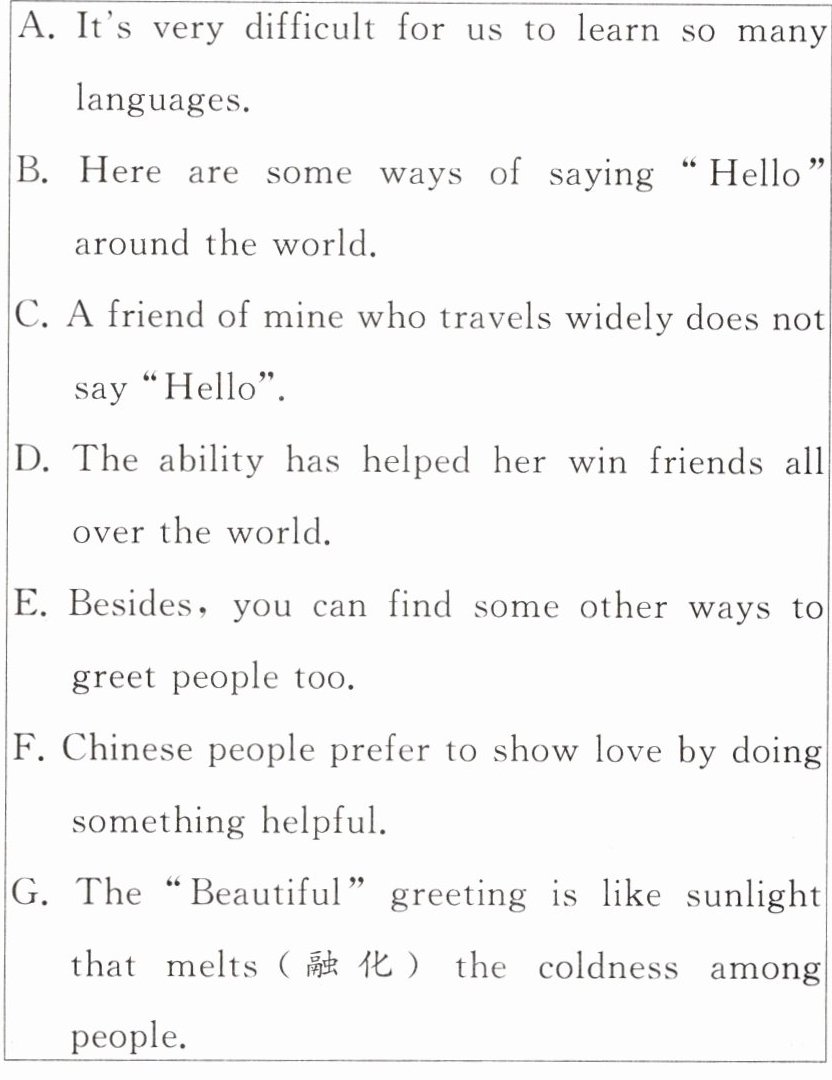
A. It's very difficult for us to learn so many languages.
B. Here are some ways of saying "Hello" around the world.
C. A friend of mine who travels widely does not say "Hello".
D. The ability has helped her win friends all over the world.
E. Besides, you can find some other ways to greet people too.
F. Chinese people prefer to show love by doing something helpful.
G. The "Beautiful" greeting is like sunlight that melts (融化) the coldness among people.
1.
4.
题中题 016
从方框中选出能填入空白处的最佳选项。选项中有两项多余。
How to Greet People in Different Languages
文化意识 跨文化交流 Have you ever stopped to think about how many people are saying "Hello" to greet each other today, and in how many different languages? If you want to say "Hello" to everyone on the planet, you would have to learn at least 7,000 languages and greet at least 7,800,000,000 people.
B
1 Hola in Spanish, Ciao in Italian, Nihao in Chinese or Bonjour in French and many more!Sounds hard to learn to say so many "Hellos"? Don't worry! It seems that nowadays the English word "Hello" is getting accepted in more and more cultures.
E
2 Here is a simple and amusing way to greet foreigners wherever you might travel around the world.C
3 But she tries to learn to say "Beautiful" in the local language. She can use it to "greet" a mother holding a baby, or to "greet" an old lady watering her flowers, or to "greet" a lonely salesman showing a photo of his family. D
4 So why not say it when even one word can bring about such pleasure?Fun, isn't it? And we don't need to pronounce those different local greeting words. With a hearty smile, it can be well understood and appreciated(欣赏).
G
5 So let's learn to say "Beautiful" in the local language whenever and wherever you travel around the world!A. It's very difficult for us to learn so many languages.
B. Here are some ways of saying "Hello" around the world.
C. A friend of mine who travels widely does not say "Hello".
D. The ability has helped her win friends all over the world.
E. Besides, you can find some other ways to greet people too.
F. Chinese people prefer to show love by doing something helpful.
G. The "Beautiful" greeting is like sunlight that melts (融化) the coldness among people.
1.
B
2. E
3. C
4.
D
5. G
题中题 016
答案
1.B 2.E 3.C 4.D 5.G
【语篇解读】本文是一篇说明文,主要介绍了怎样用不同语言问候他人。
1. B 解析:根据“Hola in Spanish, Ciao in Italian, Nihao in Chinese or Bonjour in French and many more!”可知,上句是指各地问好的不同方式。选项 B“这里有一些世界各地说‘你好’的方式。”符合语境。故选 B。
2. E 解析:根据“Sounds hard to learn to say so many ‘Hellos’? Don't worry!”可知,此处提到除了“Hello”之外的其他问候方式。选项 E“此外,你也可以找到一些其他的方式来问候别人。”符合语境。故选 E。
3. C 解析:根据“But she tries to learn to say ‘Beautiful’ in the local language.”可知,作者介绍自己的朋友,她努力学习用当地语言说“美丽”,可推知空处是介绍一个朋友的独特问候方式。选项 C“我的一个周游世界的朋友,她不说‘你好’。”符合语境。故选 C。
4. D 解析:根据“She can use it to ‘greet’ a mother holding a baby, or to ‘greet’ an old lady watering her flowers, or to ‘greet’ a lonely salesman showing a photo of his family.”以及前面介绍的“travel widely”可知,她周游世界,并用不同方式问候他人的行为受到欢迎,空处说明这种方式的效果。选项 D“这种能力帮助她赢得了全世界的朋友。”符合语境。故选 D。
5. G 解析:根据“So let's learn to say ‘Beautiful’ in the local language whenever and wherever you travel around the world!”可知,无论何时何地在世界各地旅行时让我们学习用当地语言说“美丽”。选项 G“‘美丽’的问候就像阳光,融化了人与人之间的冷漠。”符合语境。故选 G。
【语篇解读】本文是一篇说明文,主要介绍了怎样用不同语言问候他人。
1. B 解析:根据“Hola in Spanish, Ciao in Italian, Nihao in Chinese or Bonjour in French and many more!”可知,上句是指各地问好的不同方式。选项 B“这里有一些世界各地说‘你好’的方式。”符合语境。故选 B。
2. E 解析:根据“Sounds hard to learn to say so many ‘Hellos’? Don't worry!”可知,此处提到除了“Hello”之外的其他问候方式。选项 E“此外,你也可以找到一些其他的方式来问候别人。”符合语境。故选 E。
3. C 解析:根据“But she tries to learn to say ‘Beautiful’ in the local language.”可知,作者介绍自己的朋友,她努力学习用当地语言说“美丽”,可推知空处是介绍一个朋友的独特问候方式。选项 C“我的一个周游世界的朋友,她不说‘你好’。”符合语境。故选 C。
4. D 解析:根据“She can use it to ‘greet’ a mother holding a baby, or to ‘greet’ an old lady watering her flowers, or to ‘greet’ a lonely salesman showing a photo of his family.”以及前面介绍的“travel widely”可知,她周游世界,并用不同方式问候他人的行为受到欢迎,空处说明这种方式的效果。选项 D“这种能力帮助她赢得了全世界的朋友。”符合语境。故选 D。
5. G 解析:根据“So let's learn to say ‘Beautiful’ in the local language whenever and wherever you travel around the world!”可知,无论何时何地在世界各地旅行时让我们学习用当地语言说“美丽”。选项 G“‘美丽’的问候就像阳光,融化了人与人之间的冷漠。”符合语境。故选 G。
解析
【分析】
做阅读还原题时,需先通读全文把握主旨(本文介绍不同语言的问候方式),再结合空格前后的语境、关键词逐一匹配选项:第1空后列举不同语言的“Hello”表达,需找对应“世界各地问候方式”的选项;第2空前提到英语“Hello”被接受,后引出其他问候方式,需找“其他问候方式”的选项;第3空后有转折词“But she”,需找介绍人物(朋友)的选项;第4空前介绍朋友的问候行为,需找该行为效果的选项;第5空后提到“Beautiful”问候,需找对应“Beautiful问候”的选项。
【解析】
1. 根据空格后“Hola in Spanish...many more!”可知,此处列举世界各地不同语言的问候语,对应选项B“这里有一些世界各地说‘你好’的方式”,符合语境。
2. 空格前提到英语“Hello”被接受,空格后引出其他问候方式,结合前文“Sounds hard to learn many Hellos? Don't worry!”,对应选项E“此外,你也可以找到一些其他的方式来问候别人”,符合语境。
3. 空格后有转折词“But she”,说明前文介绍一位人物,对应选项C“我的一个周游世界的朋友,她不说‘你好’”,符合语境。
4. 空格前介绍朋友用不同方式问候的行为,结合前文“travel widely”,对应选项D“这种能力帮助她赢得了全世界的朋友”,符合语境。
5. 空格后提到学习说“Beautiful”问候,对应选项G“‘美丽’的问候就像阳光,融化了人与人之间的冷漠”,符合语境。
【答案】
1.B 2.E 3.C 4.D 5.G
【知识点】
英语阅读理解、语境推理、语篇衔接
【点评】
本题为中考常见的阅读还原题,围绕“不同语言问候”主题,考查学生对上下文语境、语篇逻辑的理解与匹配能力,需结合关键词和语义衔接解题,难度适中。
【难度系数】
0.5
做阅读还原题时,需先通读全文把握主旨(本文介绍不同语言的问候方式),再结合空格前后的语境、关键词逐一匹配选项:第1空后列举不同语言的“Hello”表达,需找对应“世界各地问候方式”的选项;第2空前提到英语“Hello”被接受,后引出其他问候方式,需找“其他问候方式”的选项;第3空后有转折词“But she”,需找介绍人物(朋友)的选项;第4空前介绍朋友的问候行为,需找该行为效果的选项;第5空后提到“Beautiful”问候,需找对应“Beautiful问候”的选项。
【解析】
1. 根据空格后“Hola in Spanish...many more!”可知,此处列举世界各地不同语言的问候语,对应选项B“这里有一些世界各地说‘你好’的方式”,符合语境。
2. 空格前提到英语“Hello”被接受,空格后引出其他问候方式,结合前文“Sounds hard to learn many Hellos? Don't worry!”,对应选项E“此外,你也可以找到一些其他的方式来问候别人”,符合语境。
3. 空格后有转折词“But she”,说明前文介绍一位人物,对应选项C“我的一个周游世界的朋友,她不说‘你好’”,符合语境。
4. 空格前介绍朋友用不同方式问候的行为,结合前文“travel widely”,对应选项D“这种能力帮助她赢得了全世界的朋友”,符合语境。
5. 空格后提到学习说“Beautiful”问候,对应选项G“‘美丽’的问候就像阳光,融化了人与人之间的冷漠”,符合语境。
【答案】
1.B 2.E 3.C 4.D 5.G
【知识点】
英语阅读理解、语境推理、语篇衔接
【点评】
本题为中考常见的阅读还原题,围绕“不同语言问候”主题,考查学生对上下文语境、语篇逻辑的理解与匹配能力,需结合关键词和语义衔接解题,难度适中。
【难度系数】
0.5
