登录
登录
11. 如图,在平行四边形$ABCD$中,$AC$,$BD$相交于点$O$,$E$,$F$分别是$OA$,$OC$中点,连接$BE$,$BF$,$DE$,$DF$.
(1)求证:$∠ADE = ∠CBF$.
(2)若$OC = BD$,试判断四边形$DEBF$的形状,并证明你的结论.
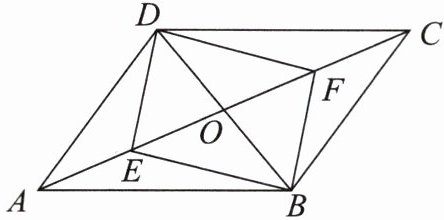
(1)求证:$∠ADE = ∠CBF$.
(2)若$OC = BD$,试判断四边形$DEBF$的形状,并证明你的结论.
答案
11. (1)证明:$\because$四边形$ABCD$是平行四边形,
$\therefore AD// BC,AD=BC$,
$\therefore ∠ EAD=∠ FCB,OC=OA$,
$\because E,F$分别是$OA,OC$中点,
$\therefore OC=2CF,OA=2AE$,
$\therefore CF=AE$,
$\therefore △ ADE≌△ BCF(\mathrm{SAS})$,
$\therefore ∠ ADE=∠ CBF$.
(2)解:$\because$四边形$ABCD$是平行四边形,
$\therefore OC=OA,OB=OD$,
$\because E,F$分别是$OA,OC$中点,
$\therefore OC=2CF=2OF,OA=2AE=2OE$,
$\therefore OE=OF=AE=CF$,
$\therefore$四边形$DEBF$是平行四边形.
$\because OE=OF=AE=CF$,
$\therefore OE+OF=EF=OC$,
$\because BD=OC$,
$\therefore EF=BD$,
$\therefore$四边形$DEBF$是矩形.
$\therefore AD// BC,AD=BC$,
$\therefore ∠ EAD=∠ FCB,OC=OA$,
$\because E,F$分别是$OA,OC$中点,
$\therefore OC=2CF,OA=2AE$,
$\therefore CF=AE$,
$\therefore △ ADE≌△ BCF(\mathrm{SAS})$,
$\therefore ∠ ADE=∠ CBF$.
(2)解:$\because$四边形$ABCD$是平行四边形,
$\therefore OC=OA,OB=OD$,
$\because E,F$分别是$OA,OC$中点,
$\therefore OC=2CF=2OF,OA=2AE=2OE$,
$\therefore OE=OF=AE=CF$,
$\therefore$四边形$DEBF$是平行四边形.
$\because OE=OF=AE=CF$,
$\therefore OE+OF=EF=OC$,
$\because BD=OC$,
$\therefore EF=BD$,
$\therefore$四边形$DEBF$是矩形.
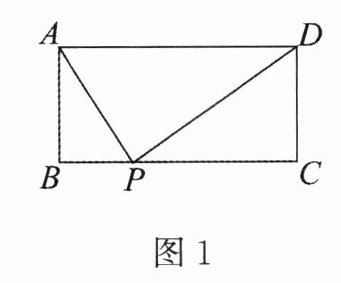
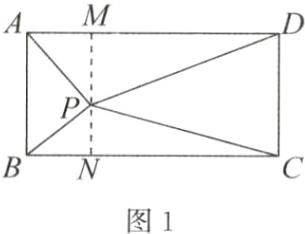
12. 已知矩形$ABCD$和点$P$,当点$P$在$BC$上任一位置(如图 1 所示)时,易证得结论:$PA^{2} + PC^{2} = PB^{2} + PD^{2}$.
请你探究:当点$P$分别在图 2、图 3 中的位置时,$PA^{2}$,$PB^{2}$,$PC^{2}$和$PD^{2}$又有怎样的数量关系?请你写出对上述两种情况的探究结论,并证明你的结论.
(1)对图 2 的探究结论为
(2)对图 3 的探究结论为
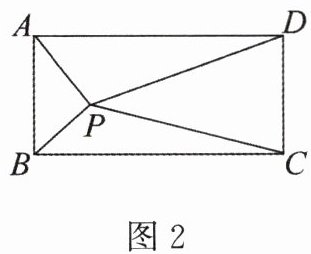
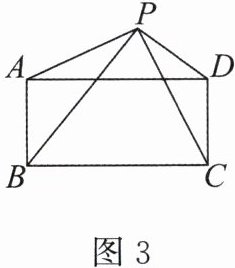
请你探究:当点$P$分别在图 2、图 3 中的位置时,$PA^{2}$,$PB^{2}$,$PC^{2}$和$PD^{2}$又有怎样的数量关系?请你写出对上述两种情况的探究结论,并证明你的结论.
(1)对图 2 的探究结论为
$PA^2+PC^2=PB^2+PD^2$
;(2)对图 3 的探究结论为
$PA^2+PC^2=PB^2+PD^2$
.答案
12. (1)$PA^2+PC^2=PB^2+PD^2$
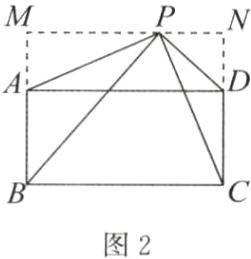
证明:如图1,过点$P$作$MN// AB$,交$AD$于点$M$,交$BC$于点$N$,
$\therefore$四边形$ABNM$和四边形$NCDM$均为矩形.
根据题中的结论,得在矩形$ABNM$中有$PA^2+PN^2=PB^2+PM^2$,
在矩形$NCDM$中有$PC^2+PM^2=PD^2+PN^2$.
两式相加,得$PA^2+PN^2+PC^2+PM^2=PB^2+PM^2+PD^2+PN^2$,
$\therefore PA^2+PC^2=PB^2+PD^2$.
(2)$PA^2+PC^2=PB^2+PD^2$
证明:如图2,过点$P$作$MN// AB$,交$BA$的延长线于点$M$,交$CD$的延长线于点$N$,
$\therefore$四边形$BCNM$和四边形$ADNM$均为矩形,同理可证结论.