

 登录
登录
Ⅳ.单项选择。(5分)
()1. My friend will come to the party. He can play . It's a Chinese instrument(乐器).
A.ping-pong
B.the piano
C.the pipa
()1. My friend will come to the party. He can play . It's a Chinese instrument(乐器).
A.ping-pong
B.the piano
C.the pipa
答案
C
解析
先根据句中关键信息“It's a Chinese instrument(乐器)”判断:A选项ping-pong是乒乓球,属于体育运动,不是乐器,排除;B选项the piano是钢琴,属于西方乐器,不符合要求;C选项the pipa是琵琶,是中国乐器,同时play后接乐器类名词要加定冠词the,符合语法和题意。
()2. —What's your sister like? —She's .
A.clever
B.ten
C.a student
A.clever
B.ten
C.a student
答案
A
解析
句型"What's sb like?"用于询问人物的性格或外貌特征,需要选择描述人物特征的词汇。选项B是年龄表述、选项C是身份表述,都不符合该问句的应答要求,只有A选项clever是描述人物性格的形容词,符合题意。
()3. I often play Chinese chess my grandpa.
A.in
B.for
C.with
A.in
B.for
C.with
答案
C
解析
本题考查介词辨析。A.in表示在……之内;B.for表示为了;C.with表示和……一起。句意为“我经常和我的爷爷下中国象棋”,表达和某人一同做某事要用介词with,因此选C。
()4. — do you like apples?
—Because they are delicious and healthy.
A.Why
B.What
C.How
—Because they are delicious and healthy.
A.Why
B.What
C.How
答案
A
解析
答句用Because引导内容说明原因,英语中针对原因提问要使用疑问词Why,What用于询问事物,How用于询问方式或状态,符合题意的是A选项。
()5. —Do you go to the park at the weekend?
— I often read books there.
A.Yes, I do.
B.No, I don't.
C.No, I can't.
— I often read books there.
A.Yes, I do.
B.No, I don't.
C.No, I can't.
答案
A
解析
本题是助动词Do引导的一般疑问句,问句询问对方周末是否去公园。根据答句后半句“我经常在那里读书”,可知是肯定回答。Do引导的一般疑问句的肯定回答为Yes, I do. 选项C用情态动词can't作答,和问句的助动词搭配不符,选项B为否定回答,和后半句语境矛盾,因此选A。
Ⅴ.用所给单词的适当形式填空。(5分)
1. Mary often (play) the pipa on Saturdays.
2. I can play basketball, but I (can) jump rope.
3. What would you like (drink)?
4. There (be) many trees in the nature park.
5. I like hamburgers. I eat (they) every day.
1. Mary often (play) the pipa on Saturdays.
2. I can play basketball, but I (can) jump rope.
3. What would you like (drink)?
4. There (be) many trees in the nature park.
5. I like hamburgers. I eat (they) every day.
答案
1. plays
2. can't
3. to drink
4. are
5. them
2. can't
3. to drink
4. are
5. them
解析
1. 本题考查一般现在时的主谓一致,主语Mary是第三人称单数,句中频度副词often表示经常性动作,谓语动词要使用第三人称单数形式,play的第三人称单数形式为plays。
2. 本题考查情态动词的否定形式,连词but表示语义转折,前半句意为“我会打篮球”,后半句要表达“但是我不会跳绳”,因此填can的否定形式can't。
3. 本题考查固定搭配,would like后接动词不定式构成固定用法would like to do sth.,表示“想要做某事”,因此填to drink。
4. 本题考查there be句型的用法,句中主语many trees是复数形式,对应的be动词要用are。
5. 本题考查人称代词的宾格,动词eat后面要接人称代词的宾格作宾语,主格they的宾格形式是them。
2. 本题考查情态动词的否定形式,连词but表示语义转折,前半句意为“我会打篮球”,后半句要表达“但是我不会跳绳”,因此填can的否定形式can't。
3. 本题考查固定搭配,would like后接动词不定式构成固定用法would like to do sth.,表示“想要做某事”,因此填to drink。
4. 本题考查there be句型的用法,句中主语many trees是复数形式,对应的be动词要用are。
5. 本题考查人称代词的宾格,动词eat后面要接人称代词的宾格作宾语,主格they的宾格形式是them。
Ⅵ.选择与句子相符的图片。(5分)
()1. You can talk to your parents. A.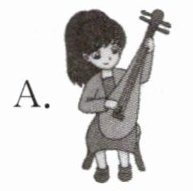
()2. There is a long river in the mountains. B.
()3. I usually have pipa lessons on Sundays.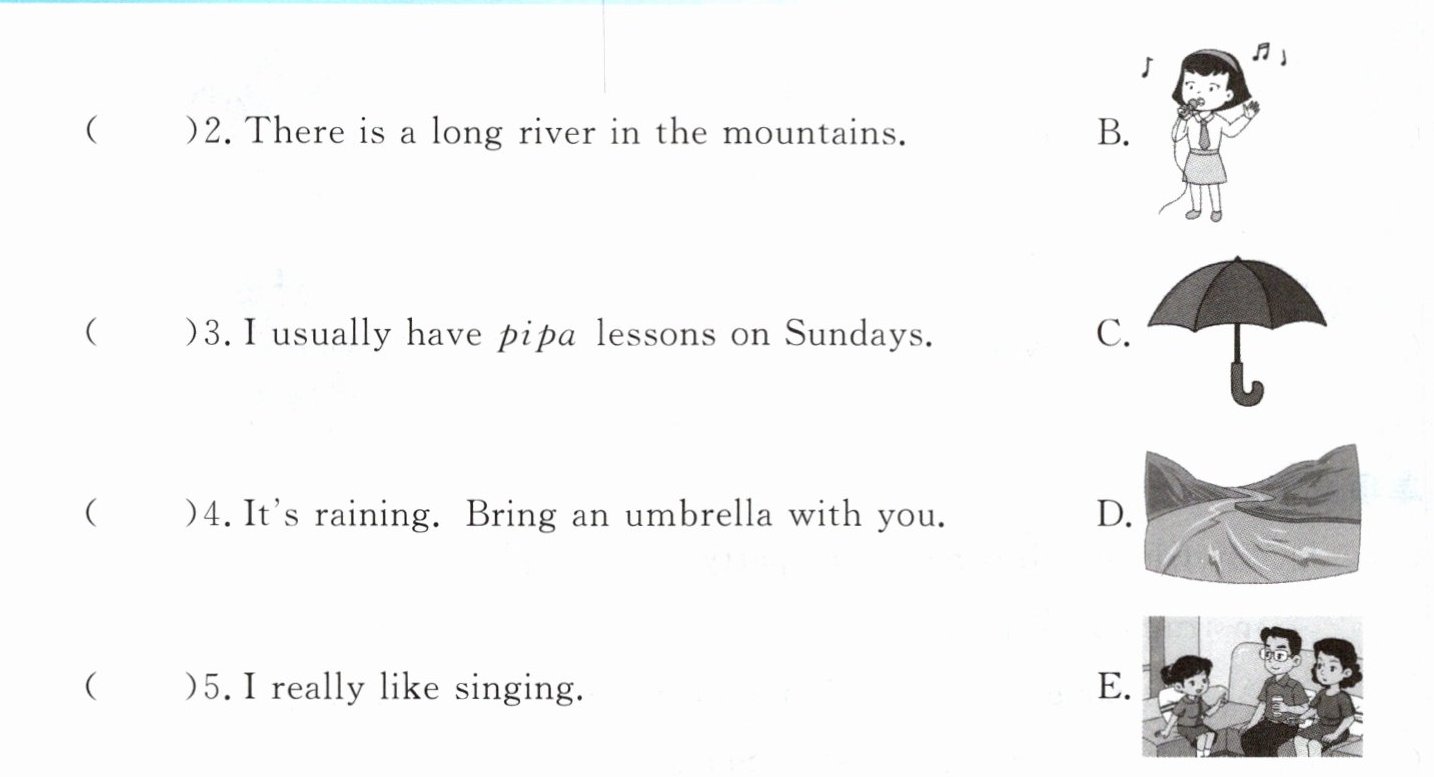
()4. It's raining. Bring an umbrella with you. C.
()5. I really like singing. D.
()1. You can talk to your parents. A.
()2. There is a long river in the mountains. B.
()3. I usually have pipa lessons on Sundays.
()4. It's raining. Bring an umbrella with you. C.
()5. I really like singing. D.
答案
1. E 2. D 3. A 4. C 5. B
解析
我们逐句匹配图片含义:
1. 句子"You can talk to your parents."意为“你可以和你的父母交谈”,图片E呈现了孩子和父母坐在一起交流的场景,二者匹配。
2. 句子"There is a long river in the mountains."意为“山里有一条长河”,图片D呈现了山间的长河景观,二者匹配。
3. 句子"I usually have pipa lessons on Sundays."意为“我通常在周日上琵琶课”,图片A呈现了女孩弹奏琵琶的画面,二者匹配。
4. 句子"It's raining. Bring an umbrella with you."意为“下雨了,随身带一把伞”,图片C是雨伞的图案,二者匹配。
5. 句子"I really like singing."意为“我真的很喜欢唱歌”,图片B呈现了女孩拿着话筒唱歌的画面,二者匹配。
1. 句子"You can talk to your parents."意为“你可以和你的父母交谈”,图片E呈现了孩子和父母坐在一起交流的场景,二者匹配。
2. 句子"There is a long river in the mountains."意为“山里有一条长河”,图片D呈现了山间的长河景观,二者匹配。
3. 句子"I usually have pipa lessons on Sundays."意为“我通常在周日上琵琶课”,图片A呈现了女孩弹奏琵琶的画面,二者匹配。
4. 句子"It's raining. Bring an umbrella with you."意为“下雨了,随身带一把伞”,图片C是雨伞的图案,二者匹配。
5. 句子"I really like singing."意为“我真的很喜欢唱歌”,图片B呈现了女孩拿着话筒唱歌的画面,二者匹配。
