

 登录
登录
Ⅱ. 阅读理解
Memory is the ability to remember things. A good memory can help us do better in school, such as language learning. A few people are born with amazing memories, but most people need to improve their memories by practising. Here are some secrets about memories.
We can still remember things happened in our childhood, but not those last week. In fact, if the things have strong connections with our feelings in our mind, we can remember them longer. When things happen for the first time, children often have strong feelings. Also, parents tell us the interesting or funny stories from our childhood again and again. As a result, we remember them much better.
It's natural for common people to forget the new words which they learnt yesterday. Hermann Ebbinghaus wrote a book called Memory and showed a famous forgetting curve(曲线). According to him, the quickest loss of memory happens during the first two days after learning. That means going over what we've learnt during this time can help us very well to remember the information.
A 15-year-old sometimes forgets things, but that doesn't mean his or her memory is getting worse. Our memory gets the top at the age of 25. At that point, we can remember over 12,000 pieces of information in a minute. But after this age, the brain starts to get smaller. By middle age, our memory is much worse than when we were young.
(
A. By being born with it.
B. By doing nothing.
C. By practising.
D. By watching TV.
(
A. A few people with amazing memories.
B. Most people who need to improve memories.
C. Hermann Ebbinghaus.
D. Some language learners.
(
A.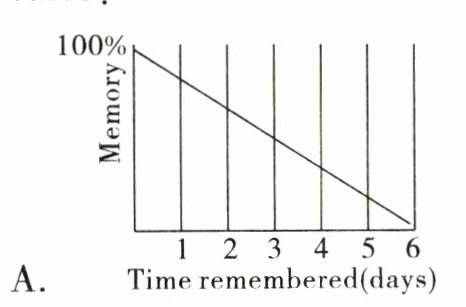
B.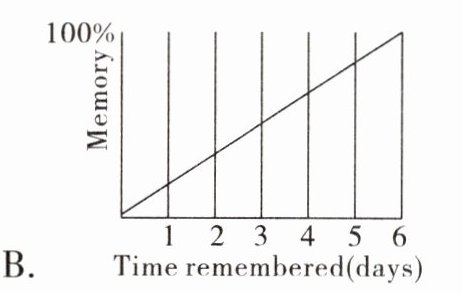
C.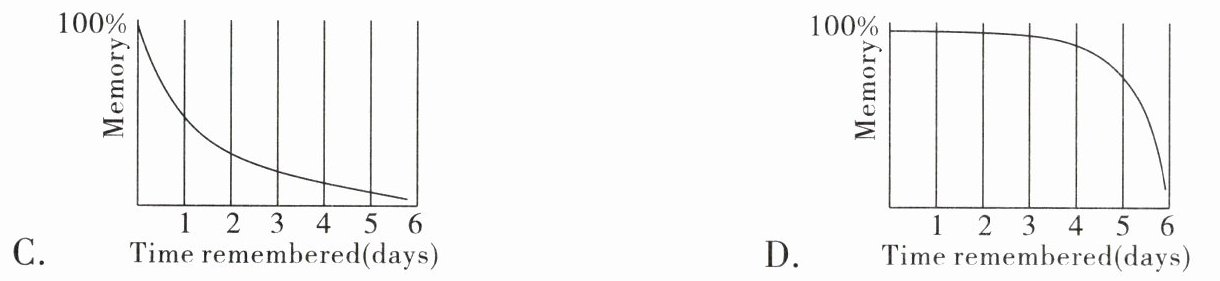 中左侧图
中左侧图
D. 中右侧图
(
A. 15;10,000.
B. 25;over 12,000.
C. Middle age;8,000.
D. 20;around 11,000.
(
A. All people are born with amazing memories.
B. We can remember last week's things better than childhood things.
C. We can't improve our memories by practising.
D. Having strong connections with our feelings can help remember childhood things better.
Memory is the ability to remember things. A good memory can help us do better in school, such as language learning. A few people are born with amazing memories, but most people need to improve their memories by practising. Here are some secrets about memories.
We can still remember things happened in our childhood, but not those last week. In fact, if the things have strong connections with our feelings in our mind, we can remember them longer. When things happen for the first time, children often have strong feelings. Also, parents tell us the interesting or funny stories from our childhood again and again. As a result, we remember them much better.
It's natural for common people to forget the new words which they learnt yesterday. Hermann Ebbinghaus wrote a book called Memory and showed a famous forgetting curve(曲线). According to him, the quickest loss of memory happens during the first two days after learning. That means going over what we've learnt during this time can help us very well to remember the information.
A 15-year-old sometimes forgets things, but that doesn't mean his or her memory is getting worse. Our memory gets the top at the age of 25. At that point, we can remember over 12,000 pieces of information in a minute. But after this age, the brain starts to get smaller. By middle age, our memory is much worse than when we were young.
(
C
)11. How do most people improve their memories?A. By being born with it.
B. By doing nothing.
C. By practising.
D. By watching TV.
(
C
)12. Who wrote the book Memory and put forward a famous forgetting curve?A. A few people with amazing memories.
B. Most people who need to improve memories.
C. Hermann Ebbinghaus.
D. Some language learners.
(
C
)13. [新考法·图示理解] Which is the right picture for Hermann Ebbinghaus's forgetting curve?A.
B.
C.
中左侧图D. 中右侧图
(
B
)14. At what age does our memory reach its peak, and how many pieces of information can we remember in a minute at that age?A. 15;10,000.
B. 25;over 12,000.
C. Middle age;8,000.
D. 20;around 11,000.
(
D
)15. Which of the following is TRUE according to the passage?A. All people are born with amazing memories.
B. We can remember last week's things better than childhood things.
C. We can't improve our memories by practising.
D. Having strong connections with our feelings can help remember childhood things better.
答案
11. C
12. C
13. C
14. B
15. D
12. C
13. C
14. B
15. D
解析
【分析】
这是一篇关于记忆的英语科普阅读理解,解题思路为:先通读全文把握主旨,再针对每道题目,回到原文定位对应信息,将选项与原文内容逐一比对,排除错误选项,选出正确答案。
【解析】
11题:根据原文第一段“but most people need to improve their memories by practising”,可知大多数人通过练习提高记忆力,对应选项C,故选C。
12题:根据原文第三段“Hermann Ebbinghaus wrote a book called Memory and showed a famous forgetting curve”,可知是Hermann Ebbinghaus写了这本书并提出遗忘曲线,对应选项C,故选C。
13题:遗忘曲线的特点是学习后最初两天遗忘速度最快,之后逐渐减慢,选项C的左侧图符合该曲线特征,故选C。
14题:根据原文第四段“Our memory gets the top at the age of 25. At that point, we can remember over 12,000 pieces of information in a minute”,可知25岁时记忆达到顶峰,每分钟能记住超过12000条信息,对应选项B,故选B。
15题:逐一分析选项:A项与原文“A few people are born with amazing memories”不符;B项与原文“We can still remember things happened in our childhood, but not those last week”不符;C项与原文“most people need to improve their memories by practising”不符;D项与原文“if the things have strong connections with our feelings in our mind, we can remember them longer”相符,故选D。
【答案】
11.C 12.C 13.C 14.B 15.D
【知识点】
英语阅读理解,细节理解题,科普类阅读
【点评】
本题为科普类英语阅读理解,主要考查学生快速定位原文细节、比对信息的能力,题型以细节理解为主,整体难度适中,需学生仔细阅读原文,准确抓取关键信息。
【难度系数】
0.6
这是一篇关于记忆的英语科普阅读理解,解题思路为:先通读全文把握主旨,再针对每道题目,回到原文定位对应信息,将选项与原文内容逐一比对,排除错误选项,选出正确答案。
【解析】
11题:根据原文第一段“but most people need to improve their memories by practising”,可知大多数人通过练习提高记忆力,对应选项C,故选C。
12题:根据原文第三段“Hermann Ebbinghaus wrote a book called Memory and showed a famous forgetting curve”,可知是Hermann Ebbinghaus写了这本书并提出遗忘曲线,对应选项C,故选C。
13题:遗忘曲线的特点是学习后最初两天遗忘速度最快,之后逐渐减慢,选项C的左侧图符合该曲线特征,故选C。
14题:根据原文第四段“Our memory gets the top at the age of 25. At that point, we can remember over 12,000 pieces of information in a minute”,可知25岁时记忆达到顶峰,每分钟能记住超过12000条信息,对应选项B,故选B。
15题:逐一分析选项:A项与原文“A few people are born with amazing memories”不符;B项与原文“We can still remember things happened in our childhood, but not those last week”不符;C项与原文“most people need to improve their memories by practising”不符;D项与原文“if the things have strong connections with our feelings in our mind, we can remember them longer”相符,故选D。
【答案】
11.C 12.C 13.C 14.B 15.D
【知识点】
英语阅读理解,细节理解题,科普类阅读
【点评】
本题为科普类英语阅读理解,主要考查学生快速定位原文细节、比对信息的能力,题型以细节理解为主,整体难度适中,需学生仔细阅读原文,准确抓取关键信息。
【难度系数】
0.6
