

 登录
登录
6. 如图,在$□ ABCD$中,$∠ BCD$的平分线与$BA$的延长线相交于点$E$,$BH⊥ EC$,垂足为$H$。
(1) 求证:$CH = EH$。
(2) 若$AD = 5$,$CD = 3$,求$AE$的长。
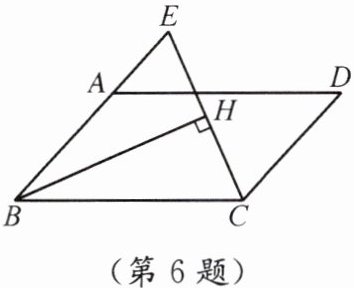
(1) 求证:$CH = EH$。
(2) 若$AD = 5$,$CD = 3$,求$AE$的长。
答案
(1)见证明;(2)2。
解析
(1)证明:
∵四边形ABCD是平行四边形,
∴AB//CD,
∴∠E=∠DCE(两直线平行,内错角相等)。
∵CE平分∠BCD,
∴∠BCE=∠DCE,
∴∠E=∠BCE,
∴BE=BC(等角对等边)。
∵BH⊥EC,
∴CH=EH(等腰三角形三线合一)。
(2)解:
∵四边形ABCD是平行四边形,
∴BC=AD=5,AB=CD=3。
由(1)知BE=BC=5,
∵E在BA延长线上,
∴BE=AB+AE,
∴AE=BE-AB=5-3=2。
∵四边形ABCD是平行四边形,
∴AB//CD,
∴∠E=∠DCE(两直线平行,内错角相等)。
∵CE平分∠BCD,
∴∠BCE=∠DCE,
∴∠E=∠BCE,
∴BE=BC(等角对等边)。
∵BH⊥EC,
∴CH=EH(等腰三角形三线合一)。
(2)解:
∵四边形ABCD是平行四边形,
∴BC=AD=5,AB=CD=3。
由(1)知BE=BC=5,
∵E在BA延长线上,
∴BE=AB+AE,
∴AE=BE-AB=5-3=2。
7. 如图,在$□ ABCD$中,$P$是$CD$上一点,且$AP$和$BP$分别平分$∠ DAB$和$∠ CBA$。
(1) 求$∠ APB$的度数;
(2) 如果$AD = 2.5$,$AP = 4$,求$△ APB$的面积。
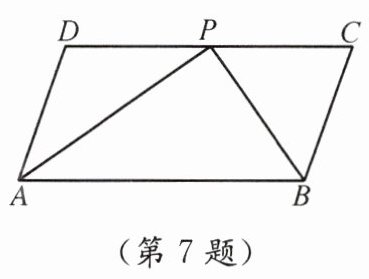
(1) 求$∠ APB$的度数;
(2) 如果$AD = 2.5$,$AP = 4$,求$△ APB$的面积。
答案
(1) 在$□ABCD$中,$AD// BC$,$\therefore∠ DAB+∠ CBA=180°$。
$\because AP$平分$∠ DAB$,$BP$平分$∠ CBA$,
$\therefore∠ PAB=\frac{1}{2}∠ DAB$,$∠ PBA=\frac{1}{2}∠ CBA$。
$\therefore∠ PAB+∠ PBA=\frac{1}{2}(∠ DAB+∠ CBA)=\frac{1}{2}×180°=90°$。
在$△ APB$中,$∠ APB=180°-(∠ PAB+∠ PBA)=180°-90°=90°$。
(2) $\because$四边形$ABCD$是平行四边形,$\therefore AD=BC=2.5$,$AB=CD$,$AB// CD$。
$\because AP$平分$∠ DAB$,$\therefore∠ DAP=∠ PAB$。
$\because AB// CD$,$\therefore∠ PAB=∠ DPA$,$\therefore∠ DAP=∠ DPA$,$\therefore DP=AD=2.5$。
同理,$BP$平分$∠ CBA$,$∠ CBP=∠ PBA$,$\because AB// CD$,$∠ PBA=∠ CPB$,$\therefore∠ CBP=∠ CPB$,$\therefore CP=BC=2.5$。
$\therefore CD=DP+CP=2.5+2.5=5$,$\therefore AB=CD=5$。
在$Rt△ APB$中,$AB=5$,$AP=4$,由勾股定理得$BP=\sqrt{AB^2-AP^2}=\sqrt{5^2-4^2}=3$。
$\therefore S_{△ APB}=\frac{1}{2}× AP× BP=\frac{1}{2}×4×3=6$。
(1) $90°$;(2) $6$。
$\because AP$平分$∠ DAB$,$BP$平分$∠ CBA$,
$\therefore∠ PAB=\frac{1}{2}∠ DAB$,$∠ PBA=\frac{1}{2}∠ CBA$。
$\therefore∠ PAB+∠ PBA=\frac{1}{2}(∠ DAB+∠ CBA)=\frac{1}{2}×180°=90°$。
在$△ APB$中,$∠ APB=180°-(∠ PAB+∠ PBA)=180°-90°=90°$。
(2) $\because$四边形$ABCD$是平行四边形,$\therefore AD=BC=2.5$,$AB=CD$,$AB// CD$。
$\because AP$平分$∠ DAB$,$\therefore∠ DAP=∠ PAB$。
$\because AB// CD$,$\therefore∠ PAB=∠ DPA$,$\therefore∠ DAP=∠ DPA$,$\therefore DP=AD=2.5$。
同理,$BP$平分$∠ CBA$,$∠ CBP=∠ PBA$,$\because AB// CD$,$∠ PBA=∠ CPB$,$\therefore∠ CBP=∠ CPB$,$\therefore CP=BC=2.5$。
$\therefore CD=DP+CP=2.5+2.5=5$,$\therefore AB=CD=5$。
在$Rt△ APB$中,$AB=5$,$AP=4$,由勾股定理得$BP=\sqrt{AB^2-AP^2}=\sqrt{5^2-4^2}=3$。
$\therefore S_{△ APB}=\frac{1}{2}× AP× BP=\frac{1}{2}×4×3=6$。
(1) $90°$;(2) $6$。
8. 如图,在$□ ABCD$中,点$E$,$F$分别在边$AB$,$CD$上。
(1) 已知$DE// BF$,求证:$CF = AE$。
(2) 若将第(1)题中的条件“$DE// BF$”改为“$AE = CF$”,则$DE$与$BF$有怎样的位置关系和数量关系?证明你的结论。
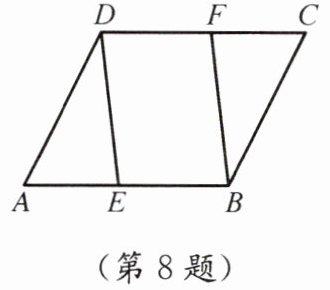
(1) 已知$DE// BF$,求证:$CF = AE$。
(2) 若将第(1)题中的条件“$DE// BF$”改为“$AE = CF$”,则$DE$与$BF$有怎样的位置关系和数量关系?证明你的结论。
答案
(1)
证明:
$\because$四边形$ABCD$是平行四边形,
$\therefore AB// CD$,且$AB = CD$,
$\because DE// BF$,
$\therefore$四边形$DEBF$是平行四边形,
$\therefore DF = BE$,
$\because AB - BE = CD - DF$,
$\therefore AE = CF$。
(2)
$DE// BF$,$DE = BF$。
证明:
$\because$四边形$ABCD$是平行四边形,
$\therefore AB// CD$,$AB = CD$,
$\because AE = CF$,
$\therefore AB - AE = CD - CF$,
即$BE = DF$,
$\because BE// DF$,
$\therefore$四边形$DEBF$是平行四边形,
$\therefore DE// BF$,$DE = BF$。
证明:
$\because$四边形$ABCD$是平行四边形,
$\therefore AB// CD$,且$AB = CD$,
$\because DE// BF$,
$\therefore$四边形$DEBF$是平行四边形,
$\therefore DF = BE$,
$\because AB - BE = CD - DF$,
$\therefore AE = CF$。
(2)
$DE// BF$,$DE = BF$。
证明:
$\because$四边形$ABCD$是平行四边形,
$\therefore AB// CD$,$AB = CD$,
$\because AE = CF$,
$\therefore AB - AE = CD - CF$,
即$BE = DF$,
$\because BE// DF$,
$\therefore$四边形$DEBF$是平行四边形,
$\therefore DE// BF$,$DE = BF$。
