

 登录
登录
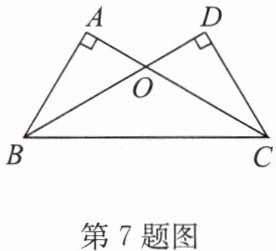
7.如图,已知∠A=∠D=90°,AC=DB,AC,DB相交于点O.
(1)求证:OB=OC;
(2)若取BC的中点E,试判断OE与BC的位置关系并说明理由.
(1)求证:OB=OC;
(2)若取BC的中点E,试判断OE与BC的位置关系并说明理由.
答案
7.(1)证明:在$\mathrm{Rt}△ABC$和$\mathrm{Rt}△DCB$中,$\begin{cases} AC=DB,\\ BC=CB, \end{cases}$
$\therefore \mathrm{Rt}△ABC≌\mathrm{Rt}△DCB(\mathrm{HL}),\therefore ∠ACB=∠DBC,$
$\therefore OB=OC.$
(2)解:$OE⊥BC$于点E.理由如下:
由(1)中结论可得$OB=OC$.
又$\because BE=CE,OE=OE,$
$\therefore △OBE≌△OCE(\mathrm{SSS}),\therefore ∠OEB=∠OEC.$
$\because ∠OEB+∠OEC=180°,$
$\therefore ∠OEB=∠OEC=90°,\therefore OE⊥BC.$
$\therefore \mathrm{Rt}△ABC≌\mathrm{Rt}△DCB(\mathrm{HL}),\therefore ∠ACB=∠DBC,$
$\therefore OB=OC.$
(2)解:$OE⊥BC$于点E.理由如下:
由(1)中结论可得$OB=OC$.
又$\because BE=CE,OE=OE,$
$\therefore △OBE≌△OCE(\mathrm{SSS}),\therefore ∠OEB=∠OEC.$
$\because ∠OEB+∠OEC=180°,$
$\therefore ∠OEB=∠OEC=90°,\therefore OE⊥BC.$
解析
【分析】
(1) 要证OB=OC,根据等角对等边的性质,可先证明∠ACB=∠DBC。已知∠A=∠D=90°,△ABC和△DCB都是直角三角形,题中给出AC=DB,且BC是两个三角形的公共斜边,可通过HL定理证明两个直角三角形全等,得到对应角∠ACB=∠DBC,进而推出OB=OC。
(2) 判断OE与BC的位置关系,由(1)已得OB=OC,可知△OBC为等腰三角形,E是BC中点,可通过SSS证明△OBE≌△OCE,得到∠OEB=∠OEC,结合两个角的和为平角180°,可推出两个角均为90°,即可得到OE与BC垂直的关系。
【解析】
(1) 证明: 在$\mathrm{Rt}△ABC$和$\mathrm{Rt}△DCB$中,
$\begin{cases} AC=DB,\\ BC=CB, \end{cases}$
$\therefore \mathrm{Rt}△ABC≌\mathrm{Rt}△DCB(\mathrm{HL}),$
$\therefore ∠ACB=∠DBC,$
$\therefore OB=OC.$
(2) 解:$OE⊥BC$。理由如下:
由(1)中结论可得$OB=OC$.
又$\because BE=CE,OE=OE,$
$\therefore △OBE≌△OCE(\mathrm{SSS}),$
$\therefore ∠OEB=∠OEC.$
$\because ∠OEB+∠OEC=180°,$
$\therefore ∠OEB=∠OEC=90°,$
$\therefore OE⊥BC.$
【答案】
(1) 证明: 在$\mathrm{Rt}△ABC$和$\mathrm{Rt}△DCB$中,$\begin{cases} AC=DB,\\ BC=CB, \end{cases}$
$\therefore \mathrm{Rt}△ABC≌\mathrm{Rt}△DCB(\mathrm{HL}),\therefore ∠ACB=∠DBC,$
$\therefore OB=OC.$
(2) $OE⊥BC$于点E。理由如下:
由(1)中结论可得$OB=OC$.
又$\because BE=CE,OE=OE,$
$\therefore △OBE≌△OCE(\mathrm{SSS}),\therefore ∠OEB=∠OEC.$
$\because ∠OEB+∠OEC=180°,$
$\therefore ∠OEB=∠OEC=90°,\therefore OE⊥BC.$
【知识点】
1. HL判定全等
2. 全等三角形性质
3. 等腰三角形性质
【点评】
本题属于基础几何证明题,考查了直角三角形全等的判定、全等三角形的性质以及等腰三角形的相关性质,解题时需结合已知条件和图形特征,选择合适的判定定理逐步推导边、角关系即可求解,有助于巩固全等三角形和等腰三角形的相关基础知识点。
【难度系数】
0.8
(1) 要证OB=OC,根据等角对等边的性质,可先证明∠ACB=∠DBC。已知∠A=∠D=90°,△ABC和△DCB都是直角三角形,题中给出AC=DB,且BC是两个三角形的公共斜边,可通过HL定理证明两个直角三角形全等,得到对应角∠ACB=∠DBC,进而推出OB=OC。
(2) 判断OE与BC的位置关系,由(1)已得OB=OC,可知△OBC为等腰三角形,E是BC中点,可通过SSS证明△OBE≌△OCE,得到∠OEB=∠OEC,结合两个角的和为平角180°,可推出两个角均为90°,即可得到OE与BC垂直的关系。
【解析】
(1) 证明: 在$\mathrm{Rt}△ABC$和$\mathrm{Rt}△DCB$中,
$\begin{cases} AC=DB,\\ BC=CB, \end{cases}$
$\therefore \mathrm{Rt}△ABC≌\mathrm{Rt}△DCB(\mathrm{HL}),$
$\therefore ∠ACB=∠DBC,$
$\therefore OB=OC.$
(2) 解:$OE⊥BC$。理由如下:
由(1)中结论可得$OB=OC$.
又$\because BE=CE,OE=OE,$
$\therefore △OBE≌△OCE(\mathrm{SSS}),$
$\therefore ∠OEB=∠OEC.$
$\because ∠OEB+∠OEC=180°,$
$\therefore ∠OEB=∠OEC=90°,$
$\therefore OE⊥BC.$
【答案】
(1) 证明: 在$\mathrm{Rt}△ABC$和$\mathrm{Rt}△DCB$中,$\begin{cases} AC=DB,\\ BC=CB, \end{cases}$
$\therefore \mathrm{Rt}△ABC≌\mathrm{Rt}△DCB(\mathrm{HL}),\therefore ∠ACB=∠DBC,$
$\therefore OB=OC.$
(2) $OE⊥BC$于点E。理由如下:
由(1)中结论可得$OB=OC$.
又$\because BE=CE,OE=OE,$
$\therefore △OBE≌△OCE(\mathrm{SSS}),\therefore ∠OEB=∠OEC.$
$\because ∠OEB+∠OEC=180°,$
$\therefore ∠OEB=∠OEC=90°,\therefore OE⊥BC.$
【知识点】
1. HL判定全等
2. 全等三角形性质
3. 等腰三角形性质
【点评】
本题属于基础几何证明题,考查了直角三角形全等的判定、全等三角形的性质以及等腰三角形的相关性质,解题时需结合已知条件和图形特征,选择合适的判定定理逐步推导边、角关系即可求解,有助于巩固全等三角形和等腰三角形的相关基础知识点。
【难度系数】
0.8
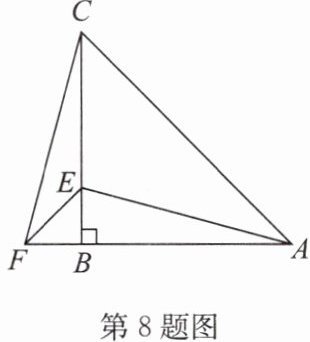
8.(姑苏区期末)如图,在△ABC中,AB=BC,∠ABC=90°,F为AB的延长线上一点,点E在BC上,且AE=CF.
(1)求证:Rt△ABE≅Rt△CBF;
(2)若∠CAE=30°,求∠ACF的度数.
(1)求证:Rt△ABE≅Rt△CBF;
(2)若∠CAE=30°,求∠ACF的度数.
答案
8.(1)证明:$\because ∠ABC=90°,\therefore ∠CBF=∠ABE=90°.$
在$\mathrm{Rt}△ABE$和$\mathrm{Rt}△CBF$中,$\begin{cases} AE=CF,\\ AB=CB, \end{cases}$
$\therefore \mathrm{Rt}△ABE≌\mathrm{Rt}△CBF(\mathrm{HL}).$
(2)解:$\because ∠ABC=90°,AB=BC,\therefore ∠BAC=∠ACB=45°.$
$\because ∠CAE=30°,\therefore ∠BAE=∠CAB-∠CAE=15°.$
由(1)知$\mathrm{Rt}△ABE≌\mathrm{Rt}△CBF$,
$\therefore ∠BCF=∠BAE=15°,$
$\therefore ∠ACF=∠BCF+∠ACB=15°+45°=60°.$
在$\mathrm{Rt}△ABE$和$\mathrm{Rt}△CBF$中,$\begin{cases} AE=CF,\\ AB=CB, \end{cases}$
$\therefore \mathrm{Rt}△ABE≌\mathrm{Rt}△CBF(\mathrm{HL}).$
(2)解:$\because ∠ABC=90°,AB=BC,\therefore ∠BAC=∠ACB=45°.$
$\because ∠CAE=30°,\therefore ∠BAE=∠CAB-∠CAE=15°.$
由(1)知$\mathrm{Rt}△ABE≌\mathrm{Rt}△CBF$,
$\therefore ∠BCF=∠BAE=15°,$
$\therefore ∠ACF=∠BCF+∠ACB=15°+45°=60°.$
解析
【分析】
(1) 要证明两个直角三角形全等,首先确认$\mathrm{Rt}△ABE$和$\mathrm{Rt}△CBF$都是直角三角形,题目已经给出斜边$AE=CF$、直角边$AB=CB$,刚好符合直角三角形全等的HL判定条件,按要求整理条件即可证明全等。
(2) 求$∠ ACF$的度数,首先根据$AB=BC$、$∠ ABC=90°$判断$△ ABC$是等腰直角三角形,可得底角为$45°$,结合$∠ CAE=30°$先算出$∠ BAE$的度数,再利用第一问全等的结论得到对应角$∠ BCF=∠ BAE$,最后用$∠ ACB$加$∠ BCF$即可求出$∠ ACF$的度数。
【解析】
(1) 证明:$\because ∠ABC=90°,\therefore ∠CBF=∠ABE=90°.$
在$\mathrm{Rt}△ABE$和$\mathrm{Rt}△CBF$中,$\begin{cases} AE=CF,\\ AB=CB, \end{cases}$
$\therefore \mathrm{Rt}△ABE≌\mathrm{Rt}△CBF(\mathrm{HL}).$
(2) 解:$\because ∠ABC=90°,AB=BC,\therefore ∠BAC=∠ACB=45°.$
$\because ∠CAE=30°,\therefore ∠BAE=∠CAB-∠CAE=45°-30°=15°.$
由(1)知$\mathrm{Rt}△ABE≌\mathrm{Rt}△CBF$,
$\therefore ∠BCF=∠BAE=15°,$
$\therefore ∠ACF=∠BCF+∠ACB=15°+45°=60°.$
【答案】
(1) 已证$\mathrm{Rt}△ABE≅\mathrm{Rt}△CBF$;
(2) $\boxed{60°}$
【知识点】
直角三角形全等判定,等腰直角三角形性质,全等三角形性质
【点评】
本题属于基础几何综合题,考查了直角三角形全等的判定、全等三角形的性质以及等腰直角三角形的角度计算,解题核心是熟练掌握HL判定定理,结合角度的和差关系推导所求角度。
【难度系数】
0.8
(1) 要证明两个直角三角形全等,首先确认$\mathrm{Rt}△ABE$和$\mathrm{Rt}△CBF$都是直角三角形,题目已经给出斜边$AE=CF$、直角边$AB=CB$,刚好符合直角三角形全等的HL判定条件,按要求整理条件即可证明全等。
(2) 求$∠ ACF$的度数,首先根据$AB=BC$、$∠ ABC=90°$判断$△ ABC$是等腰直角三角形,可得底角为$45°$,结合$∠ CAE=30°$先算出$∠ BAE$的度数,再利用第一问全等的结论得到对应角$∠ BCF=∠ BAE$,最后用$∠ ACB$加$∠ BCF$即可求出$∠ ACF$的度数。
【解析】
(1) 证明:$\because ∠ABC=90°,\therefore ∠CBF=∠ABE=90°.$
在$\mathrm{Rt}△ABE$和$\mathrm{Rt}△CBF$中,$\begin{cases} AE=CF,\\ AB=CB, \end{cases}$
$\therefore \mathrm{Rt}△ABE≌\mathrm{Rt}△CBF(\mathrm{HL}).$
(2) 解:$\because ∠ABC=90°,AB=BC,\therefore ∠BAC=∠ACB=45°.$
$\because ∠CAE=30°,\therefore ∠BAE=∠CAB-∠CAE=45°-30°=15°.$
由(1)知$\mathrm{Rt}△ABE≌\mathrm{Rt}△CBF$,
$\therefore ∠BCF=∠BAE=15°,$
$\therefore ∠ACF=∠BCF+∠ACB=15°+45°=60°.$
【答案】
(1) 已证$\mathrm{Rt}△ABE≅\mathrm{Rt}△CBF$;
(2) $\boxed{60°}$
【知识点】
直角三角形全等判定,等腰直角三角形性质,全等三角形性质
【点评】
本题属于基础几何综合题,考查了直角三角形全等的判定、全等三角形的性质以及等腰直角三角形的角度计算,解题核心是熟练掌握HL判定定理,结合角度的和差关系推导所求角度。
【难度系数】
0.8
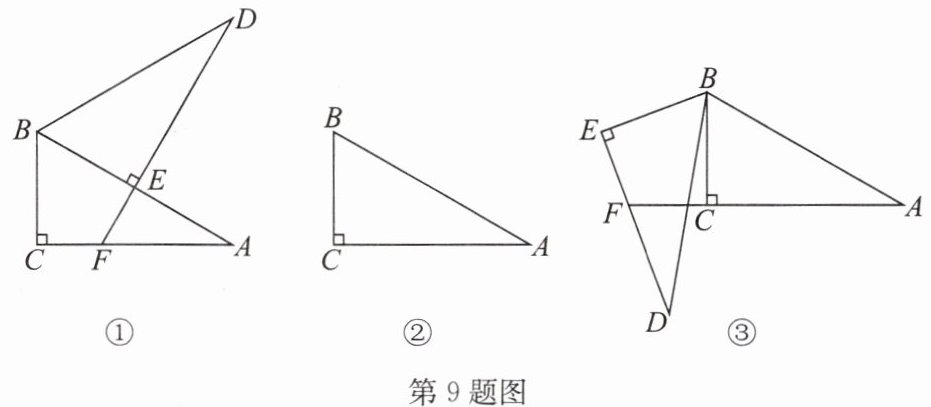
9. 将两个全等的$\mathrm{Rt}△ ABC$和$\mathrm{Rt}△ DBE$按如图①的方式摆放,其中$∠ ACB=∠ DEB=90°$,$∠ A=∠ D=30°$,点$E$落在$AB$上,$DE$所在直线交$AC$所在直线于点$F$.
(1)求证:$AF+EF=DE$.
(2)若将图①中的$△ DBE$绕点$B$按顺时针方向旋转角$α$,且$0°<α<60°$,其他条件不变,请在图②中画出变换后的图形,并直接写出(1)中的结论是否仍然成立.
(3)若将图①中的$△ DBE$绕点$B$按顺时针方向旋转角$β$,且$60°<β<180°$,其他条件不变,如图③.你认为(1)中的结论还成立吗?若成立,写出证明过程;若不成立,请写出此时$AF,EF$与$DE$之间的数量关系,并说明理由.
(1)求证:$AF+EF=DE$.
(2)若将图①中的$△ DBE$绕点$B$按顺时针方向旋转角$α$,且$0°<α<60°$,其他条件不变,请在图②中画出变换后的图形,并直接写出(1)中的结论是否仍然成立.
(3)若将图①中的$△ DBE$绕点$B$按顺时针方向旋转角$β$,且$60°<β<180°$,其他条件不变,如图③.你认为(1)中的结论还成立吗?若成立,写出证明过程;若不成立,请写出此时$AF,EF$与$DE$之间的数量关系,并说明理由.
答案
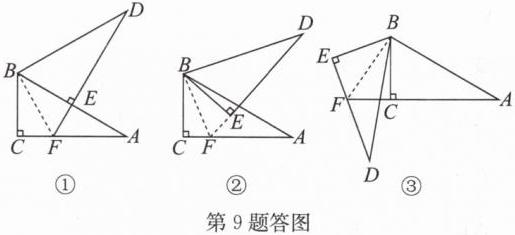
9.(1)证明:如答图①,连接$BF$.
$\because △ABC≌△DBE,\therefore BC=BE,AC=DE.$
在$\mathrm{Rt}△BCF$和$\mathrm{Rt}△BEF$中,$\begin{cases} BC=BE,\\ BF=BF, \end{cases}$
$\therefore \mathrm{Rt}△BCF≌\mathrm{Rt}△BEF(\mathrm{HL}),\therefore EF=CF,$
$\therefore AF+EF=AF+CF=AC=DE.$
(2)解:(1)中的结论仍然成立.理由如下:
如答图②,延长$DE$交$AC$于点$F$,连接$BF$.
$\because △ABC≌△DBE,\therefore BC=BE,AC=DE.$
在$\mathrm{Rt}△BCF$和$\mathrm{Rt}△BEF$中,$\begin{cases} BC=BE,\\ BF=BF, \end{cases}$
$\therefore \mathrm{Rt}△BCF≌\mathrm{Rt}△BEF(\mathrm{HL}),\therefore EF=CF,$
$\therefore AF+EF=AF+CF=AC=DE.$
(3)解:(1)中的结论不成立,$AF-EF=DE$.理由如下:
如答图③,连接$BF$.
$\because △ABC≌△DBE,\therefore BC=BE,AC=DE.$
在$\mathrm{Rt}△BCF$和$\mathrm{Rt}△BEF$中,$\begin{cases} BC=BE,\\ BF=BF, \end{cases}$
$\therefore \mathrm{Rt}△BCF≌\mathrm{Rt}△BEF(\mathrm{HL}),\therefore CF=EF.$
$\because AF-FC=AC=DE,\therefore AF-EF=DE.$
 第9题答图
第9题答图解析
【分析】
本题是三角形全等与旋转结合的探究类题目,解题思路如下:
(1) 要证明$AF+EF=DE$,首先根据两个三角形全等可得$AC=DE$,因此只需证明$AF+EF=AC$即可。观察图形,$AC=AF+CF$,因此只要证明$EF=CF$就可推出结论,连接公共边$BF$,利用HL证明$\mathrm{Rt}△BCF$和$\mathrm{Rt}△BEF$全等即可得到$EF=CF$,完成推导。
(2) 旋转角$0°<α<60°$时,图形位置发生变化,但$BC=BE$、$∠ACB=∠DEB=90°$的条件不变,仍然可以通过连接$BF$,用HL证明两个直角三角形全等得到$EF=CF$,因此(1)的结论仍然成立。
(3) 旋转角$60°<β<180°$时,点$F$位于$AC$的延长线上,此时$AC=AF-CF$,同样通过HL证全等得$CF=EF$,因此原来的和的关系变为差的关系,即$AF-EF=DE$。
【解析】
(1) 证明:如答图①,连接$BF$。
$\because △ABC≌△DBE,\therefore BC=BE,AC=DE.$
在$\mathrm{Rt}△BCF$和$\mathrm{Rt}△BEF$中,$\begin{cases} BC=BE,\\ BF=BF, \end{cases}$
$\therefore \mathrm{Rt}△BCF≌\mathrm{Rt}△BEF(\mathrm{HL}),\therefore EF=CF,$
$\therefore AF+EF=AF+CF=AC=DE.$
(2) 变换后的图形如答图②所示,(1)中的结论仍然成立。
证明:延长$DE$交$AC$于点$F$,连接$BF$。
$\because △ABC≌△DBE,\therefore BC=BE,AC=DE.$
在$\mathrm{Rt}△BCF$和$\mathrm{Rt}△BEF$中,$\begin{cases} BC=BE,\\ BF=BF, \end{cases}$
$\therefore \mathrm{Rt}△BCF≌\mathrm{Rt}△BEF(\mathrm{HL}),\therefore EF=CF,$
$\therefore AF+EF=AF+CF=AC=DE$,故结论仍成立。
(3) (1)中的结论不成立,此时$AF,EF$与$DE$的数量关系为$AF-EF=DE$。
理由:如答图③,连接$BF$。
$\because △ABC≌△DBE,\therefore BC=BE,AC=DE.$
在$\mathrm{Rt}△BCF$和$\mathrm{Rt}△BEF$中,$\begin{cases} BC=BE,\\ BF=BF, \end{cases}$
$\therefore \mathrm{Rt}△BCF≌\mathrm{Rt}△BEF(\mathrm{HL}),\therefore CF=EF.$
$\because AF-FC=AC=DE,\therefore AF-EF=DE.$
【答案】
(1) 证明见解析;
(2) 图形见答图②,(1)中结论仍然成立;
(3) (1)中结论不成立,数量关系为$\boldsymbol{AF-EF=DE}$,理由见解析。
第9题答图
【知识点】
直角三角形全等的判定;全等三角形的性质;旋转的性质
【点评】
本题属于几何动态探究题,围绕旋转过程中不变的边、角关系展开,核心是利用HL判定直角三角形全等,实现线段的等量转化,解题时需注意不同旋转角度下线段的位置变化,分类讨论线段和差的关系。
【难度系数】
0.6
本题是三角形全等与旋转结合的探究类题目,解题思路如下:
(1) 要证明$AF+EF=DE$,首先根据两个三角形全等可得$AC=DE$,因此只需证明$AF+EF=AC$即可。观察图形,$AC=AF+CF$,因此只要证明$EF=CF$就可推出结论,连接公共边$BF$,利用HL证明$\mathrm{Rt}△BCF$和$\mathrm{Rt}△BEF$全等即可得到$EF=CF$,完成推导。
(2) 旋转角$0°<α<60°$时,图形位置发生变化,但$BC=BE$、$∠ACB=∠DEB=90°$的条件不变,仍然可以通过连接$BF$,用HL证明两个直角三角形全等得到$EF=CF$,因此(1)的结论仍然成立。
(3) 旋转角$60°<β<180°$时,点$F$位于$AC$的延长线上,此时$AC=AF-CF$,同样通过HL证全等得$CF=EF$,因此原来的和的关系变为差的关系,即$AF-EF=DE$。
【解析】
(1) 证明:如答图①,连接$BF$。
$\because △ABC≌△DBE,\therefore BC=BE,AC=DE.$
在$\mathrm{Rt}△BCF$和$\mathrm{Rt}△BEF$中,$\begin{cases} BC=BE,\\ BF=BF, \end{cases}$
$\therefore \mathrm{Rt}△BCF≌\mathrm{Rt}△BEF(\mathrm{HL}),\therefore EF=CF,$
$\therefore AF+EF=AF+CF=AC=DE.$
(2) 变换后的图形如答图②所示,(1)中的结论仍然成立。
证明:延长$DE$交$AC$于点$F$,连接$BF$。
$\because △ABC≌△DBE,\therefore BC=BE,AC=DE.$
在$\mathrm{Rt}△BCF$和$\mathrm{Rt}△BEF$中,$\begin{cases} BC=BE,\\ BF=BF, \end{cases}$
$\therefore \mathrm{Rt}△BCF≌\mathrm{Rt}△BEF(\mathrm{HL}),\therefore EF=CF,$
$\therefore AF+EF=AF+CF=AC=DE$,故结论仍成立。
(3) (1)中的结论不成立,此时$AF,EF$与$DE$的数量关系为$AF-EF=DE$。
理由:如答图③,连接$BF$。
$\because △ABC≌△DBE,\therefore BC=BE,AC=DE.$
在$\mathrm{Rt}△BCF$和$\mathrm{Rt}△BEF$中,$\begin{cases} BC=BE,\\ BF=BF, \end{cases}$
$\therefore \mathrm{Rt}△BCF≌\mathrm{Rt}△BEF(\mathrm{HL}),\therefore CF=EF.$
$\because AF-FC=AC=DE,\therefore AF-EF=DE.$
【答案】
(1) 证明见解析;
(2) 图形见答图②,(1)中结论仍然成立;
(3) (1)中结论不成立,数量关系为$\boldsymbol{AF-EF=DE}$,理由见解析。
第9题答图【知识点】
直角三角形全等的判定;全等三角形的性质;旋转的性质
【点评】
本题属于几何动态探究题,围绕旋转过程中不变的边、角关系展开,核心是利用HL判定直角三角形全等,实现线段的等量转化,解题时需注意不同旋转角度下线段的位置变化,分类讨论线段和差的关系。
【难度系数】
0.6
