

 登录
登录
六、Lucy 想要养成整理书桌的好习惯。请帮她将下列如何养成习惯的句子按照正确的顺序排列。

A.Put your books and pens back in their places every evening.
B.Decide that you want to keep your desk tidy.
C.After one month, it will become a habit automatically.
D.Start with a small goal: tidy your desk for 3 minutes each day.
A.Put your books and pens back in their places every evening.
B.Decide that you want to keep your desk tidy.
C.After one month, it will become a habit automatically.
D.Start with a small goal: tidy your desk for 3 minutes each day.
答案
B D A C
句子排序题的解题方法
对于句子排序题,先通读所有句子,找逻辑线索——时间顺序词(First、Then、Finally)、因果关系词(because、so)、代词指代(上句出现人名/事物,下句用he/she/it/they指代)以及问句和答句的对应关系。将明显是开头或结尾的句子先确定,再依次连接中间部分,最后通读检查是否通顺。无论是哪种排序,核心都是"先抓主干,再理逻辑,最后校对标点"。
句子排序题的解题方法
对于句子排序题,先通读所有句子,找逻辑线索——时间顺序词(First、Then、Finally)、因果关系词(because、so)、代词指代(上句出现人名/事物,下句用he/she/it/they指代)以及问句和答句的对应关系。将明显是开头或结尾的句子先确定,再依次连接中间部分,最后通读检查是否通顺。无论是哪种排序,核心都是"先抓主干,再理逻辑,最后校对标点"。
解析
【分析】
要解决句子排序题,需先通读所有句子,梳理养成整理书桌习惯的逻辑顺序:首先明确养成习惯的意愿,接着设定具体小目标,再说明行动步骤,最后是习惯养成的结果,按此逻辑即可排列正确顺序。
【解析】
1. 确定开头句:B句“Decide that you want to keep your desk tidy.”是养成习惯的前提,即先明确想要保持整洁的意愿,适合作为开头;
2. 承接开头:D句“Start with a small goal: tidy your desk for 3 minutes each day.”,在确定意愿后,需设定具体小目标,承接上文;
3. 行动步骤:A句“Put your books and pens back in their places every evening.”,这是小目标对应的具体做法,承接小目标的执行;
4. 结尾句:C句“After one month, it will become a habit automatically.”,说明坚持行动后的结果,适合作为结尾。
通读后逻辑通顺,正确顺序为B D A C。
【答案】
B D A C
【知识点】
英语句子排序、逻辑推理
【点评】
本题围绕养成习惯的逻辑展开句子排序,考查学生对日常行为逻辑的梳理能力,解题核心是理清“意愿→目标→行动→结果”的递进顺序。
【难度系数】
0.3
要解决句子排序题,需先通读所有句子,梳理养成整理书桌习惯的逻辑顺序:首先明确养成习惯的意愿,接着设定具体小目标,再说明行动步骤,最后是习惯养成的结果,按此逻辑即可排列正确顺序。
【解析】
1. 确定开头句:B句“Decide that you want to keep your desk tidy.”是养成习惯的前提,即先明确想要保持整洁的意愿,适合作为开头;
2. 承接开头:D句“Start with a small goal: tidy your desk for 3 minutes each day.”,在确定意愿后,需设定具体小目标,承接上文;
3. 行动步骤:A句“Put your books and pens back in their places every evening.”,这是小目标对应的具体做法,承接小目标的执行;
4. 结尾句:C句“After one month, it will become a habit automatically.”,说明坚持行动后的结果,适合作为结尾。
通读后逻辑通顺,正确顺序为B D A C。
【答案】
B D A C
【知识点】
英语句子排序、逻辑推理
【点评】
本题围绕养成习惯的逻辑展开句子排序,考查学生对日常行为逻辑的梳理能力,解题核心是理清“意愿→目标→行动→结果”的递进顺序。
【难度系数】
0.3
句子排序题的解题方法详见“答案与解析”P2
七、从方框中选择合适的单词,并用其适当形式补全短文。(可重复使用)
do be read listen put take have
Yang Ling and Wang Bing 1.
Yang Ling 3.
八、假设你想养成每天运动的好习惯。请根据短文中的21天规则,完成下面的计划表。
Do you want to have good habits? It is not very hard. Here is how your brain(大脑)works.
When you do something for the first time, your brain feels new. If you do exercise again and again, your brain gets used to it. Soon, you do it without(没有)thinking . That is a habit.
How long does it take?
Scientists say it takes about 21 days to form(形成) a new habit.
Days 1-7: It feels hard. You must try your best.
Days 8-14: It gets easier. Your brain starts to like it.
Days 15-21: It becomes automatic. You just do it.
Good habits and bad habits both work the same way(方式). If you read in bed every night, that becomes a bad habit. If you want to change(改变) it, do not just stop. Start a new good habit. For example, read at your desk for 21 days. Then the good habit will be stronger.
So, what habit do you want to form? Start today!
Plans for good 1.
| Goal | Do 2.
| Date | Start date: 3.
End date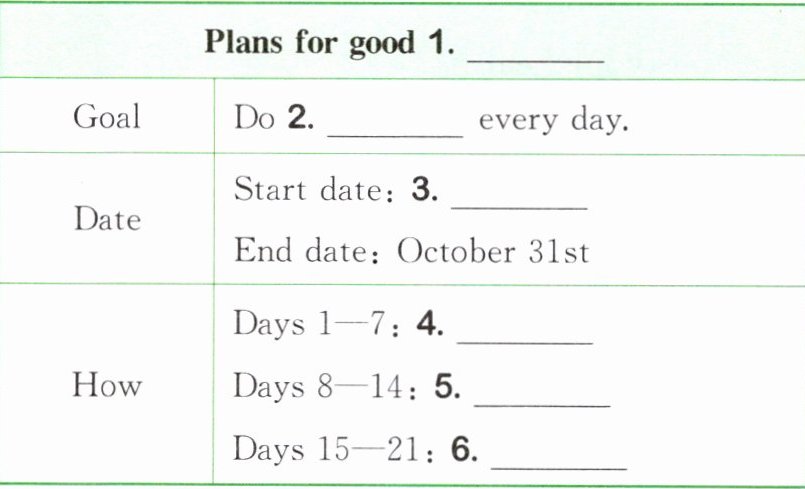 October 31st |
| How | Days 1—7: 4.
Days 8—14: 5.
Days 15—21: 6.
阅读短文补全表格的解题方法详见“答案与解析”P2
七、从方框中选择合适的单词,并用其适当形式补全短文。(可重复使用)
do be read listen put take have
Yang Ling and Wang Bing 1.
are
both students. They 2. have
many habits.Yang Ling 3.
does
chores every day and 4. listens
to her teachers carefully. She 5. reads
a lot of books, but she often 6. reads
in bed. That 7. is
bad for her eyes. Wang Bing 8. takes
notes in class and 9. puts
his school things in order every night. He 10. does
exercise every day. However, he often goes to bed late. That is not a good habit.八、假设你想养成每天运动的好习惯。请根据短文中的21天规则,完成下面的计划表。
Do you want to have good habits? It is not very hard. Here is how your brain(大脑)works.
When you do something for the first time, your brain feels new. If you do exercise again and again, your brain gets used to it. Soon, you do it without(没有)
How long does it take?
Scientists say it takes about 21 days to form(形成) a new habit.
Days 1-7: It feels hard. You must try your best.
Days 8-14: It gets easier. Your brain starts to like it.
Days 15-21: It becomes automatic. You just do it.
Good habits and bad habits both work the same way(方式). If you read in bed every night, that becomes a bad habit. If you want to change(改变) it, do not just stop. Start a new good habit. For example, read at your desk for 21 days. Then the good habit will be stronger.
So, what habit do you want to form? Start today!
Plans for good 1.
habits
| Goal | Do 2.
exercise
every day. || Date | Start date: 3.
October 11th
End date
October 31st || How | Days 1—7: 4.
hard
Days 8—14: 5.
easier
Days 15—21: 6.
automatic
|阅读短文补全表格的解题方法详见“答案与解析”P2
答案
七、1. are 2. have 3. does 4. listens 5. reads
6. reads 7. is 8. takes 9. puts 10. does
八、1. habits 2. exercise 3. October 11th
4. hard 5. easier 6. automatic
阅读短文补全表格的解题方法
表格填空题的答案往往可以直接从原文中找到原词或进行简单的词形转换。
具体步骤:
定位关键词——根据表格中的提示词快速找到原文对应段落。
寻找原句——原文中"Days 1-7: It feels hard."对应表格中的"Days 1-7:4. ______",答案即为hard。
注意词性一致——确认表格中所缺部分的成分,原文中的词填入表格需使用相应形式,避免语法错误。
无需过度推理——80%的答案可直接照搬原文,不要擅自改变单词形式。
6. reads 7. is 8. takes 9. puts 10. does
八、1. habits 2. exercise 3. October 11th
4. hard 5. easier 6. automatic
阅读短文补全表格的解题方法
表格填空题的答案往往可以直接从原文中找到原词或进行简单的词形转换。
具体步骤:
定位关键词——根据表格中的提示词快速找到原文对应段落。
寻找原句——原文中"Days 1-7: It feels hard."对应表格中的"Days 1-7:4. ______",答案即为hard。
注意词性一致——确认表格中所缺部分的成分,原文中的词填入表格需使用相应形式,避免语法错误。
无需过度推理——80%的答案可直接照搬原文,不要擅自改变单词形式。
解析
【分析】本题是根据短文内容补全表格的英语阅读理解题,解题思路为:先定位表格每个空的提示信息,回到原文找到对应内容,大部分答案可直接提取原文原词,仅日期需结合21天规则简单计算,无需过度推理。
【解析】1. 表格标题“Plans for good 1.”,原文围绕养成好习惯展开,对应“good habits”,故1填habits;2. Goal要求“每天做的事”,短文提到“想养成每天运动的好习惯”,故2填exercise;3. Start date:结合21天养成习惯,End date是October 31st,计算得Start date为October 11th(11号至31号共21天);4. Days1-7:原文明确“Days 1-7: It feels hard.”,故4填hard;5. Days8-14:原文“Days 8-14: It gets easier.”,故5填easier;6. Days15-21:原文“Days 15-21: It becomes automatic.”,故6填automatic。
【答案】1. habits 2. exercise 3. October 11th 4. hard 5. easier 6. automatic
【知识点】阅读理解补全表格、提取原文信息、日期计算
【点评】本题属于基础阅读理解题,答案多来自原文原词,仅日期需简单计算,主要考查学生快速定位信息的能力,难度较低。
【难度系数】0.8
【解析】1. 表格标题“Plans for good 1.”,原文围绕养成好习惯展开,对应“good habits”,故1填habits;2. Goal要求“每天做的事”,短文提到“想养成每天运动的好习惯”,故2填exercise;3. Start date:结合21天养成习惯,End date是October 31st,计算得Start date为October 11th(11号至31号共21天);4. Days1-7:原文明确“Days 1-7: It feels hard.”,故4填hard;5. Days8-14:原文“Days 8-14: It gets easier.”,故5填easier;6. Days15-21:原文“Days 15-21: It becomes automatic.”,故6填automatic。
【答案】1. habits 2. exercise 3. October 11th 4. hard 5. easier 6. automatic
【知识点】阅读理解补全表格、提取原文信息、日期计算
【点评】本题属于基础阅读理解题,答案多来自原文原词,仅日期需简单计算,主要考查学生快速定位信息的能力,难度较低。
【难度系数】0.8
