

 登录
登录
Ⅱ.完形填空
Around the world, people have different ideas about what good manners are. When you go to restaurants in different parts of the world, it's 1 to know the right and wrong things to do. For example, in China, it's OK to 2 a lot of noises in a restaurant. In fact, if a restaurant isn't noisy and 3, you may think there's something wrong with it. However, in many Western countries, restaurants are 4 places. If people at the table talk too loud, other people who are eating there might be 5 with the restaurant.
Paying the bill(账单) is also different from country to country. In China, one person usually pays for 6. In Western countries, when friends eat together, they usually 7 the cost. This is called “going Dutch(均摊费用)”. Also, when westerners pay the bill, they usually leave some money for the 8. This called “leaving a tip”. Leaving a tip is thought to be polite. In the US, it's 9 to leave tips of 10%, 15%, or 20% of the bill, which is decided by how good the service is. Good waiters can make a lot of money!
The way people eat food is not the same in different parts of the world, but you can 10 the same kinds of food in many countries.
(
(
(
(
(
(
(
(
(
(
Around the world, people have different ideas about what good manners are. When you go to restaurants in different parts of the world, it's 1 to know the right and wrong things to do. For example, in China, it's OK to 2 a lot of noises in a restaurant. In fact, if a restaurant isn't noisy and 3, you may think there's something wrong with it. However, in many Western countries, restaurants are 4 places. If people at the table talk too loud, other people who are eating there might be 5 with the restaurant.
Paying the bill(账单) is also different from country to country. In China, one person usually pays for 6. In Western countries, when friends eat together, they usually 7 the cost. This is called “going Dutch(均摊费用)”. Also, when westerners pay the bill, they usually leave some money for the 8. This called “leaving a tip”. Leaving a tip is thought to be polite. In the US, it's 9 to leave tips of 10%, 15%, or 20% of the bill, which is decided by how good the service is. Good waiters can make a lot of money!
The way people eat food is not the same in different parts of the world, but you can 10 the same kinds of food in many countries.
(
C
)1. A. popular B. difficult C. important D. enjoyable(
D
)2. A. cause B. keep C. hear D. make(
A
)3. A. lively B. friendly C. lucky D. polite(
B
)4. A. noisy B. quiet C. busy D. clean(
C
)5. A. wrong B. natural C. unhappy D. interested(
A
)6. A. everybody B. nobody C. somebody D. none(
B
)7. A. suggest B. share C. match D. raise(
C
)8. A. guards B. sellers C. waiters D. visitors(
B
)9. A. terrible B. common C. serious D. unusual(
D
)10. A. invent B. accept C. prefer D. find答案
1. C 2. D 3. A 4. B 5. C 6. A 7. B 8. C 9. B 10. D
解析
【分析】
首先通读全文,明确文章主旨为不同国家的餐桌礼仪差异,围绕餐厅氛围、账单支付、小费等方面展开。解题时需结合上下文语境、逻辑关系、固定搭配及文化常识,逐个分析每个小题:
1. 第1题:考查固定句型,it's + adj + to do sth,结合语境“去不同国家餐厅知道该做的事是重要的”,选important;
2. 第2题:考查固定搭配make noises(制造噪音),对应中国餐厅允许吵闹的文化;
3. 第3题:结合前文noisy,需选同义的lively(热闹的),表示餐厅不热闹就有问题;
4. 第4题:转折词however提示与前文中国餐厅的noisy相反,西方餐厅是quiet(安静的);
5. 第5题:西方餐厅要求安静,说话大声会让其他顾客unhappy(不高兴);
6. 第6题:中国餐桌文化中通常一人支付所有人的费用,选everybody;
7. 第7题:西方朋友聚餐均摊费用,固定搭配share the cost;
8. 第8题:小费是给餐厅服务员(waiters)的,对应文化常识;
9. 第9题:在美国按账单比例留小费是常见的(common)做法;
10. 第10题:结合语境,在很多国家能找到相同的食物,选find。
【解析】
1. 选C。固定句型it's important to do sth,意为“做某事是重要的”,符合语境“去不同国家餐厅了解正确做法很重要”。
2. 选D。固定搭配make noises意为“制造噪音”,符合中国餐厅允许吵闹的文化。
3. 选A。前文提到noisy,此处需选同义的lively(热闹的),表示餐厅不热闹就有问题。
4. 选B。转折词however提示与前文中国餐厅的noisy相反,西方餐厅是quiet(安静的)。
5. 选C。西方餐厅要求安静,说话大声会让其他顾客unhappy(不高兴),be unhappy with为固定搭配。
6. 选A。中国餐桌文化中通常一人支付所有人的费用,everybody符合语境。
7. 选B。固定搭配share the cost意为“均摊费用”,对应西方朋友聚餐的文化。
8. 选C。小费是给餐厅服务员(waiters)的,符合西方小费文化。
9. 选B。common意为“常见的”,表示在美国按账单比例留小费是常见做法。
10. 选D。find意为“找到”,符合语境“在很多国家能找到相同的食物”。
【答案】
1.C 2.D 3.A 4.B 5.C 6.A 7.B 8.C 9.B 10.D
【知识点】
完形填空解题技巧、形容词词义辨析、动词词义辨析
【点评】
本文围绕不同国家的餐桌礼仪展开,考查词汇辨析、固定搭配及语境理解,需结合文化常识解题,是初中英语常见题型。
【难度系数】
0.5
首先通读全文,明确文章主旨为不同国家的餐桌礼仪差异,围绕餐厅氛围、账单支付、小费等方面展开。解题时需结合上下文语境、逻辑关系、固定搭配及文化常识,逐个分析每个小题:
1. 第1题:考查固定句型,it's + adj + to do sth,结合语境“去不同国家餐厅知道该做的事是重要的”,选important;
2. 第2题:考查固定搭配make noises(制造噪音),对应中国餐厅允许吵闹的文化;
3. 第3题:结合前文noisy,需选同义的lively(热闹的),表示餐厅不热闹就有问题;
4. 第4题:转折词however提示与前文中国餐厅的noisy相反,西方餐厅是quiet(安静的);
5. 第5题:西方餐厅要求安静,说话大声会让其他顾客unhappy(不高兴);
6. 第6题:中国餐桌文化中通常一人支付所有人的费用,选everybody;
7. 第7题:西方朋友聚餐均摊费用,固定搭配share the cost;
8. 第8题:小费是给餐厅服务员(waiters)的,对应文化常识;
9. 第9题:在美国按账单比例留小费是常见的(common)做法;
10. 第10题:结合语境,在很多国家能找到相同的食物,选find。
【解析】
1. 选C。固定句型it's important to do sth,意为“做某事是重要的”,符合语境“去不同国家餐厅了解正确做法很重要”。
2. 选D。固定搭配make noises意为“制造噪音”,符合中国餐厅允许吵闹的文化。
3. 选A。前文提到noisy,此处需选同义的lively(热闹的),表示餐厅不热闹就有问题。
4. 选B。转折词however提示与前文中国餐厅的noisy相反,西方餐厅是quiet(安静的)。
5. 选C。西方餐厅要求安静,说话大声会让其他顾客unhappy(不高兴),be unhappy with为固定搭配。
6. 选A。中国餐桌文化中通常一人支付所有人的费用,everybody符合语境。
7. 选B。固定搭配share the cost意为“均摊费用”,对应西方朋友聚餐的文化。
8. 选C。小费是给餐厅服务员(waiters)的,符合西方小费文化。
9. 选B。common意为“常见的”,表示在美国按账单比例留小费是常见做法。
10. 选D。find意为“找到”,符合语境“在很多国家能找到相同的食物”。
【答案】
1.C 2.D 3.A 4.B 5.C 6.A 7.B 8.C 9.B 10.D
【知识点】
完形填空解题技巧、形容词词义辨析、动词词义辨析
【点评】
本文围绕不同国家的餐桌礼仪展开,考查词汇辨析、固定搭配及语境理解,需结合文化常识解题,是初中英语常见题型。
【难度系数】
0.5
Ⅲ. 阅读理解
续表
(
A. Take photos.
B. Run.
C. Smoke.
D. Get on the trains.
(
A. One.
B. Two.
C. Three.
D. Four.
(
A. Sally—she wants to find a restaurant with delicious hamburgers.
B. Jack—he wants to know what he shouldn't do in the swimming pool.
C. Mark—he would like to buy a new pair of shoes.
D. Susan—she wants to find a good place to enjoy reading in the afternoon.
续表
(
A
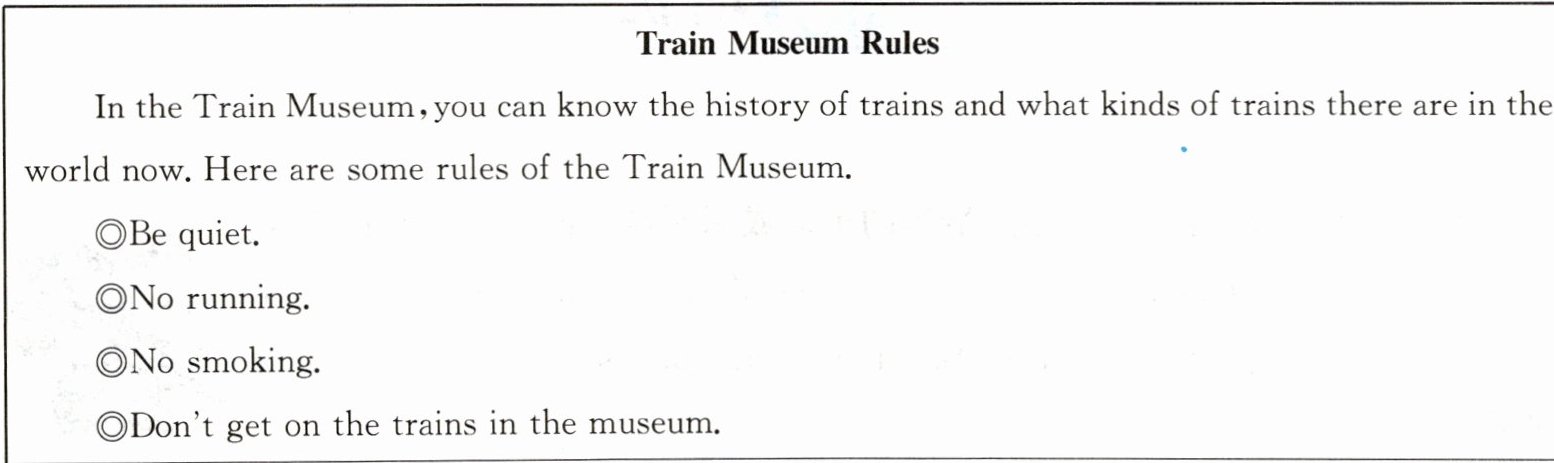
)1. What can people probably do in the Train Museum?A. Take photos.
B. Run.
C. Smoke.
D. Get on the trains.
(
C
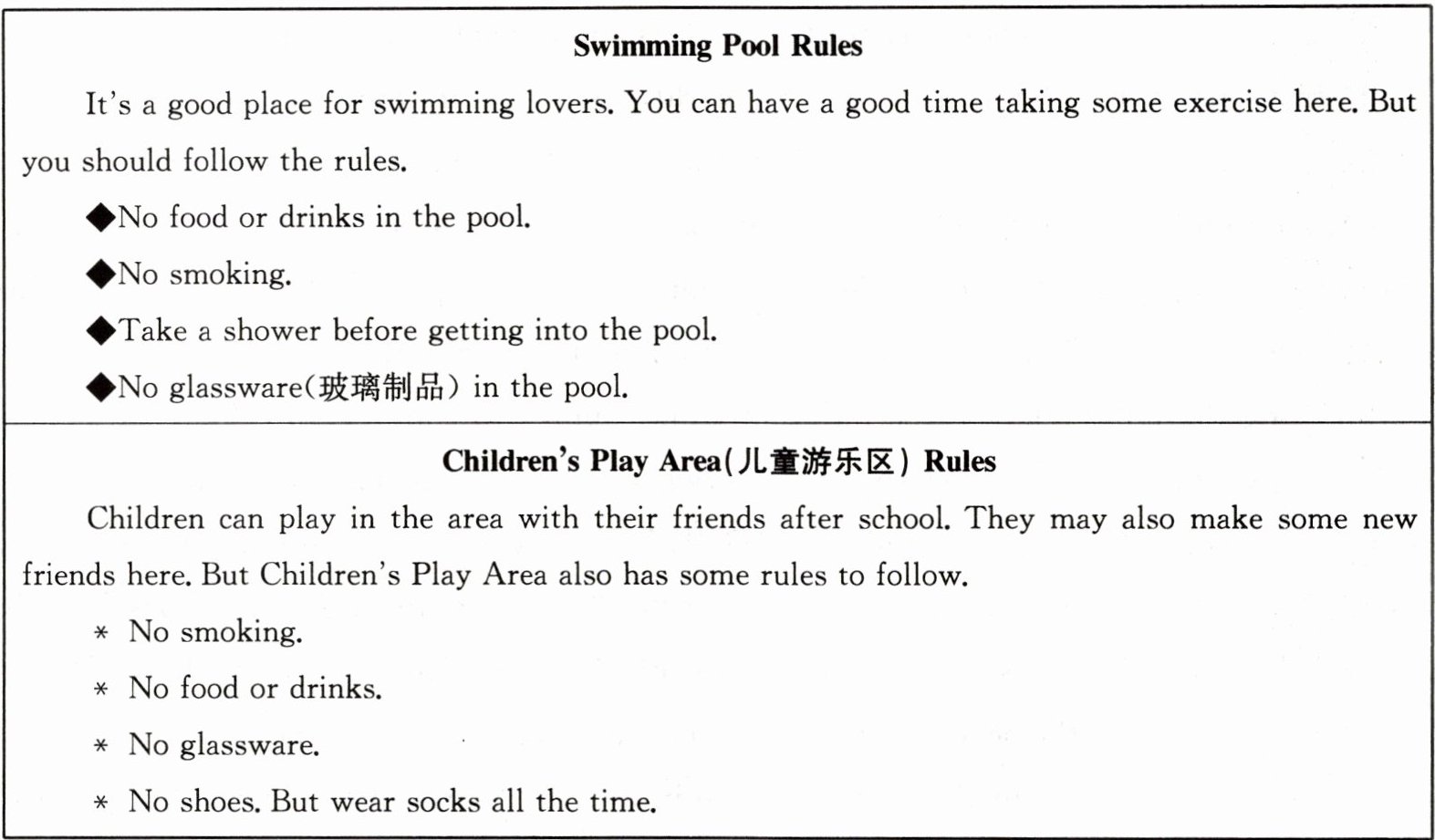
)2. How many rules of Children's Play Area are the same as rules of the swimming pool?A. One.
B. Two.
C. Three.
D. Four.
(
B
)3.【推理判断题】Who may be interested in the material?A. Sally—she wants to find a restaurant with delicious hamburgers.
B. Jack—he wants to know what he shouldn't do in the swimming pool.
C. Mark—he would like to buy a new pair of shoes.
D. Susan—she wants to find a good place to enjoy reading in the afternoon.
答案
1. A 2. C 3. B
解析
【分析】
本题为阅读理解选择题,需结合场所规则的隐含信息及常识逐一分析:第1题是细节理解题,根据火车博物馆的公共属性排除禁止行为;第2题需对比儿童游乐区与游泳池的规则,统计相同规则数量;第3题是推理判断题,匹配材料内容与人物需求。
【解析】
1. 细节理解题:火车博物馆属于公共文化场所,通常禁止奔跑、吸烟,也不允许随意登上列车,拍照是允许的,故选A。
2. 细节对比题:对比儿童游乐区和游泳池的规则,两者相同的规则共3条,故选C。
3. 推理判断题:材料涉及不同场所的规则,B选项中Jack想了解游泳池的禁忌,与材料内容匹配;A(找餐厅)、C(买鞋)、D(找阅读地)均与材料无关,故选B。
【答案】
1.A 2.C 3.B
【知识点】
阅读理解(细节理解题、推理判断题)
【点评】
本题考查阅读理解的细节查找、规则对比及推理判断能力,需结合生活常识和文本隐含信息作答,难度适中。
【难度系数】
0.5
本题为阅读理解选择题,需结合场所规则的隐含信息及常识逐一分析:第1题是细节理解题,根据火车博物馆的公共属性排除禁止行为;第2题需对比儿童游乐区与游泳池的规则,统计相同规则数量;第3题是推理判断题,匹配材料内容与人物需求。
【解析】
1. 细节理解题:火车博物馆属于公共文化场所,通常禁止奔跑、吸烟,也不允许随意登上列车,拍照是允许的,故选A。
2. 细节对比题:对比儿童游乐区和游泳池的规则,两者相同的规则共3条,故选C。
3. 推理判断题:材料涉及不同场所的规则,B选项中Jack想了解游泳池的禁忌,与材料内容匹配;A(找餐厅)、C(买鞋)、D(找阅读地)均与材料无关,故选B。
【答案】
1.A 2.C 3.B
【知识点】
阅读理解(细节理解题、推理判断题)
【点评】
本题考查阅读理解的细节查找、规则对比及推理判断能力,需结合生活常识和文本隐含信息作答,难度适中。
【难度系数】
0.5
