

 登录
登录
Ⅰ. 补全短文。
Cultural dining manners might surprise you with some of their important rules. 1. Knowing some tips will help ensure that you have an enjoyable meal with friends or family—no matter where you are in the world.
Chopstick Rules
The way you hold chopsticks is important to avoid annoying(使烦恼)your companions(陪伴). When you put them down between bites, always put them down together so they are parallel with the edge of the table in front of you. 2.
Hands or Utensils(餐具)
In India and the Middle East, it's considered very rude to eat with your left hand. People in France expect you to eat with a utensil in each hand. 3, instead preferring to use their hands. In Chile, you may never touch any food with your fingers. People in Thailand generally use their forks only to push food onto their spoons.
Making Requests
4. In Portugal, this would be a serious mistake, because it shows the chefs that you don't like their seasoning skills. Similarly, in Italy, never ask for extra cheese to add to your food.
Some of these cultural dining manners may seem accidental(偶然的)and strange, but they are important in different countries. 5, the more comfortable you'll begin to feel with its foreign cultural practices.
1.
2.
3.
4.
5.
Cultural dining manners might surprise you with some of their important rules. 1. Knowing some tips will help ensure that you have an enjoyable meal with friends or family—no matter where you are in the world.
Chopstick Rules
The way you hold chopsticks is important to avoid annoying(使烦恼)your companions(陪伴). When you put them down between bites, always put them down together so they are parallel with the edge of the table in front of you. 2.
Hands or Utensils(餐具)
In India and the Middle East, it's considered very rude to eat with your left hand. People in France expect you to eat with a utensil in each hand. 3, instead preferring to use their hands. In Chile, you may never touch any food with your fingers. People in Thailand generally use their forks only to push food onto their spoons.
Making Requests
4. In Portugal, this would be a serious mistake, because it shows the chefs that you don't like their seasoning skills. Similarly, in Italy, never ask for extra cheese to add to your food.
Some of these cultural dining manners may seem accidental(偶然的)and strange, but they are important in different countries. 5, the more comfortable you'll begin to feel with its foreign cultural practices.
1.
D
2.
E
3.
C
4.
A
5.
B
答案
1. D 2. E 3. C 4. A 5. B
解析
【分析】
本题为文化类补全短文题,需结合上下文语境、逻辑关系及文化常识选择合适句子。解题思路:先通读全文把握主题为不同国家的用餐礼仪规则,再逐空分析前后句衔接逻辑:第1空需引出避免用餐尴尬错误的内容;第2空对应筷子规则的补充说明;第3空需衔接“用手吃饭”的话题;第4空需引出请求类的错误例子;第5空需符合“the more...the more...”的结构逻辑。
【解析】
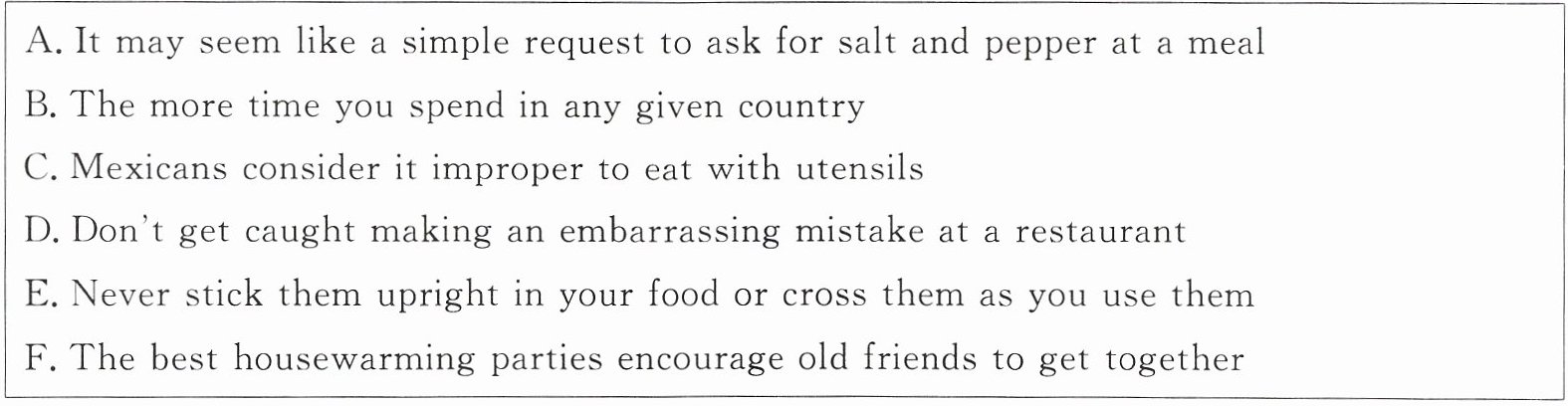
1. 第1空:前文提到文化用餐礼仪有重要规则,后文说知道技巧能确保用餐愉快,D选项“Don't get caught making an embarrassing mistake at a restaurant”(别在餐厅犯尴尬错误)承接上文,引出下文的技巧说明,故选D。
2. 第2空:本段主题为筷子规则,前文讲放下筷子的要求,E选项“Never stick them upright in your food or cross them as you use them”(不要把筷子插在食物里或交叉使用)是筷子的禁忌规则,符合语境,故选E。
3. 第3空:本段主题为“手或餐具”,后文说“instead preferring to use their hands”(反而更喜欢用手),C选项“Mexicans consider it improper to eat with utensils”(墨西哥人认为用餐具吃饭不合适)与后文衔接,说明他们不用餐具而用手,故选C。
4. 第4空:本段主题为“请求”,后文说在葡萄牙要盐和胡椒是严重错误,A选项“It may seem like a simple request to ask for salt and pepper at a meal”(用餐时要盐和胡椒看似简单)引出下文的错误例子,故选A。
5. 第5空:后文“the more comfortable you'll begin to feel with its foreign cultural practices”(你会对外国文化习俗越舒服),B选项“The more time you spend in any given country”(你在某个国家待的时间越久)符合“the more...the more...”的结构,逻辑通顺,故选B。
【答案】
1.D 2.E 3.C 4.A 5.B
【知识点】
文化常识、阅读理解补全、语境逻辑分析
【点评】
本题围绕不同国家的用餐礼仪展开,考查学生对跨文化知识的理解及上下文衔接能力,需结合语境和文化背景选择句子,有助于拓展跨文化交际认知。
【难度系数】
0.5
本题为文化类补全短文题,需结合上下文语境、逻辑关系及文化常识选择合适句子。解题思路:先通读全文把握主题为不同国家的用餐礼仪规则,再逐空分析前后句衔接逻辑:第1空需引出避免用餐尴尬错误的内容;第2空对应筷子规则的补充说明;第3空需衔接“用手吃饭”的话题;第4空需引出请求类的错误例子;第5空需符合“the more...the more...”的结构逻辑。
【解析】
1. 第1空:前文提到文化用餐礼仪有重要规则,后文说知道技巧能确保用餐愉快,D选项“Don't get caught making an embarrassing mistake at a restaurant”(别在餐厅犯尴尬错误)承接上文,引出下文的技巧说明,故选D。
2. 第2空:本段主题为筷子规则,前文讲放下筷子的要求,E选项“Never stick them upright in your food or cross them as you use them”(不要把筷子插在食物里或交叉使用)是筷子的禁忌规则,符合语境,故选E。
3. 第3空:本段主题为“手或餐具”,后文说“instead preferring to use their hands”(反而更喜欢用手),C选项“Mexicans consider it improper to eat with utensils”(墨西哥人认为用餐具吃饭不合适)与后文衔接,说明他们不用餐具而用手,故选C。
4. 第4空:本段主题为“请求”,后文说在葡萄牙要盐和胡椒是严重错误,A选项“It may seem like a simple request to ask for salt and pepper at a meal”(用餐时要盐和胡椒看似简单)引出下文的错误例子,故选A。
5. 第5空:后文“the more comfortable you'll begin to feel with its foreign cultural practices”(你会对外国文化习俗越舒服),B选项“The more time you spend in any given country”(你在某个国家待的时间越久)符合“the more...the more...”的结构,逻辑通顺,故选B。
【答案】
1.D 2.E 3.C 4.A 5.B
【知识点】
文化常识、阅读理解补全、语境逻辑分析
【点评】
本题围绕不同国家的用餐礼仪展开,考查学生对跨文化知识的理解及上下文衔接能力,需结合语境和文化背景选择句子,有助于拓展跨文化交际认知。
【难度系数】
0.5
Ⅱ.阅读下面短文,根据短文内容完成表格中所缺信息。
Long ago, when Chinese people got hurt, they found smart ways to deal with cuts. Let's see how they made it!
First, stopping bleeding was very important. If someone lost too much blood, doctors might press hot things against the cuts. They found cuts closed faster when they were near hot things. This way also helped make germs(细菌)develop slowly. They also tied(绑住)the cuts with cloths or ropes to make the blood go slowly. Doctors also used special medicine like jinchuangyao to stop bleeding and make people feel better.
Cleaning cuts was another step. People in the past knew cuts could make people sick or even kill people if they didn't clean the cuts in time. So they would wash cuts with clean water if possible. When cuts got infected(感染的), some people even opened them with knives. This could help make people feel better.
Old ideas seem simple, but they show how clever people were. Many of the ideas doctors use today come from them. They just make some changes to make these ideas work better.
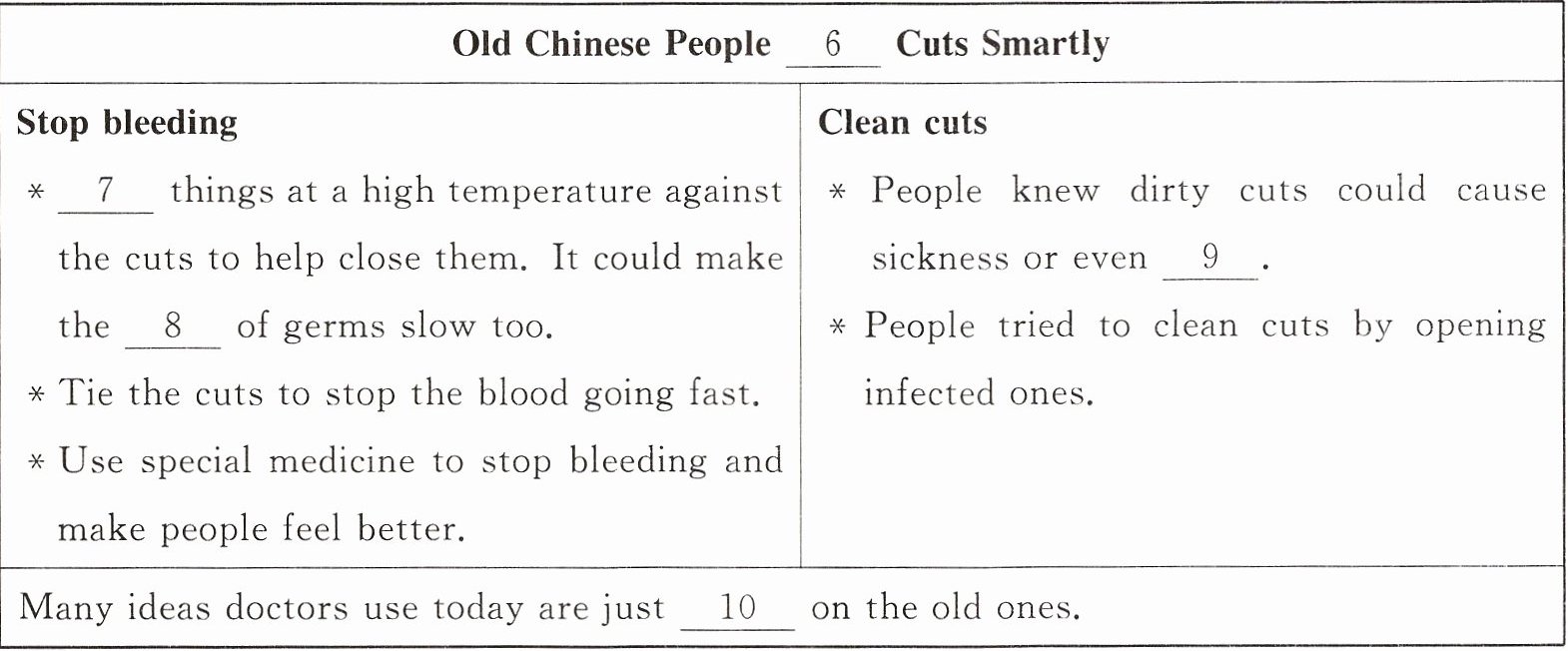
Old Chinese People 6 Cuts Smartly
Stop bleeding
7 things at a high temperature against the cuts to help close them. It could make the 8 of germs slow too.
Tie the cuts to stop the blood going fast.
Use special medicine to stop bleeding and make people feel better.
Clean cuts
People knew dirty cuts could cause sickness or even 9.
People tried to clean cuts by opening infected ones.
Many ideas doctors use today are just 10 on the old ones.
6.
7.
8.
9.
10.
Long ago, when Chinese people got hurt, they found smart ways to deal with cuts. Let's see how they made it!
First, stopping bleeding was very important. If someone lost too much blood, doctors might press hot things against the cuts. They found cuts closed faster when they were near hot things. This way also helped make germs(细菌)develop slowly. They also tied(绑住)the cuts with cloths or ropes to make the blood go slowly. Doctors also used special medicine like jinchuangyao to stop bleeding and make people feel better.
Cleaning cuts was another step. People in the past knew cuts could make people sick or even kill people if they didn't clean the cuts in time. So they would wash cuts with clean water if possible. When cuts got infected(感染的), some people even opened them with knives. This could help make people feel better.
Old ideas seem simple, but they show how clever people were. Many of the ideas doctors use today come from them. They just make some changes to make these ideas work better.
Old Chinese People 6 Cuts Smartly
Stop bleeding
7 things at a high temperature against the cuts to help close them. It could make the 8 of germs slow too.
Tie the cuts to stop the blood going fast.
Use special medicine to stop bleeding and make people feel better.
Clean cuts
People knew dirty cuts could cause sickness or even 9.
People tried to clean cuts by opening infected ones.
Many ideas doctors use today are just 10 on the old ones.
6.
7.
8.
9.
10.
答案
6. Dealt with
7. Press
8. development
9. death
10. improvements
7. Press
8. development
9. death
10. improvements
解析
【分析】本题为信息匹配类阅读理解题,需根据短文内容填写表格空缺。解题思路:1. 通读短文,明确短文核心是古代中国人处理伤口的智慧方法;2. 针对每个空缺,定位原文对应语句,分析空缺处的词性、句意,匹配原文词汇或转换形式;3. 验证填写内容是否符合语境和语法规则。
【解析】6. 定位原文第一段“they found smart ways to deal with cuts”,标题需体现“处理伤口”,故填Dealt with;7. 定位原文第二段“doctors might press hot things against the cuts”,此处为动词原形开头的短语,故填Press;8. 定位原文第二段“This way also helped make germs develop slowly”,空缺处需名词,develop的名词形式为development,故填development;9. 定位原文第三段“could make people sick or even kill people”,even后需名词,kill的名词形式为death,故填death;10. 定位原文最后一段“They just make some changes to make these ideas work better”,此处表示“基于旧方法的改进”,improvement用复数形式,故填improvements。
【答案】6. Dealt with;7. Press;8. development;9. death;10. improvements
【知识点】阅读理解信息匹配、名词形式转换、动词短语运用
【点评】本题考查学生快速提取原文关键信息、结合语境和词性填写正确词汇的能力,需仔细对比原文与表格内容,注意词汇的词性变化。
【难度系数】0.3
【解析】6. 定位原文第一段“they found smart ways to deal with cuts”,标题需体现“处理伤口”,故填Dealt with;7. 定位原文第二段“doctors might press hot things against the cuts”,此处为动词原形开头的短语,故填Press;8. 定位原文第二段“This way also helped make germs develop slowly”,空缺处需名词,develop的名词形式为development,故填development;9. 定位原文第三段“could make people sick or even kill people”,even后需名词,kill的名词形式为death,故填death;10. 定位原文最后一段“They just make some changes to make these ideas work better”,此处表示“基于旧方法的改进”,improvement用复数形式,故填improvements。
【答案】6. Dealt with;7. Press;8. development;9. death;10. improvements
【知识点】阅读理解信息匹配、名词形式转换、动词短语运用
【点评】本题考查学生快速提取原文关键信息、结合语境和词性填写正确词汇的能力,需仔细对比原文与表格内容,注意词汇的词性变化。
【难度系数】0.3
