

 登录
登录
( )(1) ______ Mike good at running?
A.Are
B.Does
C.Is
A.Are
B.Does
C.Is
答案
C
解析
(1) 题干为“Mike good at running?”,其中good at为“擅长”的意思,需要使用be good at结构。由于主语Mike为第三人称单数,因此be动词应使用is。选项A的Are用于第二人称或复数主语,选项B的Does为助动词,用于构成疑问句或否定句,但此处需要be动词,故选项C的Is为正确答案。
(2) 题干为“She often ______ to the cinema at weekends.”,其中often表示经常做某事,需要用一般现在时。由于主语She为第三人称单数,因此动词需要用第三人称单数形式。选项A的go为动词原形,选项C的does为助动词,与题意不符。选项B的goes为go的第三人称单数形式,符合题意,故为正确答案。
(3) 题干为“Let's go ______.”,其中Let's为“让我们”的意思,后接动词原形构成祈使句。但此处需要用到go的固定搭配,即go+doing表示“去做某事”。选项B的swims为第三人称单数形式,选项C的swim为动词原形,但不符合go的固定搭配。选项A的swimming符合go swimming的固定搭配,表示“去游泳”,故为正确答案。
( )(2) She often ______ to the cinema at weekends.
A.go
B.goes
C.does
A.go
B.goes
C.does
答案
B
( )(3) Let's go ______.
A.swimming
B.swims
C.swim
A.swimming
B.swims
C.swim
答案
A
4. 连词成句。
(1) after, clean, do, school, you, the, classroom (?)
______ you ______ ______ ______ ______ school?
(2) do, brother, what, does, her/a, is, policeman, he (?. )
— What ______ her brother ______?
— He ______ a ______.
(3) usually, Su Hai, does, morning, what, do, the, in (.)
What ______ Su Hai ______ ______ in the ______?
(4) any, party, things, there, at, pretty, are, the (?)
______ there ______ pretty ______ ______ the party?
(5) often, Internet, the, Bobby, on, chats (.)______
(1) after, clean, do, school, you, the, classroom (?)
______ you ______ ______ ______ ______ school?
(2) do, brother, what, does, her/a, is, policeman, he (?. )
— What ______ her brother ______?
— He ______ a ______.
(3) usually, Su Hai, does, morning, what, do, the, in (.)
What ______ Su Hai ______ ______ in the ______?
(4) any, party, things, there, at, pretty, are, the (?)
______ there ______ pretty ______ ______ the party?
(5) often, Internet, the, Bobby, on, chats (.)______
答案
Do
clean
the
classroom
after
does
do
is
policeman
does
usually
do
morning
Are
any
things
at
Bobby often chats on the Internet.
clean
the
classroom
after
does
do
is
policeman
does
usually
do
morning
Are
any
things
at
Bobby often chats on the Internet.
解析
(1) 根据问号和所给单词可知该句为一般疑问句,询问“你放学后打扫教室吗?”。一般疑问句将助动词do提前,后面动词用原形,after school表示“放学后”,the classroom表示“教室”,所以句子为Do you clean the classroom after school?
(2) 第一句根据问号和所给单词可知是询问“她哥哥是干什么的?”,用What does her brother do? 第二句根据所给单词可知是回答“他是一名警察。”,用He is a policeman.
(3) 根据所给单词可知是询问“苏海在早上通常做什么?”,What does Su Hai usually do in the morning?
(4) 根据问号和所给单词可知该句为一般疑问句,询问“聚会上有什么漂亮的东西吗?”,用Are there any pretty things at the party?
(5) 根据所给单词可知句子为“Bobby经常在网上聊天。”,Bobby often chats on the Internet.
(2) 第一句根据问号和所给单词可知是询问“她哥哥是干什么的?”,用What does her brother do? 第二句根据所给单词可知是回答“他是一名警察。”,用He is a policeman.
(3) 根据所给单词可知是询问“苏海在早上通常做什么?”,What does Su Hai usually do in the morning?
(4) 根据问号和所给单词可知该句为一般疑问句,询问“聚会上有什么漂亮的东西吗?”,用Are there any pretty things at the party?
(5) 根据所给单词可知句子为“Bobby经常在网上聊天。”,Bobby often chats on the Internet.
5. 根据图片和信息,完成短文。
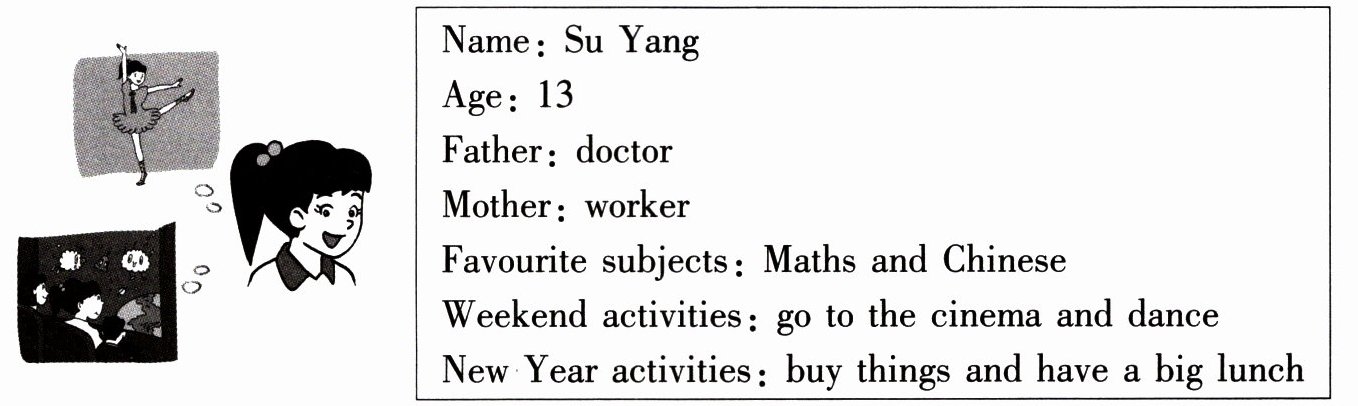
Name: Su Yang
Age: 13
Father: doctor
Mother: worker
Favourite subjects: Maths and Chinese
Weekend activities: go to the cinema and dance
New Year activities: buy things and have a big lunch
This is Su Yang. She is ______ ______ old. Her father is a ______. ______ mother is a ______. She likes ______ and ______. She usually ______ to the ______ and ______ at ______. And she ______ ______ and ______ a ______ ______ on New Year's Day.
Name: Su Yang
Age: 13
Father: doctor
Mother: worker
Favourite subjects: Maths and Chinese
Weekend activities: go to the cinema and dance
New Year activities: buy things and have a big lunch
This is Su Yang. She is ______ ______ old. Her father is a ______. ______ mother is a ______. She likes ______ and ______. She usually ______ to the ______ and ______ at ______. And she ______ ______ and ______ a ______ ______ on New Year's Day.
答案
13
years
doctor
Her
worker
Maths
Chinese
goes
cinema
dances
weekends
buys
things
has
big
lunch
years
doctor
Her
worker
Maths
Chinese
goes
cinema
dances
weekends
buys
things
has
big
lunch
解析
1. 根据“Age: 13”可知,她十三岁了。“十三岁”的表达是“thirteen years old”,所以前两空填“thirteen years”。
2. 根据“Father: doctor”可知,她爸爸是一名医生,所以第三空填“doctor”。
3. 根据“Mother: worker”可知,这里说的是她的妈妈,用形容词性物主代词“Her”,第四空填“Her”。
4. 根据“Mother: worker”可知,她妈妈是一名工人,所以第五空填“worker”。
5. 根据“Favourite subjects: Maths and Chinese”可知,她喜欢数学和语文,所以第六、七空分别填“Maths”和“Chinese”。
6. 根据“Weekend activities: go to the cinema and dance”可知,她周末通常去看电影和跳舞。“去看电影”是“go to the cinema”,“跳舞”是“dance”,“在周末”是“at weekends”,所以第八、九、十空分别填“goes”“cinema”“dances”“weekends”。
7. 根据“New Year activities: buy things and have a big lunch”可知,在新年她买东西和吃一顿丰盛的午餐。“买东西”是“buy things”,“吃一顿丰盛的午餐”是“have a big lunch”,主语是she,动词用第三人称单数形式,所以第十一、十二、十三空分别填“buys”“things”“has”“big”“lunch”。
2. 根据“Father: doctor”可知,她爸爸是一名医生,所以第三空填“doctor”。
3. 根据“Mother: worker”可知,这里说的是她的妈妈,用形容词性物主代词“Her”,第四空填“Her”。
4. 根据“Mother: worker”可知,她妈妈是一名工人,所以第五空填“worker”。
5. 根据“Favourite subjects: Maths and Chinese”可知,她喜欢数学和语文,所以第六、七空分别填“Maths”和“Chinese”。
6. 根据“Weekend activities: go to the cinema and dance”可知,她周末通常去看电影和跳舞。“去看电影”是“go to the cinema”,“跳舞”是“dance”,“在周末”是“at weekends”,所以第八、九、十空分别填“goes”“cinema”“dances”“weekends”。
7. 根据“New Year activities: buy things and have a big lunch”可知,在新年她买东西和吃一顿丰盛的午餐。“买东西”是“buy things”,“吃一顿丰盛的午餐”是“have a big lunch”,主语是she,动词用第三人称单数形式,所以第十一、十二、十三空分别填“buys”“things”“has”“big”“lunch”。
