

 登录
登录
要点探究
pardon
【感知】
» Pardon me, where can I get a bus to the airport?(教材第35页)
抱歉,我在哪里可以坐去机场的公共汽车?
» She pardoned her brother for breaking her favourite cup.
她原谅了弟弟打碎她最喜欢的杯子这件事。
» —Let's meet at 3 o'clock in the park.
我们三点在公园见面吧。
—Pardon? / Beg your pardon? / I beg your pardon? I didn't hear the time clearly.
请再说一遍好吗?我没听清时间。
【探究】
(1)pardon 动词,意为“原谅”。常用短语:
①
了”,此时相当于 excuse me。
②pardon sb for (doing) sth 原谅某人(做)某事
(2)pardon 感叹词,意为“请再说一遍;抱歉”。
【应用】
完成句子或对话
①——考试在周四。
——请再说一遍好吗?你说的是周二还是周四?
—The test will be on Thursday.
—
②她原谅了朋友忘记她的生日。
She
pardon
【感知】
» Pardon me, where can I get a bus to the airport?(教材第35页)
抱歉,我在哪里可以坐去机场的公共汽车?
» She pardoned her brother for breaking her favourite cup.
她原谅了弟弟打碎她最喜欢的杯子这件事。
» —Let's meet at 3 o'clock in the park.
我们三点在公园见面吧。
—Pardon? / Beg your pardon? / I beg your pardon? I didn't hear the time clearly.
请再说一遍好吗?我没听清时间。
【探究】
(1)pardon 动词,意为“原谅”。常用短语:
①
pardon me
“对不起;劳驾;打扰了”,此时相当于 excuse me。
②pardon sb for (doing) sth 原谅某人(做)某事
(2)pardon 感叹词,意为“请再说一遍;抱歉”。
【应用】
完成句子或对话
①——考试在周四。
——请再说一遍好吗?你说的是周二还是周四?
—The test will be on Thursday.
—
Pardon
? Did you say Tuesday or Thursday?②她原谅了朋友忘记她的生日。
She
pardoned
her friend for
forgetting
her birthday.答案
[探究](1)①pardon me
[应用]①Pardon
②pardoned; for forgetting
[应用]①Pardon
②pardoned; for forgetting
解析
【分析】
本题围绕核心词汇pardon的不同词性及用法展开,解题时需结合语境判断pardon的词性,再回忆其固定短语搭配。探究部分根据短语含义匹配对应表达,应用部分①根据“没听清内容需重复”的语境确定感叹词用法,应用部分②结合固定短语结构及时态要求填写正确形式。
【解析】
1. 探究(1)①:pardon作为动词,短语“pardon me”意为“对不起;劳驾;打扰了”,与excuse me含义相近,故填pardon me。
2. 应用①:对话中未听清对方提及的考试时间,需要对方重复内容,此时pardon作为感叹词,意为“请再说一遍”,故填Pardon。
3. 应用②:固定短语“pardon sb for (doing) sth”表示“原谅某人(做)某事”,句子描述过去发生的动作,需用一般过去时,故填pardoned;for forgetting。
【答案】
[探究](1)①pardon me;[应用]①Pardon;②pardoned; for forgetting
【知识点】
pardon的用法、固定短语搭配
【点评】
本题考查英语基础词汇pardon的不同词性及常用搭配,需准确记忆其不同语境下的用法,属于常规词汇考查题,难度不大。
【难度系数】
0.8
本题围绕核心词汇pardon的不同词性及用法展开,解题时需结合语境判断pardon的词性,再回忆其固定短语搭配。探究部分根据短语含义匹配对应表达,应用部分①根据“没听清内容需重复”的语境确定感叹词用法,应用部分②结合固定短语结构及时态要求填写正确形式。
【解析】
1. 探究(1)①:pardon作为动词,短语“pardon me”意为“对不起;劳驾;打扰了”,与excuse me含义相近,故填pardon me。
2. 应用①:对话中未听清对方提及的考试时间,需要对方重复内容,此时pardon作为感叹词,意为“请再说一遍”,故填Pardon。
3. 应用②:固定短语“pardon sb for (doing) sth”表示“原谅某人(做)某事”,句子描述过去发生的动作,需用一般过去时,故填pardoned;for forgetting。
【答案】
[探究](1)①pardon me;[应用]①Pardon;②pardoned; for forgetting
【知识点】
pardon的用法、固定短语搭配
【点评】
本题考查英语基础词汇pardon的不同词性及常用搭配,需准确记忆其不同语境下的用法,属于常规词汇考查题,难度不大。
【难度系数】
0.8
语法探究
wh-词引导的宾语从句
wh-词
引导的宾语从句
引导词
连接代词:what、who、whom、which、whose
在从句中作主语、宾语、定语或表语等
连接副词:when、where、how、why
在从句中作时间、地点、方式、原因状语
与简单句的相互转换
若主句的主语或宾语与从句的主语一致,则宾语从句可以变成“wh-词+动词不定式”的形式
三个关键点
引导词
1. 从句为陈述意义,引导词用that
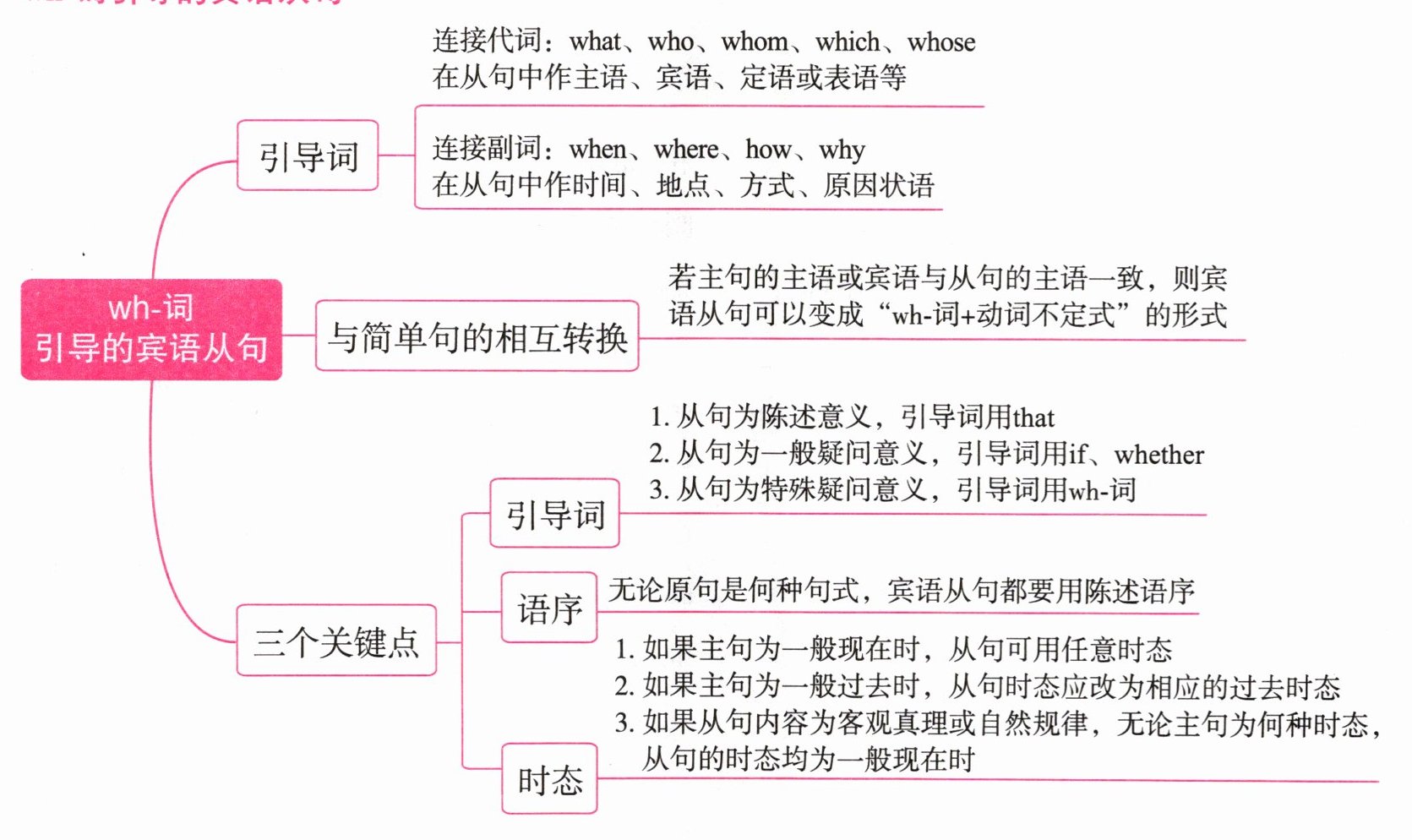
2. 从句为一般疑问意义,引导词用if、whether
3. 从句为特殊疑问意义,引导词用wh-词
语序
无论原句是何种句式,宾语从句都要用陈述语序
时态
1. 如果主句为一般现在时,从句可用任意时态
2. 如果主句为一般过去时,从句时态应改为相应的过去时态
3. 如果从句内容为客观真理或自然规律,无论主句为何种时态,从句的时态均为一般现在时
【应用】
(1)将句子改为含有宾语从句的复合句
①What does the picture in the sign mean?
Could you tell me?
Could you tell me
②“Who will repair the broken sweeping robot?” Mum asked.
Mum asked
③Would you please tell me? When will Dad be back from work, Mum?
Would you please tell me
④“Why does the boy come to school on foot?”
Mary wanted to know.
Mary wanted to know
⑤How are they getting on? I wonder.
I wonder
(2)同义句转换
①I can't decide where I will go with him.
I can't decide
②My aunt will show me how to make a cake.
My aunt will show me
③ I don't know what I should do to improve my English.
I don't know
wh-词引导的宾语从句
wh-词
引导的宾语从句
引导词
连接代词:what、who、whom、which、whose
在从句中作主语、宾语、定语或表语等
连接副词:when、where、how、why
在从句中作时间、地点、方式、原因状语
与简单句的相互转换
若主句的主语或宾语与从句的主语一致,则宾语从句可以变成“wh-词+动词不定式”的形式
三个关键点
引导词
1. 从句为陈述意义,引导词用that
2. 从句为一般疑问意义,引导词用if、whether
3. 从句为特殊疑问意义,引导词用wh-词
语序
无论原句是何种句式,宾语从句都要用陈述语序
时态
1. 如果主句为一般现在时,从句可用任意时态
2. 如果主句为一般过去时,从句时态应改为相应的过去时态
3. 如果从句内容为客观真理或自然规律,无论主句为何种时态,从句的时态均为一般现在时
【应用】
(1)将句子改为含有宾语从句的复合句
①What does the picture in the sign mean?
Could you tell me?
Could you tell me
what
the picture in the sign means
?②“Who will repair the broken sweeping robot?” Mum asked.
Mum asked
who
would
repair the broken sweeping robot.③Would you please tell me? When will Dad be back from work, Mum?
Would you please tell me
when
Dad will
be back from work, Mum?④“Why does the boy come to school on foot?”
Mary wanted to know.
Mary wanted to know
why
the boy came
to school on foot.⑤How are they getting on? I wonder.
I wonder
how
they
are
getting
on
.(2)同义句转换
①I can't decide where I will go with him.
I can't decide
where
to
go
with him.②My aunt will show me how to make a cake.
My aunt will show me
how
I
can
make
a cake.③ I don't know what I should do to improve my English.
I don't know
what
to
do
to improve my English.答案
(1)①what; means ②who would
③when; will ④why; came
⑤how they are getting on
(2)①where to go ②how I can make
③what to do
③when; will ④why; came
⑤how they are getting on
(2)①where to go ②how I can make
③what to do
解析
【分析】
本题考查wh-词引导的宾语从句的用法,需掌握宾语从句的引导词选择、陈述语序要求、时态搭配规则,以及宾语从句与简单句的转换方法。解题时,先判断句子类型(特殊疑问/陈述等)确定引导词,调整从句为陈述语序,根据主句时态调整从句时态;当主句与从句主语一致时,可将“wh-词+宾语从句”转换为“wh-词+动词不定式”结构。
【解析】
(1)①:原句为特殊疑问句,作宾语从句时,引导词用what,从句需改为陈述语序,主句为委婉语气(一般现在时),从句时态不变,故填what; means。
②:原句为特殊疑问句,引导词用who;主句为一般过去时,从句时态需改为相应过去时,will变为would,故填who would。
③:原句为特殊疑问句,引导词用when,从句改为陈述语序,主句为一般现在时,从句用一般将来时,故填when; will。
④:原句为特殊疑问句,引导词用why;主句为一般过去时,从句时态改为一般过去时,come变为came,故填why; came。
⑤:原句为特殊疑问句,引导词用how,从句改为陈述语序,即they are getting on,故填how they are getting on。
(2)①:主句主语I与从句主语I一致,宾语从句可转换为“wh-词+不定式”结构,故填where to go。
②:原句为宾语从句,转换为“wh-词+不定式”结构时,需保持逻辑主语一致,故填how I can make。
③:主句主语I与从句主语I一致,宾语从句转换为“wh-词+不定式”结构,故填what to do。
【答案】
(1)①what; means ②who would ③when; will ④why; came ⑤how they are getting on
(2)①where to go ②how I can make ③what to do
【知识点】
wh-词引导的宾语从句;宾语从句的语序与时态;宾语从句与简单句的转换
【点评】
本题聚焦wh-词引导的宾语从句核心考点,涵盖引导词选择、语序调整、时态呼应及句式转换,是英语语法的基础应用题型,需学生熟练掌握规则并灵活运用。
【难度系数】
0.5
本题考查wh-词引导的宾语从句的用法,需掌握宾语从句的引导词选择、陈述语序要求、时态搭配规则,以及宾语从句与简单句的转换方法。解题时,先判断句子类型(特殊疑问/陈述等)确定引导词,调整从句为陈述语序,根据主句时态调整从句时态;当主句与从句主语一致时,可将“wh-词+宾语从句”转换为“wh-词+动词不定式”结构。
【解析】
(1)①:原句为特殊疑问句,作宾语从句时,引导词用what,从句需改为陈述语序,主句为委婉语气(一般现在时),从句时态不变,故填what; means。
②:原句为特殊疑问句,引导词用who;主句为一般过去时,从句时态需改为相应过去时,will变为would,故填who would。
③:原句为特殊疑问句,引导词用when,从句改为陈述语序,主句为一般现在时,从句用一般将来时,故填when; will。
④:原句为特殊疑问句,引导词用why;主句为一般过去时,从句时态改为一般过去时,come变为came,故填why; came。
⑤:原句为特殊疑问句,引导词用how,从句改为陈述语序,即they are getting on,故填how they are getting on。
(2)①:主句主语I与从句主语I一致,宾语从句可转换为“wh-词+不定式”结构,故填where to go。
②:原句为宾语从句,转换为“wh-词+不定式”结构时,需保持逻辑主语一致,故填how I can make。
③:主句主语I与从句主语I一致,宾语从句转换为“wh-词+不定式”结构,故填what to do。
【答案】
(1)①what; means ②who would ③when; will ④why; came ⑤how they are getting on
(2)①where to go ②how I can make ③what to do
【知识点】
wh-词引导的宾语从句;宾语从句的语序与时态;宾语从句与简单句的转换
【点评】
本题聚焦wh-词引导的宾语从句核心考点,涵盖引导词选择、语序调整、时态呼应及句式转换,是英语语法的基础应用题型,需学生熟练掌握规则并灵活运用。
【难度系数】
0.5
