

 登录
登录
Ⅰ. 阅读短文,判断正误。正确的写“T”,错误的写“F”,并从短文中找出依据(摘录关键句子)。
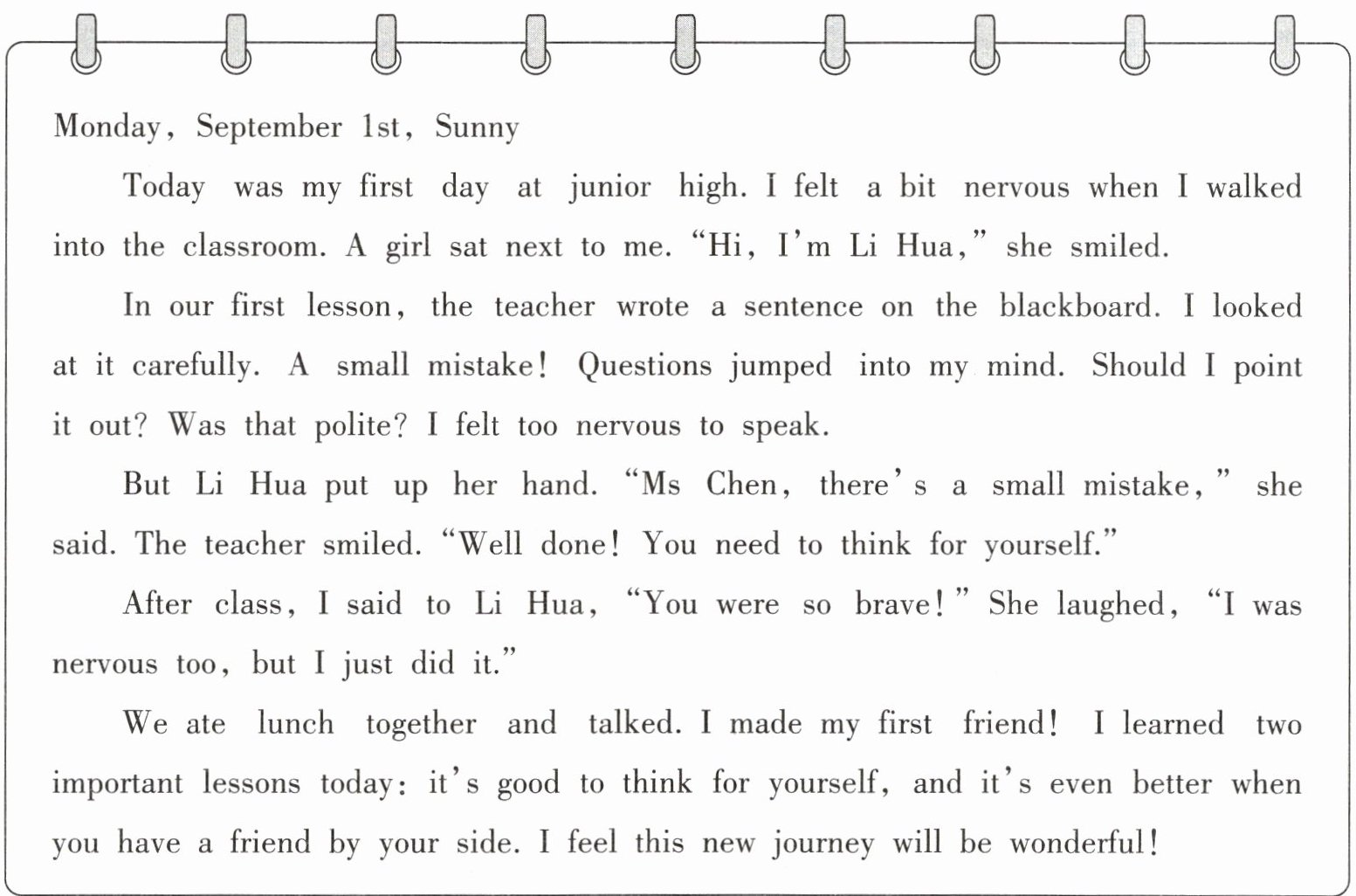
( T )1. The writer felt nervous when she walked into the classroom.
Proof(依据): I felt a bit nervous when I walked into the classroom.
(
Proof:
(
Proof:
(
Proof:
(
Proof:
( T )1. The writer felt nervous when she walked into the classroom.
Proof(依据): I felt a bit nervous when I walked into the classroom.
(
T
)2. Li Hua pointed out a mistake in the first lesson.Proof:
But Li Hua put up her hand. “Ms Chen, there's a small mistake,” she said.
(
T
)3. The writer thought it was not polite to point out the mistake.Proof:
Questions jumped into my mind. Should I point it out? Was that polite?
(
F
)4. The writer ate lunch alone on the first day.Proof:
We ate lunch together and talked.
(
T
)5. The writer learned that having a friend by your side is good.Proof:
I learned two important lessons today: it's good to think for yourself, and it's even better when you have a friend by your side.
答案
( T )1. The writer felt nervous when she walked into the classroom.
Proof:I felt a bit nervous when I walked into the classroom.
( T )2. Li Hua pointed out a mistake in the first lesson.
Proof:But Li Hua put up her hand. “Ms Chen, there's a small mistake,” she said.
( T )3. The writer thought it was not polite to point out the mistake.
Proof:Questions jumped into my mind. Should I point it out? Was that polite?
( F )4. The writer ate lunch alone on the first day.
Proof:We ate lunch together and talked.
( T )5. The writer learned that having a friend by your side is good.
Proof:I learned two important lessons today: it's good to think for yourself, and it's even better when you have a friend by your side.
Proof:I felt a bit nervous when I walked into the classroom.
( T )2. Li Hua pointed out a mistake in the first lesson.
Proof:But Li Hua put up her hand. “Ms Chen, there's a small mistake,” she said.
( T )3. The writer thought it was not polite to point out the mistake.
Proof:Questions jumped into my mind. Should I point it out? Was that polite?
( F )4. The writer ate lunch alone on the first day.
Proof:We ate lunch together and talked.
( T )5. The writer learned that having a friend by your side is good.
Proof:I learned two important lessons today: it's good to think for yourself, and it's even better when you have a friend by your side.
解析
【分析】本题为英语阅读理解中的判断正误题,解题思路为:先通读短文把握内容,再针对每个小题的陈述,在短文中定位相关语句,对比陈述与原文内容判断正误,最后摘录原文关键语句作为判断依据。
【解析】1. 小题1:陈述“作者走进教室时感到紧张”,与原文“I felt a bit nervous when I walked into the classroom.”一致,判断为T,依据为该句;2. 小题2:陈述“李华在第一节课指出了一个错误”,对应原文“But Li Hua put up her hand. “Ms Chen, there's a small mistake,” she said.”,判断为T,依据为该句;3. 小题3:陈述“作者认为指出错误是不礼貌的”,对应原文作者的疑问“Questions jumped into my mind. Should I point it out? Was that polite?”,体现作者对是否礼貌的纠结,判断为T,依据为该疑问句;4. 小题4:陈述“作者第一天独自吃午饭”,与原文“We ate lunch together and talked.”不符,判断为F,依据为该句;5. 小题5:陈述“作者学到有朋友在身边很好”,对应原文“I learned two important lessons today: it's good to think for yourself, and it's even better when you have a friend by your side.”,判断为T,依据为该句。
【答案】( T )1. The writer felt nervous when she walked into the classroom.
Proof: I felt a bit nervous when I walked into the classroom.
( T )2. Li Hua pointed out a mistake in the first lesson.
Proof: But Li Hua put up her hand. “Ms Chen, there's a small mistake,” she said.
( T )3. The writer thought it was not polite to point out the mistake.
Proof: Questions jumped into my mind. Should I point it out? Was that polite?
( F )4. The writer ate lunch alone on the first day.
Proof: We ate lunch together and talked.
( T )5. The writer learned that having a friend by your side is good.
Proof: I learned two important lessons today: it's good to think for yourself, and it's even better when you have a friend by your side.
【知识点】阅读理解、信息提取、判断正误
【点评】本题是基础英语阅读判断题,考查学生从短文中定位关键信息并对比判断的能力,解题时需仔细核对原文与陈述内容,难度较低,适合巩固基础。
【难度系数】0.8
【解析】1. 小题1:陈述“作者走进教室时感到紧张”,与原文“I felt a bit nervous when I walked into the classroom.”一致,判断为T,依据为该句;2. 小题2:陈述“李华在第一节课指出了一个错误”,对应原文“But Li Hua put up her hand. “Ms Chen, there's a small mistake,” she said.”,判断为T,依据为该句;3. 小题3:陈述“作者认为指出错误是不礼貌的”,对应原文作者的疑问“Questions jumped into my mind. Should I point it out? Was that polite?”,体现作者对是否礼貌的纠结,判断为T,依据为该疑问句;4. 小题4:陈述“作者第一天独自吃午饭”,与原文“We ate lunch together and talked.”不符,判断为F,依据为该句;5. 小题5:陈述“作者学到有朋友在身边很好”,对应原文“I learned two important lessons today: it's good to think for yourself, and it's even better when you have a friend by your side.”,判断为T,依据为该句。
【答案】( T )1. The writer felt nervous when she walked into the classroom.
Proof: I felt a bit nervous when I walked into the classroom.
( T )2. Li Hua pointed out a mistake in the first lesson.
Proof: But Li Hua put up her hand. “Ms Chen, there's a small mistake,” she said.
( T )3. The writer thought it was not polite to point out the mistake.
Proof: Questions jumped into my mind. Should I point it out? Was that polite?
( F )4. The writer ate lunch alone on the first day.
Proof: We ate lunch together and talked.
( T )5. The writer learned that having a friend by your side is good.
Proof: I learned two important lessons today: it's good to think for yourself, and it's even better when you have a friend by your side.
【知识点】阅读理解、信息提取、判断正误
【点评】本题是基础英语阅读判断题,考查学生从短文中定位关键信息并对比判断的能力,解题时需仔细核对原文与陈述内容,难度较低,适合巩固基础。
【难度系数】0.8
