

 登录
登录
五、新形式 立德树人·传承中国传统文化 阅读理解
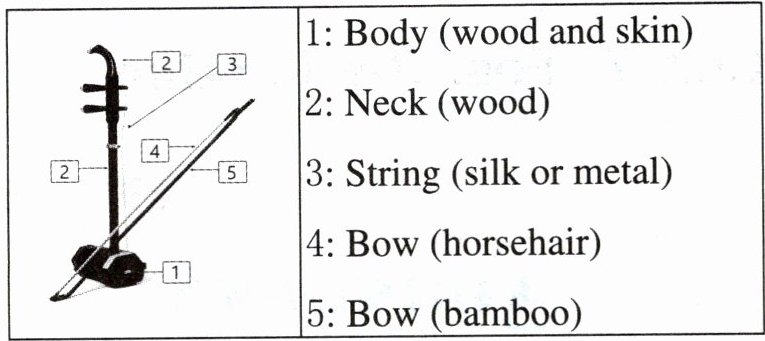
The erhu is a traditional Chinese string (弦) instrument with a history of over 1,000 years. It has two strings, a wooden body, and a long neck. Players use a bow to make sounds by pulling or pushing it between the strings.
◇Appearance:
●Body: Made of red sandalwood (檀香木) and python skin (蟒皮)
●Strings: Made of silk or metal
●Bow: Made of bamboo and horsehair
◇Sounds:
The erhu can play nice music. It often sounds sad but beautiful, like crying or laughing. Many people say it “sings with the heart”.
◇Uses:
●Played in Chinese operas
●Used in music concerts
●Taught in music schools across China
◇Fun Fact:
A good erhu player can make the erhu sound like birds singing, horse neighing or wind blowing.
86 英语 九年级 上册 人教版
(
A. One hundred years ago.
B. More than one thousand years ago.
C. One million years ago.
D. More than one million years ago.
(
A. Metal or wood.
B. Metal or silk.
C. Bamboo and horsehair.
D. Wood and skin.
(
A. Happy and loud.
B. Angry and noisy.
C. Sad but beautiful.
D. Happy but noisy.
(
A. In music schools.
B. In cooking schools.
C. In science labs.
D. In the instrument factory.
(
A. The erhu can only play loud music.
B. The erhu’s body is made of wood and bamboo.
C. A good player can make the erhu sound like nature.
D. The erhu is never played in Chinese operas.
The erhu is a traditional Chinese string (弦) instrument with a history of over 1,000 years. It has two strings, a wooden body, and a long neck. Players use a bow to make sounds by pulling or pushing it between the strings.
◇Appearance:
●Body: Made of red sandalwood (檀香木) and python skin (蟒皮)
●Strings: Made of silk or metal
●Bow: Made of bamboo and horsehair
◇Sounds:
The erhu can play nice music. It often sounds sad but beautiful, like crying or laughing. Many people say it “sings with the heart”.
◇Uses:
●Played in Chinese operas
●Used in music concerts
●Taught in music schools across China
◇Fun Fact:
A good erhu player can make the erhu sound like birds singing, horse neighing or wind blowing.
86 英语 九年级 上册 人教版
(
B
) 21. When did the erhu appear in China?A. One hundred years ago.
B. More than one thousand years ago.
C. One million years ago.
D. More than one million years ago.
(
C
) 22. What material is the erhu’s bow usually made of?A. Metal or wood.
B. Metal or silk.
C. Bamboo and horsehair.
D. Wood and skin.
(
C
) 23. How does the music of the erhu often sound?A. Happy and loud.
B. Angry and noisy.
C. Sad but beautiful.
D. Happy but noisy.
(
A
) 24. Where can you learn to play the erhu?A. In music schools.
B. In cooking schools.
C. In science labs.
D. In the instrument factory.
(
C
) 25. 能力训练点·逻辑推理 Which sentence is TRUE according to the passage?A. The erhu can only play loud music.
B. The erhu’s body is made of wood and bamboo.
C. A good player can make the erhu sound like nature.
D. The erhu is never played in Chinese operas.
答案
21-25: BCCAC
解析
【分析】
解答本题需先通读原文把握大意,再针对每道题的问题,定位原文对应内容:细节理解题直接匹配原文信息,推理判断题需结合原文逐一验证选项,排除错误答案得出正确结论。
【解析】
21题:根据原文第一句“The erhu is a traditional Chinese string instrument with a history of over 1,000 years.”可知二胡有超过1000年的历史,对应选项B。
22题:根据原文Appearance板块中“Bow: Made of bamboo and horsehair.”可知二胡的琴弓由竹子和马毛制成,对应选项C。
23题:根据原文Sounds板块中“It often sounds sad but beautiful, like crying or laughing.”可知二胡的音乐常听起来悲伤但优美,对应选项C。
24题:根据原文Uses板块中“Taught in music schools across China.”可知可以在音乐学校学习二胡,对应选项A。
25题:逐一分析选项:A选项“只能演奏大声的音乐”与原文不符;B选项“二胡琴身由木头和竹子制成”错误,原文琴身材料为檀香木和蟒皮;C选项“优秀的演奏者能让二胡发出自然的声音”对应原文Fun Fact中“sound like birds singing, horse neighing or wind blowing”,符合文意;D选项“二胡从不用于中国戏曲”与原文“Played in Chinese operas”矛盾,故正确选项为C。
【答案】
21.B 22.C 23.C 24.A 25.C
【知识点】
阅读理解(细节理解)、阅读理解(推理判断)
【点评】
本题以中国传统乐器二胡为主题,结合传统文化立德树人的要求,考查学生的英语阅读能力,涵盖细节查找与逻辑推理,难度适中,适合九年级学生练习。
【难度系数】
0.7
解答本题需先通读原文把握大意,再针对每道题的问题,定位原文对应内容:细节理解题直接匹配原文信息,推理判断题需结合原文逐一验证选项,排除错误答案得出正确结论。
【解析】
21题:根据原文第一句“The erhu is a traditional Chinese string instrument with a history of over 1,000 years.”可知二胡有超过1000年的历史,对应选项B。
22题:根据原文Appearance板块中“Bow: Made of bamboo and horsehair.”可知二胡的琴弓由竹子和马毛制成,对应选项C。
23题:根据原文Sounds板块中“It often sounds sad but beautiful, like crying or laughing.”可知二胡的音乐常听起来悲伤但优美,对应选项C。
24题:根据原文Uses板块中“Taught in music schools across China.”可知可以在音乐学校学习二胡,对应选项A。
25题:逐一分析选项:A选项“只能演奏大声的音乐”与原文不符;B选项“二胡琴身由木头和竹子制成”错误,原文琴身材料为檀香木和蟒皮;C选项“优秀的演奏者能让二胡发出自然的声音”对应原文Fun Fact中“sound like birds singing, horse neighing or wind blowing”,符合文意;D选项“二胡从不用于中国戏曲”与原文“Played in Chinese operas”矛盾,故正确选项为C。
【答案】
21.B 22.C 23.C 24.A 25.C
【知识点】
阅读理解(细节理解)、阅读理解(推理判断)
【点评】
本题以中国传统乐器二胡为主题,结合传统文化立德树人的要求,考查学生的英语阅读能力,涵盖细节查找与逻辑推理,难度适中,适合九年级学生练习。
【难度系数】
0.7
