

 登录
登录
中考趋势 Ⅵ. 阅读还原
从方框中选出能填入空白处的最佳选项。选项中有两项多余。
文化意识 文化理解 It's that time of year again, when red envelopes are given to and received from friends and family. 1
The story behind giving red envelopes
As you probably know, the Chinese love the red colour. 2 In China, a red envelope is traditionally called "ya sui qian".
According to the story, a monster named Sui came around to hurt children on Chinese New Year's Eve. 3 And people started to tie eight coins with red strings(线) and place them under children's pillows. Soon, it became a tradition. Sui was kept off by these protective symbols and finally stopped scaring children.
4 The character "岁" actually has the same pronunciation as "祟", the monster's name. These coins were called "ya sui qian", meaning "lucky money to keep off harmful spirits". As generations passed, coins were replaced with notes and the strings were replaced with envelopes.
The custom of giving "ya sui qian"
5 If you have a job and can make money, it's time for you to start giving out "ya sui qian"! A general rule is that the more money you earn, the more money should be added to the envelopes. According to customs, your parents and grandparents will probably still keep giving you "ya sui qian" to show their love and wishes. For your own children, you can give as much as you prefer.
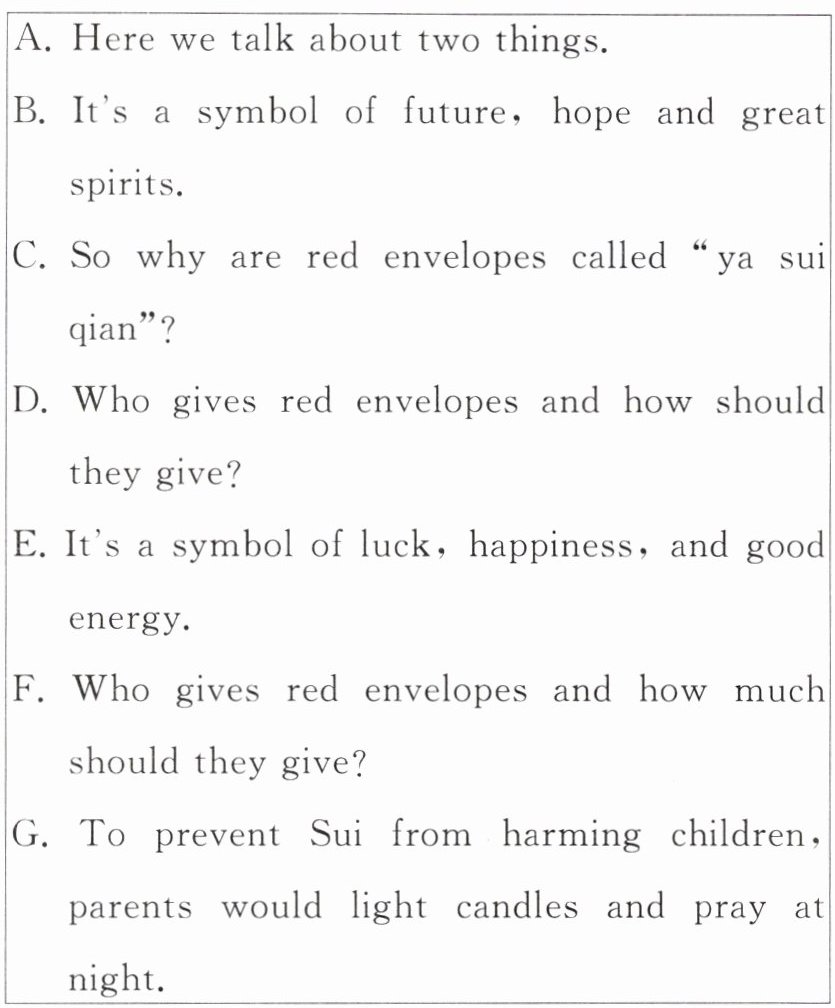
A. Here we talk about two things.
B. It's a symbol of future, hope and great spirits.
C. So why are red envelopes called "ya sui qian"?
D. Who gives red envelopes and how should they give?
E. It's a symbol of luck, happiness, and good energy.
F. Who gives red envelopes and how much should they give?
G. To prevent Sui from harming children, parents would light candles and pray at night.
1. 2. 3. 4. 5.
从方框中选出能填入空白处的最佳选项。选项中有两项多余。
文化意识 文化理解 It's that time of year again, when red envelopes are given to and received from friends and family. 1
The story behind giving red envelopes
As you probably know, the Chinese love the red colour. 2 In China, a red envelope is traditionally called "ya sui qian".
According to the story, a monster named Sui came around to hurt children on Chinese New Year's Eve. 3 And people started to tie eight coins with red strings(线) and place them under children's pillows. Soon, it became a tradition. Sui was kept off by these protective symbols and finally stopped scaring children.
4 The character "岁" actually has the same pronunciation as "祟", the monster's name. These coins were called "ya sui qian", meaning "lucky money to keep off harmful spirits". As generations passed, coins were replaced with notes and the strings were replaced with envelopes.
The custom of giving "ya sui qian"
5 If you have a job and can make money, it's time for you to start giving out "ya sui qian"! A general rule is that the more money you earn, the more money should be added to the envelopes. According to customs, your parents and grandparents will probably still keep giving you "ya sui qian" to show their love and wishes. For your own children, you can give as much as you prefer.
A. Here we talk about two things.
B. It's a symbol of future, hope and great spirits.
C. So why are red envelopes called "ya sui qian"?
D. Who gives red envelopes and how should they give?
E. It's a symbol of luck, happiness, and good energy.
F. Who gives red envelopes and how much should they give?
G. To prevent Sui from harming children, parents would light candles and pray at night.
1. 2. 3. 4. 5.
答案
VI. 1.A 2.E 3.G 4.C 5.F
【语篇解读】本文是一篇说明文,主要介绍了“压岁钱”背后的故事以及发压岁钱的习俗。
1. A 解析:根据下文“The story behind giving red envelopes”以及“The custom of giving ‘ya sui qian’”可知,文章介绍了压岁钱背后的故事以及发压岁钱的习俗,这是两件事。选项 A“这里我们讨论两件事。”符合语境。故选 A。
2. E 解析:根据上文“As you probably know, the Chinese love the red colour.”可知,中国人喜欢红色。由此可推测红色的寓意是好的。选项 E“它是运气、喜乐和好的能量的象征。”符合语境。故选 E。
3. G 解析:根据上文“According to the story, a monster named Sui came around to hurt children on Chinese New Year's Eve.”可知,一个名叫“祟”的怪兽在除夕夜来伤害孩子们,此处应是介绍人们如何驱除“祟”。选项 G“为了阻止祟伤害孩子们,父母们会在晚上点上蜡烛祈祷。”符合语境。故选 G。
4. C 解析:根据下文“The character ‘岁’ actually has the same pronunciation as ‘祟’, the monster's name. These coins were called ‘ya sui qian’, meaning ‘lucky money to keep off harmful spirits’.”可知,此处解释了“压岁钱”这一叫法的原因。选项 C“为什么红包被叫作‘压岁钱’呢?”符合语境。故选 C。
5. F 解析:根据“The custom of giving ‘ya sui qian’”以及最后一段可知,本段介绍了谁该给压岁钱和给多少压岁钱。选项 F“谁给红包,他们又该给多少钱呢?”符合语境。故选 F。
【语篇解读】本文是一篇说明文,主要介绍了“压岁钱”背后的故事以及发压岁钱的习俗。
1. A 解析:根据下文“The story behind giving red envelopes”以及“The custom of giving ‘ya sui qian’”可知,文章介绍了压岁钱背后的故事以及发压岁钱的习俗,这是两件事。选项 A“这里我们讨论两件事。”符合语境。故选 A。
2. E 解析:根据上文“As you probably know, the Chinese love the red colour.”可知,中国人喜欢红色。由此可推测红色的寓意是好的。选项 E“它是运气、喜乐和好的能量的象征。”符合语境。故选 E。
3. G 解析:根据上文“According to the story, a monster named Sui came around to hurt children on Chinese New Year's Eve.”可知,一个名叫“祟”的怪兽在除夕夜来伤害孩子们,此处应是介绍人们如何驱除“祟”。选项 G“为了阻止祟伤害孩子们,父母们会在晚上点上蜡烛祈祷。”符合语境。故选 G。
4. C 解析:根据下文“The character ‘岁’ actually has the same pronunciation as ‘祟’, the monster's name. These coins were called ‘ya sui qian’, meaning ‘lucky money to keep off harmful spirits’.”可知,此处解释了“压岁钱”这一叫法的原因。选项 C“为什么红包被叫作‘压岁钱’呢?”符合语境。故选 C。
5. F 解析:根据“The custom of giving ‘ya sui qian’”以及最后一段可知,本段介绍了谁该给压岁钱和给多少压岁钱。选项 F“谁给红包,他们又该给多少钱呢?”符合语境。故选 F。
解析
【分析】
做阅读还原题时,需结合上下文语境、逻辑关系(如总分、因果、问答对应等),分析每个空白处前后句的内容,匹配选项的语义和衔接性。本题围绕“压岁钱”的文化展开,需关注每个空前后的话题:第1空后讲两个部分(故事和习俗),对应选项A;第2空前讲中国人爱红色,对应红色的象征意义,选E;第3空前讲怪兽祟伤害孩子,对应父母的应对,选G;第4空后解释“压岁钱”名称的由来,对应选项C的提问;第5空所在段讲发压岁钱的主体和金额,对应选项F。
【解析】
1. 第1空:下文分“The story behind giving red envelopes”和“The custom of giving ‘ya sui qian’”两部分,选项A“这里我们讨论两件事”总起,符合语境,故选A。
2. 第2空:上文提到中国人喜欢红色,选项E“它是运气、喜乐和好的能量的象征”承接红色的寓意,符合逻辑,故选E。
3. 第3空:上文说怪兽祟在除夕伤害孩子,选项G“为阻止祟伤害孩子,父母会在晚上点蜡烛祈祷”是应对方法,衔接自然,故选G。
4. 第4空:下文解释“岁”与“祟”同音,说明“压岁钱”名称的由来,选项C“为什么红包被叫作‘压岁钱’呢?”引出下文解释,符合,故选C。
5. 第5空:所在段讲发压岁钱的主体(谁给)和金额,选项F“谁给红包,他们又该给多少钱呢?”对应本段话题,故选F。
【答案】
1.A 2.E 3.G 4.C 5.F
【知识点】
英语阅读还原、语篇衔接、文化常识
【点评】
本题是中考常见的阅读还原题,围绕中国传统“压岁钱”文化展开,解题关键是把握上下文的话题衔接和逻辑关系,难度适中,需学生具备一定的语篇理解能力。
【难度系数】
0.6
做阅读还原题时,需结合上下文语境、逻辑关系(如总分、因果、问答对应等),分析每个空白处前后句的内容,匹配选项的语义和衔接性。本题围绕“压岁钱”的文化展开,需关注每个空前后的话题:第1空后讲两个部分(故事和习俗),对应选项A;第2空前讲中国人爱红色,对应红色的象征意义,选E;第3空前讲怪兽祟伤害孩子,对应父母的应对,选G;第4空后解释“压岁钱”名称的由来,对应选项C的提问;第5空所在段讲发压岁钱的主体和金额,对应选项F。
【解析】
1. 第1空:下文分“The story behind giving red envelopes”和“The custom of giving ‘ya sui qian’”两部分,选项A“这里我们讨论两件事”总起,符合语境,故选A。
2. 第2空:上文提到中国人喜欢红色,选项E“它是运气、喜乐和好的能量的象征”承接红色的寓意,符合逻辑,故选E。
3. 第3空:上文说怪兽祟在除夕伤害孩子,选项G“为阻止祟伤害孩子,父母会在晚上点蜡烛祈祷”是应对方法,衔接自然,故选G。
4. 第4空:下文解释“岁”与“祟”同音,说明“压岁钱”名称的由来,选项C“为什么红包被叫作‘压岁钱’呢?”引出下文解释,符合,故选C。
5. 第5空:所在段讲发压岁钱的主体(谁给)和金额,选项F“谁给红包,他们又该给多少钱呢?”对应本段话题,故选F。
【答案】
1.A 2.E 3.G 4.C 5.F
【知识点】
英语阅读还原、语篇衔接、文化常识
【点评】
本题是中考常见的阅读还原题,围绕中国传统“压岁钱”文化展开,解题关键是把握上下文的话题衔接和逻辑关系,难度适中,需学生具备一定的语篇理解能力。
【难度系数】
0.6
