

 登录
登录
1. 一元二次方程 $3x - 1 - 2x^2 = 0$ 在用求根公式 $x = \frac{-b \pm \sqrt{b^2 - 4ac}}{2a}$ 求解时,$a,b,c$ 的值分别是(
A.$3, -1, -2$
B.$-2, -1, 3$
C.$-2, 3, 1$
D.$-2, 3, -1$
D
)A.$3, -1, -2$
B.$-2, -1, 3$
C.$-2, 3, 1$
D.$-2, 3, -1$
答案
1.D
2. 新考法逆向思维法 下列一元二次方程的根是  的是(
的是(
A.$2x^2 + 3x + 1 = 0$
B.$2x^2 - 3x + 1 = 0$
C.$2x^2 + 3x - 1 = 0$
D.$2x^2 - 3x - 1 = 0$
的是(B
)A.$2x^2 + 3x + 1 = 0$
B.$2x^2 - 3x + 1 = 0$
C.$2x^2 + 3x - 1 = 0$
D.$2x^2 - 3x - 1 = 0$
答案
2.B
3. 用公式法解方程$3x^2 -11x -1=0$,得到方程的两根为$a,b$,且$a>b$,则$a$的值是(
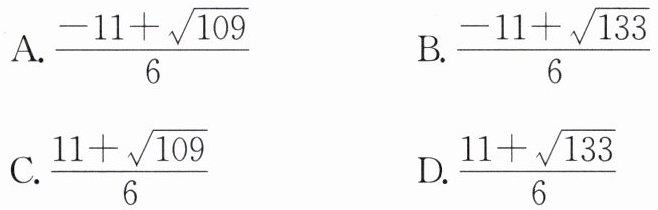
D
)答案
3.D
4.有一个正数$x$,$x$与1的和乘$x$与1的差仍得$x$,则$x=$(
A.$\frac{\sqrt{5}-1}{2}$
B.$\frac{1+\sqrt{5}}{2}$
C.$\frac{1-\sqrt{5}}{2}$
D.$\frac{1+\sqrt{5}}{2}$或$\frac{1-\sqrt{5}}{2}$
B
)A.$\frac{\sqrt{5}-1}{2}$
B.$\frac{1+\sqrt{5}}{2}$
C.$\frac{1-\sqrt{5}}{2}$
D.$\frac{1+\sqrt{5}}{2}$或$\frac{1-\sqrt{5}}{2}$
答案
4.B 【点拨】由题意,得$(x+1)(x-1)=x$,整理得 $x^2 - x-1=0. \because b^2-4ac=1-4×1×(-1)=5>0, \therefore x=\frac{1\pm\sqrt{5}}{2}$. 又$\because x>0, \therefore x=\frac{1+\sqrt{5}}{2}$.
5. 母题教材P₄₃随堂练习T₂ 用公式法解下列方程:
(1)$3x^2 - 4x - 1 = 0$;
(2)$x^2 - 6x = -1$;
(3)$x^2 + 2 = 4\sqrt{2}x$;
(4)$x(x - 3) - 4 = 0$。
(1)$3x^2 - 4x - 1 = 0$;
(2)$x^2 - 6x = -1$;
(3)$x^2 + 2 = 4\sqrt{2}x$;
(4)$x(x - 3) - 4 = 0$。
答案
5.【解】(1)这里 $a=3,b=-4,c=-1$.
$\because b^2-4ac=(-4)^2-4×3×(-1)=28>0$,
$\therefore x=\frac{4\pm2\sqrt{7}}{6}=\frac{2\pm\sqrt{7}}{3}$.
$\therefore x_1=\frac{2+\sqrt{7}}{3},x_2=\frac{2-\sqrt{7}}{3}$.
(2)整理,得 $x^2-6x+1=0$.
这里 $a=1,b=-6,c=1$.
$\because b^2-4ac=36-4=32>0$,
$\therefore x=\frac{6\pm4\sqrt{2}}{2}=3\pm2\sqrt{2}$.
$\therefore x_1=3+2\sqrt{2},x_2=3-2\sqrt{2}$.
(3)整理,得 $x^2-4\sqrt{2}x+2=0$.
这里 $a=1,b=-4\sqrt{2},c=2$.
$\because b^2-4ac=(-4\sqrt{2})^2-4×1×2=24>0$,
$\therefore x=\frac{4\sqrt{2}\pm\sqrt{24}}{2}=2\sqrt{2}\pm\sqrt{6}$.
$\therefore x_1=2\sqrt{2}+\sqrt{6},x_2=2\sqrt{2}-\sqrt{6}$.
(4)整理,得 $x^2-3x-4=0$.
这里 $a=1,b=-3,c=-4$.
$\because b^2-4ac=(-3)^2-4×1×(-4)=25>0$,
$\therefore x=\frac{3\pm5}{2}$.
$\therefore x_1=4,x_2=-1$.
$\because b^2-4ac=(-4)^2-4×3×(-1)=28>0$,
$\therefore x=\frac{4\pm2\sqrt{7}}{6}=\frac{2\pm\sqrt{7}}{3}$.
$\therefore x_1=\frac{2+\sqrt{7}}{3},x_2=\frac{2-\sqrt{7}}{3}$.
(2)整理,得 $x^2-6x+1=0$.
这里 $a=1,b=-6,c=1$.
$\because b^2-4ac=36-4=32>0$,
$\therefore x=\frac{6\pm4\sqrt{2}}{2}=3\pm2\sqrt{2}$.
$\therefore x_1=3+2\sqrt{2},x_2=3-2\sqrt{2}$.
(3)整理,得 $x^2-4\sqrt{2}x+2=0$.
这里 $a=1,b=-4\sqrt{2},c=2$.
$\because b^2-4ac=(-4\sqrt{2})^2-4×1×2=24>0$,
$\therefore x=\frac{4\sqrt{2}\pm\sqrt{24}}{2}=2\sqrt{2}\pm\sqrt{6}$.
$\therefore x_1=2\sqrt{2}+\sqrt{6},x_2=2\sqrt{2}-\sqrt{6}$.
(4)整理,得 $x^2-3x-4=0$.
这里 $a=1,b=-3,c=-4$.
$\because b^2-4ac=(-3)^2-4×1×(-4)=25>0$,
$\therefore x=\frac{3\pm5}{2}$.
$\therefore x_1=4,x_2=-1$.
6.[2025 安徽] 下列方程中,有两个不相等的实数根的是(
A.$x^2+1=0$
B.$x^2-2x+1=0$
C.$x^2+x+1=0$
D.$x^2+x-1=0$
D
)A.$x^2+1=0$
B.$x^2-2x+1=0$
C.$x^2+x+1=0$
D.$x^2+x-1=0$
答案
6.D
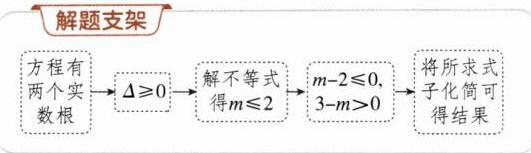
7.若关于$x$的方程$x^2 - 2(m-2)x + m^2 - 2m = 0$有两个实数根,则$\sqrt{(m-2)^2} - |3 - m|$的化简结果是(
A.$1$
B.$-1$
C.$5-2m$
D.$2m-5$
B
)A.$1$
B.$-1$
C.$5-2m$
D.$2m-5$
答案
7.B
8. 新视角条件开放题 已知关于$x$的一元二次方程$kx^2 - (2k - 1)x + k - 2 = 0$有两个不相等的实数根,则实数$k$的值可以是________(写出一个符合条件的值即可)。
答案
8.2(答案不唯一)
9. 新趋势学科内综合 已知关于$x$的一元二次方程$x^2-(m+2)x+2m=0$.
(1)求证:不论$m$为何值时,方程总有实数根;
(2)若方程两根为平行四边形一组邻边长,则当该平行四边形是菱形时,求菱形的边长.
(1)求证:不论$m$为何值时,方程总有实数根;
(2)若方程两根为平行四边形一组邻边长,则当该平行四边形是菱形时,求菱形的边长.
答案
9.(1)【证明】$\because \Delta=[-(m+2)]^2-4×2m=(m-2)^2≥0$,
$\therefore$ 不论 $m$ 为何值时,方程总有实数根.
(2)【解】$\because$ 菱形的一组邻边相等,
$\therefore$ 由题意,方程有两个相等的实数根,
$\therefore \Delta=(m-2)^2=0$.
$\therefore m=2$,此时方程为 $x^2-4x+4=0$,解得 $x_1=x_2=2$,
$\therefore$ 菱形的边长为 2.
$\therefore$ 不论 $m$ 为何值时,方程总有实数根.
(2)【解】$\because$ 菱形的一组邻边相等,
$\therefore$ 由题意,方程有两个相等的实数根,
$\therefore \Delta=(m-2)^2=0$.
$\therefore m=2$,此时方程为 $x^2-4x+4=0$,解得 $x_1=x_2=2$,
$\therefore$ 菱形的边长为 2.
10. 若一元二次方程$x^2 + bx + 4 = 0$的两个实数根中较小的一个根是$m(m≠0)$,则$b + \sqrt{b^2 -16} = ( )$
A.$m$
B.$-m$
C.$2m$
D.$-2m$
A.$m$
B.$-m$
C.$2m$
D.$-2m$
答案
10.D
