

 登录
登录
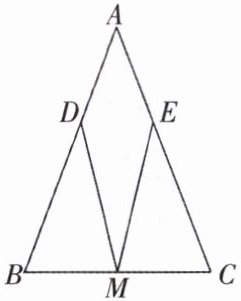
10. 如图,已知在△ABC中,AB=AC,M是BC的中点,D,E分别是AB,AC边上的点,且BD=CE.求证:MD=ME.
答案
10. 证明:$\because AB=AC,$
$\therefore ∠B=∠C.$
$\because M$是$BC$的中点,
$\therefore BM=CM.$
在$△ BDM$和$△ CEM$中$\{\begin{array}{l} BD=CE,\\ ∠B=∠C,\\ BM=CM,\end{array} $
$\therefore △ BDM≌ △ CEM,\therefore MD=ME.$
$\therefore ∠B=∠C.$
$\because M$是$BC$的中点,
$\therefore BM=CM.$
在$△ BDM$和$△ CEM$中$\{\begin{array}{l} BD=CE,\\ ∠B=∠C,\\ BM=CM,\end{array} $
$\therefore △ BDM≌ △ CEM,\therefore MD=ME.$
11. 已知在△ABC中,AB=AC.
(1)作图:在AC上有一点D,延长BD,并在BD的延长线上取点E,使AE=AB,连接AE,作∠EAC的平分线AF,AF交DE于点F;(用尺规作图,保留作图痕迹,不写作法)
(2)在(1)条件下,连接CF,求证:∠E=∠ACF.
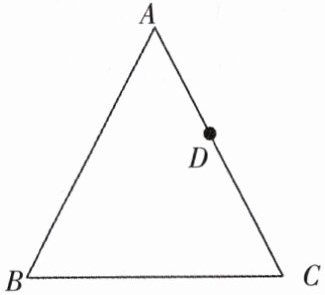
(1)作图:在AC上有一点D,延长BD,并在BD的延长线上取点E,使AE=AB,连接AE,作∠EAC的平分线AF,AF交DE于点F;(用尺规作图,保留作图痕迹,不写作法)
(2)在(1)条件下,连接CF,求证:∠E=∠ACF.
答案
11. (1)作图如图.
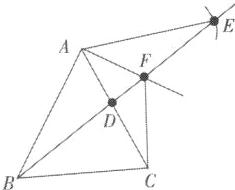
(2)证明:在$△ ACF$和$△ AEF$中,
$\because AE=AB=AC,∠EAF=∠CAF,AF=AF,$
$\therefore △ ACF≌ △ AEF.$
$\therefore ∠E=∠ACF.$
12. 如图,在△ABC中,点D,E分别在边AC,AB上,BD与CE交于点O,给出下列三个条件:①∠EBO=∠DCO;②BE=CD;③OB=OC.
(1)上述三个条件中,由哪两个条件可以判定△ABC是等腰三角形?(用序号写出所有成立的情形)
(2)请选择(1)中的一种情形,写出证明过程.
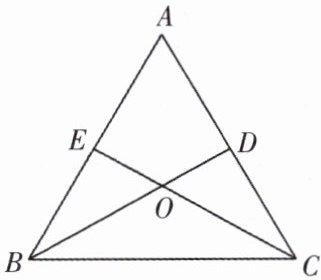
(1)上述三个条件中,由哪两个条件可以判定△ABC是等腰三角形?(用序号写出所有成立的情形)
(2)请选择(1)中的一种情形,写出证明过程.
答案
12. 解:(1)①②;①③,
(2)选①②证明如下:在$△ BOE$和$△ COD$
中,
$\because ∠EBO=∠DCO,∠EOB=∠DOC,BE=CD,$
$\therefore △ BOE≌ △ COD,$
$\therefore BO=CO,∠OBC=∠OCB,$
$\therefore ∠EBO+∠OBC=∠DCO+∠OCB$,即
$∠ABC=∠ACB,$
$\therefore AB=AC$,即$△ ABC$是等腰三角形.
(2)选①②证明如下:在$△ BOE$和$△ COD$
中,
$\because ∠EBO=∠DCO,∠EOB=∠DOC,BE=CD,$
$\therefore △ BOE≌ △ COD,$
$\therefore BO=CO,∠OBC=∠OCB,$
$\therefore ∠EBO+∠OBC=∠DCO+∠OCB$,即
$∠ABC=∠ACB,$
$\therefore AB=AC$,即$△ ABC$是等腰三角形.
13. 如图,∠ABC=90°,D,E分别在BC,AC上,AD⊥DE,且AD=DE,点F是AE的中点,FD与AB相交于点M.
(1)求证:∠FMC=∠FCM;
(2)AD与MC垂直吗?说明理由.
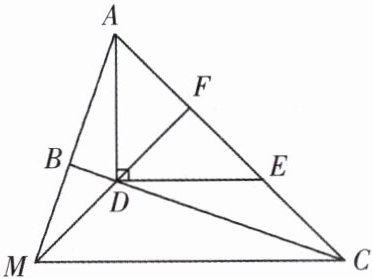
(1)求证:∠FMC=∠FCM;
(2)AD与MC垂直吗?说明理由.
答案
13. (1)证明:$\because △ ADE$是等腰三角形,F是$AE$
的中点,
$\therefore DF⊥AE,DF=AF=EF.$
$\because ∠ABC=90^{\circ },∠DCF,∠AMF$都与$∠MAC$
互余,
$\therefore ∠DCF=∠AMF.$
$\because ∠DFC=∠AFM=90^{\circ },$
$\therefore △ DFC≌ △ AFM,$
$\therefore CF=MF,$
$\therefore ∠FMC=∠FCM.$
(2)$AD⊥MC$.由(1)知$∠MFC=90^{\circ },FD=FE,$
$FM=FC$,
$\therefore ∠FDE=∠FMC=45^{\circ },$
$\therefore DE// CM,$
又$\because AD⊥DE$
$\therefore AD⊥MC.$
的中点,
$\therefore DF⊥AE,DF=AF=EF.$
$\because ∠ABC=90^{\circ },∠DCF,∠AMF$都与$∠MAC$
互余,
$\therefore ∠DCF=∠AMF.$
$\because ∠DFC=∠AFM=90^{\circ },$
$\therefore △ DFC≌ △ AFM,$
$\therefore CF=MF,$
$\therefore ∠FMC=∠FCM.$
(2)$AD⊥MC$.由(1)知$∠MFC=90^{\circ },FD=FE,$
$FM=FC$,
$\therefore ∠FDE=∠FMC=45^{\circ },$
$\therefore DE// CM,$
又$\because AD⊥DE$
$\therefore AD⊥MC.$
