

 登录
登录
Ⅳ. 跨学科 音乐风格发展史 (2026·南京鼓楼区期中)阅读理解
CLASSICAL ERA
The term "classical" is often used to tell the difference between serious music and popular music. The symphony(交响乐) developed in this period. In the late 18th and early 19th centuries, there were two most famous composers(作曲家).
Mozart was a talented composer and performed all over Europe at six. He wrote the famous opera *The Magic Flute*. The German composer Beethoven was completely deaf for the last 10 years of his life but continued to compose some of the greatest music in the world. *Symphony No. 5* is one of them. His late works moved towards the Romantic Movement.
ROMANTIC MOVEMENT
From about 1820, composers started using new harmonies(和声) and forms to create music full of different emotions (情绪). Composers cared more about creating dramas, painting pictures in sound, or telling stories.
The Russian composer Tchaikovsky was unhappy in his personal life, which brought great emotional depth to his music. He wrote many well-known works, including the famous *1812 Overture*.
MODERN MUSIC
In the 20th century, there were great changes in serious music. The music composed by Stravinsky was difficult for people to understand. Stravinsky's *The Firebird* caused a sensation at its first performance in Paris in 1910. It was a big success. The music was so different and powerful that it made the young composer famous across Europe. The German Stockhausen challenged listeners' ideas about music. In *Zyklus*, for example, he let the drummer start playing from any page of the music, and then play it in their own order.
COMPUTER COMPOSITION
Computers can help composers write music. The composer can use an electronic instrument(电子乐器) to enter the melodies into the computer, where they can be stored, changed, and printed out.
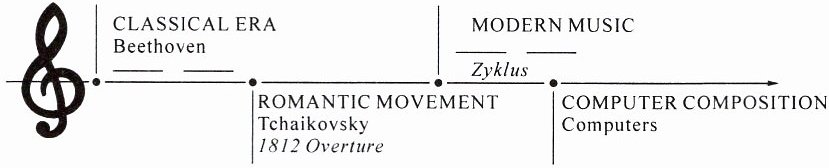
1. 新考法 时间轴理解 According to the passage, what information can be put on the timeline?
A. *The Firebird*; Mozart
B. *Symphony No. 9*; Stravinsky
C. *The Magic Flute*; Chopin
D. *Symphony No. 5*; Stockhausen
2. What do you know about Tchaikovsky and his music?
A. His music is always happy and joyful.
B. He composed worse when he was sad.
C. His personal feelings influenced his music.
D. He only composed music about his own life.
3. 新考法 短语理解 What may " caused a sensation" mean according to the text?
A. It was forgotten at once.
B. It was a piece of modern music.
C. Everyone found it easy to understand.
D. It created great excitement and surprise.
4. 新考法 标题归纳 What is the best title for the passage?
A. The great composers
B. Composers' role in music
C. A brief history of musical styles
D. How composers create music
中考提分新题 提前感知中考常考题型与难度
CLASSICAL ERA
The term "classical" is often used to tell the difference between serious music and popular music. The symphony(交响乐) developed in this period. In the late 18th and early 19th centuries, there were two most famous composers(作曲家).
Mozart was a talented composer and performed all over Europe at six. He wrote the famous opera *The Magic Flute*. The German composer Beethoven was completely deaf for the last 10 years of his life but continued to compose some of the greatest music in the world. *Symphony No. 5* is one of them. His late works moved towards the Romantic Movement.
ROMANTIC MOVEMENT
From about 1820, composers started using new harmonies(和声) and forms to create music full of different emotions (情绪). Composers cared more about creating dramas, painting pictures in sound, or telling stories.
The Russian composer Tchaikovsky was unhappy in his personal life, which brought great emotional depth to his music. He wrote many well-known works, including the famous *1812 Overture*.
MODERN MUSIC
In the 20th century, there were great changes in serious music. The music composed by Stravinsky was difficult for people to understand. Stravinsky's *The Firebird* caused a sensation at its first performance in Paris in 1910. It was a big success. The music was so different and powerful that it made the young composer famous across Europe. The German Stockhausen challenged listeners' ideas about music. In *Zyklus*, for example, he let the drummer start playing from any page of the music, and then play it in their own order.
COMPUTER COMPOSITION
Computers can help composers write music. The composer can use an electronic instrument(电子乐器) to enter the melodies into the computer, where they can be stored, changed, and printed out.
1. 新考法 时间轴理解 According to the passage, what information can be put on the timeline?
A. *The Firebird*; Mozart
B. *Symphony No. 9*; Stravinsky
C. *The Magic Flute*; Chopin
D. *Symphony No. 5*; Stockhausen
2. What do you know about Tchaikovsky and his music?
A. His music is always happy and joyful.
B. He composed worse when he was sad.
C. His personal feelings influenced his music.
D. He only composed music about his own life.
3. 新考法 短语理解 What may " caused a sensation" mean according to the text?
A. It was forgotten at once.
B. It was a piece of modern music.
C. Everyone found it easy to understand.
D. It created great excitement and surprise.
4. 新考法 标题归纳 What is the best title for the passage?
A. The great composers
B. Composers' role in music
C. A brief history of musical styles
D. How composers create music
中考提分新题 提前感知中考常考题型与难度
答案
[文章大意]本文是一篇说明文,文章主要按时间顺序介绍了古典时期、浪漫主义时期、现代音乐时期及电脑作曲阶段的音乐风格、代表作曲家和作品。
1. D [解析]图片理解题。根据"The German composer Beethoven was completely deaf for the last 10 years of his life but continued to compose some of the greatest music in the world. Symphony No. 5 is one of them."可知,《第五交响曲》是贝多芬的作品;根据"The German Stockhausen challenged listeners' ideas about music. In Zyklus, for example..."可知,《Zyklus》是 Stockhausen 的作品。故选 D。
2. C [解析]细节理解题。根据"The Russian composer Tchaikovsky was unhappy in his personal life, which brought great emotional depth to his music."可知,俄罗斯作曲家柴可夫斯基个人生活并不幸福,这为他的音乐增添了深厚的情感,即他的个人情绪影响了音乐创作。故选 C。
3. D [解析]短语理解题。根据"It was a big success. The success 作可数名词时,意为"一个成功的人或一件成功的事"
music was so different and powerful that it made the young composer famous across Europe."可知,它大获成功。这首音乐如此独特且有感染力,以至于让这位年轻的作曲家闻名全欧洲,所以可推测出"caused a sensation"意为"引起极大的兴奋和惊喜"。故选 D。
4. C [解析]标题归纳题。通读全文可知,文章依次介绍了古典音乐、浪漫主义音乐、现代音乐及电脑作曲的音乐这些不同的音乐风格及其发展,其核心是"音乐风格的简要历史"。故选 C。
1. D [解析]图片理解题。根据"The German composer Beethoven was completely deaf for the last 10 years of his life but continued to compose some of the greatest music in the world. Symphony No. 5 is one of them."可知,《第五交响曲》是贝多芬的作品;根据"The German Stockhausen challenged listeners' ideas about music. In Zyklus, for example..."可知,《Zyklus》是 Stockhausen 的作品。故选 D。
2. C [解析]细节理解题。根据"The Russian composer Tchaikovsky was unhappy in his personal life, which brought great emotional depth to his music."可知,俄罗斯作曲家柴可夫斯基个人生活并不幸福,这为他的音乐增添了深厚的情感,即他的个人情绪影响了音乐创作。故选 C。
3. D [解析]短语理解题。根据"It was a big success. The success 作可数名词时,意为"一个成功的人或一件成功的事"
music was so different and powerful that it made the young composer famous across Europe."可知,它大获成功。这首音乐如此独特且有感染力,以至于让这位年轻的作曲家闻名全欧洲,所以可推测出"caused a sensation"意为"引起极大的兴奋和惊喜"。故选 D。
4. C [解析]标题归纳题。通读全文可知,文章依次介绍了古典音乐、浪漫主义音乐、现代音乐及电脑作曲的音乐这些不同的音乐风格及其发展,其核心是"音乐风格的简要历史"。故选 C。
解析
【分析】
这是一篇跨音乐史的说明文阅读题,解题思路可以按以下步骤展开:
1. 先通读全文,明确文章是按时间顺序划分四个音乐发展阶段:古典时期、浪漫主义运动、现代音乐、计算机作曲,对应时间轴的四个板块,先理清每个板块对应的代表人物、代表作品。
2. 第1题结合时间轴的两个空位:第一个空位在古典时期贝多芬条目下,需要填入属于该板块的对应内容;第二个空位在现代音乐Zyklus条目上方,需要填入Zyklus的相关创作者信息,逐一匹配选项排除错误项。
3. 第2题直接定位到介绍柴可夫斯基的段落,找到原文对应描述,排除和原文矛盾的错误选项。
4. 第3题词义猜测题,结合划线短语后文给出的“作品大获成功、作曲家红遍全欧洲”的补充描述,反向推导短语的含义。
5. 第4题主旨归纳题,对比四个选项的覆盖范围,选出能完整对应全文核心内容的标题,排除片面的干扰项。
【解析】
1. 图文匹配题:时间轴第一个空位属于古典时期板块,对应贝多芬的相关作品,原文明确提到贝多芬的代表作是《Symphony No.5》;第二个空位属于现代音乐板块,原文提到作品《Zyklus》的创作者是德国的Stockhausen,完全匹配D选项。其余选项:A项两个内容顺序颠倒,《The Firebird》属于现代音乐、Mozart属于古典时期;B项Stravinsky的代表作不是《Zyklus》;C项Chopin没有在现代音乐板块提及,均排除。
2. 细节理解题:定位到浪漫主义板块关于柴可夫斯基的描述“Tchaikovsky was unhappy in his personal life, which brought great emotional depth to his music”,直接说明他的个人情绪和经历为音乐赋予了更深的情感,也就是个人感受影响了他的音乐创作,对应C选项。A项“他的音乐总是欢快”和原文矛盾;B项“难过时创作水平更差”和原文表述相反;D项“他只创作关于自己生活的音乐”属于无中生有的绝对化表述,均排除。
3. 词义猜测题:划线短语后文补充说明该作品首演后大获成功,风格极具冲击力,直接让年轻的斯特拉文斯基红遍全欧洲,说明首演时作品引发了观众的强烈反响,带来了巨大的惊喜和轰动,对应D选项。A项“立刻被遗忘”和成功的表述完全相反;B项“它是现代音乐”不是短语的含义;C项“所有人都觉得容易理解”和前文提到的“20世纪的现代音乐很难被大众理解”矛盾,均排除。
4. 标题归纳题:全文按时间脉络完整介绍了四个不同阶段的音乐风格特征、代表人物和作品,核心是梳理音乐风格的发展历史。A项仅聚焦伟大作曲家,内容过于片面;B项“作曲家在音乐中的作用”完全不是文章核心;D项“作曲家如何创作音乐”仅覆盖局部内容,只有C项可以完整概括全文主旨。
【答案】
1. D 2. C 3. D 4. C
【知识点】
阅读理解细节查找,词义猜测,主旨归纳
【点评】
本题属于跨学科融合的创新阅读题型,结合音乐时间轴考察图文信息联动匹配能力,既覆盖了初中英语阅读的常规考点,也引导学生跳出纯文本阅读的固化思维,训练快速定位段落信息、排除片面干扰项的解题能力,难度贴合期中测试的考察要求。
【难度系数】
0.7
这是一篇跨音乐史的说明文阅读题,解题思路可以按以下步骤展开:
1. 先通读全文,明确文章是按时间顺序划分四个音乐发展阶段:古典时期、浪漫主义运动、现代音乐、计算机作曲,对应时间轴的四个板块,先理清每个板块对应的代表人物、代表作品。
2. 第1题结合时间轴的两个空位:第一个空位在古典时期贝多芬条目下,需要填入属于该板块的对应内容;第二个空位在现代音乐Zyklus条目上方,需要填入Zyklus的相关创作者信息,逐一匹配选项排除错误项。
3. 第2题直接定位到介绍柴可夫斯基的段落,找到原文对应描述,排除和原文矛盾的错误选项。
4. 第3题词义猜测题,结合划线短语后文给出的“作品大获成功、作曲家红遍全欧洲”的补充描述,反向推导短语的含义。
5. 第4题主旨归纳题,对比四个选项的覆盖范围,选出能完整对应全文核心内容的标题,排除片面的干扰项。
【解析】
1. 图文匹配题:时间轴第一个空位属于古典时期板块,对应贝多芬的相关作品,原文明确提到贝多芬的代表作是《Symphony No.5》;第二个空位属于现代音乐板块,原文提到作品《Zyklus》的创作者是德国的Stockhausen,完全匹配D选项。其余选项:A项两个内容顺序颠倒,《The Firebird》属于现代音乐、Mozart属于古典时期;B项Stravinsky的代表作不是《Zyklus》;C项Chopin没有在现代音乐板块提及,均排除。
2. 细节理解题:定位到浪漫主义板块关于柴可夫斯基的描述“Tchaikovsky was unhappy in his personal life, which brought great emotional depth to his music”,直接说明他的个人情绪和经历为音乐赋予了更深的情感,也就是个人感受影响了他的音乐创作,对应C选项。A项“他的音乐总是欢快”和原文矛盾;B项“难过时创作水平更差”和原文表述相反;D项“他只创作关于自己生活的音乐”属于无中生有的绝对化表述,均排除。
3. 词义猜测题:划线短语后文补充说明该作品首演后大获成功,风格极具冲击力,直接让年轻的斯特拉文斯基红遍全欧洲,说明首演时作品引发了观众的强烈反响,带来了巨大的惊喜和轰动,对应D选项。A项“立刻被遗忘”和成功的表述完全相反;B项“它是现代音乐”不是短语的含义;C项“所有人都觉得容易理解”和前文提到的“20世纪的现代音乐很难被大众理解”矛盾,均排除。
4. 标题归纳题:全文按时间脉络完整介绍了四个不同阶段的音乐风格特征、代表人物和作品,核心是梳理音乐风格的发展历史。A项仅聚焦伟大作曲家,内容过于片面;B项“作曲家在音乐中的作用”完全不是文章核心;D项“作曲家如何创作音乐”仅覆盖局部内容,只有C项可以完整概括全文主旨。
【答案】
1. D 2. C 3. D 4. C
【知识点】
阅读理解细节查找,词义猜测,主旨归纳
【点评】
本题属于跨学科融合的创新阅读题型,结合音乐时间轴考察图文信息联动匹配能力,既覆盖了初中英语阅读的常规考点,也引导学生跳出纯文本阅读的固化思维,训练快速定位段落信息、排除片面干扰项的解题能力,难度贴合期中测试的考察要求。
【难度系数】
0.7
