

 登录
登录
19. (本小题满分10分)
图①是一手机支架的实物图,图②是其侧面示意图,已知伸缩臂AB的长度可调节(10 cm≤AB≤15 cm),并且可绕点A转动,转动角α的变化范围是0°<α≤90°,手机支撑片EC可绕点B转动,BC=10 cm,转动角β的变化范围是0°<β≤90°. 小明使用该支架进行线上学习,当β≥30°,且点C距底座的高度不小于7 cm时,他才感觉舒适.
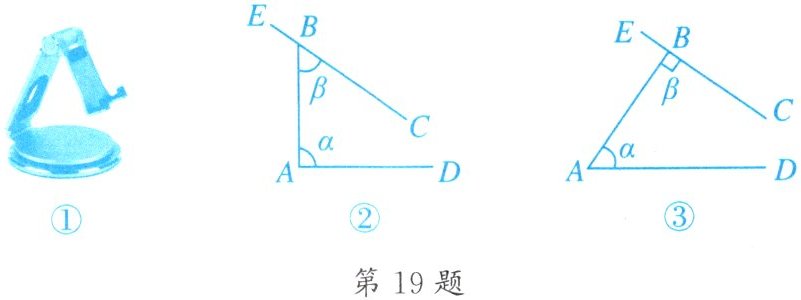
(1)如图②,当α=90°,β=37°,AB=12 cm时,求支撑片底部点C距底座的高度,并判断这个高度是否符合小明使用的舒适要求. (参考数据:$\sin37°≈0.6$,$\cos37°≈0.8$,$\tan37°≈0.75$)
(2)如图③,当α=60°,β=90°时,AB的长度为多少厘米,才能满足点C距底座的最低舒适高度要求?(结果精确到1 cm. 参考数据:$\sqrt{3}≈1.73$)
图①是一手机支架的实物图,图②是其侧面示意图,已知伸缩臂AB的长度可调节(10 cm≤AB≤15 cm),并且可绕点A转动,转动角α的变化范围是0°<α≤90°,手机支撑片EC可绕点B转动,BC=10 cm,转动角β的变化范围是0°<β≤90°. 小明使用该支架进行线上学习,当β≥30°,且点C距底座的高度不小于7 cm时,他才感觉舒适.
(1)如图②,当α=90°,β=37°,AB=12 cm时,求支撑片底部点C距底座的高度,并判断这个高度是否符合小明使用的舒适要求. (参考数据:$\sin37°≈0.6$,$\cos37°≈0.8$,$\tan37°≈0.75$)
(2)如图③,当α=60°,β=90°时,AB的长度为多少厘米,才能满足点C距底座的最低舒适高度要求?(结果精确到1 cm. 参考数据:$\sqrt{3}≈1.73$)
答案
19. 解:(1)如图,过点C作$CM⊥ AD$于点M,$CN⊥ AB$于点N.
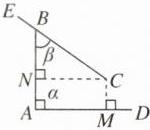
$\therefore$ 四边形AMCN是矩形.
$\therefore CM=AN$.
在$\mathrm{Rt}△ BNC$中,
$\because β=37°$,$BC=10\ \mathrm{cm}$,
$\cos β=\dfrac{BN}{BC}$,
$\therefore BN=BC· \cos 37°=10× 0.8=8(\mathrm{cm})$.
$\because AB=12\ \mathrm{cm}$,
$\therefore AN=AB-BN=4(\mathrm{cm})$.
$\therefore CM=4\ \mathrm{cm}$,即支撑片底部点C距底座的高度为4 cm.
$\because 4<7$,
$\therefore$ 这个高度不符合小明使用的舒适要求.
(2)如图,过点B作$BQ⊥ AD$于点Q,过点C作$CP⊥ AD$于点P,$CO⊥ BQ$于点O.
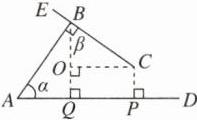
$\therefore$ 四边形PQOC是矩形.
$\therefore OQ=CP$.
$\because$ 点C距底座的高度不小于7 cm时,小明才感觉舒适,
$\therefore$ 点C距底座的最低舒适高度要求为7 cm.
$\therefore OQ=CP=7\ \mathrm{cm}$.
$\because α=60°$,$∠ AQB=90°$,
$\therefore ∠ ABQ=30°$.
$\because β=90°$,
$\therefore ∠ CBO=60°$.
在$\mathrm{Rt}△ BOC$中,
$\because BC=10\ \mathrm{cm}$,$∠ CBO=60°$,
$\therefore OB=BC· \cos 60°=10× \dfrac{1}{2}=5(\mathrm{cm})$.
$\therefore BQ=OB+OQ=5+7=12(\mathrm{cm})$.
在$\mathrm{Rt}△ AQB$中,
$\because α=60°$,$BQ=12\ \mathrm{cm}$,
$\therefore AB=\dfrac{BQ}{\sin 60°}=\dfrac{12}{\dfrac{\sqrt{3}}{2}}=8\sqrt{3}\approx14(\mathrm{cm})$.
即AB的长度为14 cm时,才能满足点C距底座的最低舒适高度要求.
