

 登录
登录
8. 二次函数 $ y = x^{2} + bx + c $ 中,若 $ b + c = 0 $,则它的图像一定过点(
A.$ (1,-1) $
B.$ (-1,1) $
C.$ (-1,-1) $
D.$ (1,1) $
D
)A.$ (1,-1) $
B.$ (-1,1) $
C.$ (-1,-1) $
D.$ (1,1) $
答案
8. D
解析
解:当$x=1$时,$y=1^{2}+b×1 + c=1 + b + c$。
因为$b + c=0$,所以$y=1 + 0=1$。
故图像一定过点$(1,1)$。
D
因为$b + c=0$,所以$y=1 + 0=1$。
故图像一定过点$(1,1)$。
D
9. (2024·苏州)二次函数 $ y = ax^{2} + bx + c(a ≠ 0) $ 的图像过点 $ A(0,m) $,$ B(1,-m) $,$ C(2,n) $,$ D(3,-m) $,其中 $ m $,$ n $ 为常数,则 $ \frac{m}{n} $ 的值为
$ -\frac{3}{5} $
.答案
9. $ -\frac{3}{5} $
解析
解:
∵二次函数图像过点$B(1,-m)$,$D(3,-m)$,
∴对称轴为直线$x=\frac{1+3}{2}=2$,即$-\frac{b}{2a}=2$,得$b=-4a$。
∵图像过点$A(0,m)$,
∴$c=m$,函数表达式为$y=ax^2-4ax+m$。
将$B(1,-m)$代入,得:
$a(1)^2-4a(1)+m=-m$,
$a-4a+m=-m$,
$-3a=-2m$,解得$a=\frac{2m}{3}$。
∴函数表达式为$y=\frac{2m}{3}x^2-\frac{8m}{3}x+m$。
∵图像过点$C(2,n)$,
∴$n=\frac{2m}{3}(2)^2-\frac{8m}{3}(2)+m=\frac{8m}{3}-\frac{16m}{3}+m=-\frac{5m}{3}$。
∴$\frac{m}{n}=\frac{m}{-\frac{5m}{3}}=-\frac{3}{5}$。
$-\frac{3}{5}$
∵二次函数图像过点$B(1,-m)$,$D(3,-m)$,
∴对称轴为直线$x=\frac{1+3}{2}=2$,即$-\frac{b}{2a}=2$,得$b=-4a$。
∵图像过点$A(0,m)$,
∴$c=m$,函数表达式为$y=ax^2-4ax+m$。
将$B(1,-m)$代入,得:
$a(1)^2-4a(1)+m=-m$,
$a-4a+m=-m$,
$-3a=-2m$,解得$a=\frac{2m}{3}$。
∴函数表达式为$y=\frac{2m}{3}x^2-\frac{8m}{3}x+m$。
∵图像过点$C(2,n)$,
∴$n=\frac{2m}{3}(2)^2-\frac{8m}{3}(2)+m=\frac{8m}{3}-\frac{16m}{3}+m=-\frac{5m}{3}$。
∴$\frac{m}{n}=\frac{m}{-\frac{5m}{3}}=-\frac{3}{5}$。
$-\frac{3}{5}$
10. (2024·福建)如图,已知二次函数 $ y = x^{2} + bx + c $ 的图像与 $ x $ 轴交于 $ A $,$ B $ 两点,与 $ y $ 轴交于点 $ C $,其中 $ A(-2,0) $,$ C(0,-2) $.
(1) 求二次函数的表达式;
(2) 若 $ P $ 是二次函数图像上的一点,且点 $ P $ 在第二象限,线段 $ PC $ 交 $ x $ 轴于点 $ D $,$ △ PDB $ 的面积是 $ △ CDB $ 的面积的 2 倍,求点 $ P $ 的坐标.
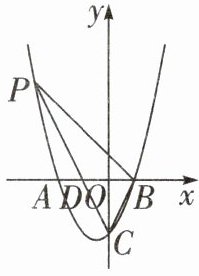
(1) 求二次函数的表达式;
(2) 若 $ P $ 是二次函数图像上的一点,且点 $ P $ 在第二象限,线段 $ PC $ 交 $ x $ 轴于点 $ D $,$ △ PDB $ 的面积是 $ △ CDB $ 的面积的 2 倍,求点 $ P $ 的坐标.
答案
10. (1) 由题意, 将 $ A(-2,0),C(0,-2) $ 代入 $ y = x^{2}+ $
$ bx + c $ 得 $ \{\begin{array}{l} 4 - 2b + c = 0,\\ c = -2.\end{array} $ $ \therefore \{\begin{array}{l} b = 1,\\ c = -2.\end{array} $ $ \therefore $ 二次函数的表达式为 $ y = x^{2}+x - 2 $. (2) 由题意, 设 $ P(m,n)(m < 0,n > $
$ 0) $, 又 $ △ PDB $ 的面积是 $ △ CDB $ 的面积的 2 倍, $ \therefore \frac{S_{△ PDB}}{S_{△ CDB}} = \frac{\frac{1}{2}BD· n}{\frac{1}{2}BD· CO} = 2 $, $ \therefore \frac{n}{CO} = 2 $. 又 $ CO = 2 $, $ \therefore n = 2CO = 4 $.
由 $ m^{2}+m - 2 = 4 $, $ \therefore m_{1} = -3,m_{2} = 2 $ (舍去), $ \therefore $ 点 $ P $ 坐标为 $ (-3,4) $.
$ bx + c $ 得 $ \{\begin{array}{l} 4 - 2b + c = 0,\\ c = -2.\end{array} $ $ \therefore \{\begin{array}{l} b = 1,\\ c = -2.\end{array} $ $ \therefore $ 二次函数的表达式为 $ y = x^{2}+x - 2 $. (2) 由题意, 设 $ P(m,n)(m < 0,n > $
$ 0) $, 又 $ △ PDB $ 的面积是 $ △ CDB $ 的面积的 2 倍, $ \therefore \frac{S_{△ PDB}}{S_{△ CDB}} = \frac{\frac{1}{2}BD· n}{\frac{1}{2}BD· CO} = 2 $, $ \therefore \frac{n}{CO} = 2 $. 又 $ CO = 2 $, $ \therefore n = 2CO = 4 $.
由 $ m^{2}+m - 2 = 4 $, $ \therefore m_{1} = -3,m_{2} = 2 $ (舍去), $ \therefore $ 点 $ P $ 坐标为 $ (-3,4) $.
11. (2024·浙江)已知二次函数 $ y = x^{2} + bx + c $($ b $,$ c $ 为常数)的图像经过点 $ A(-2,5) $,对称轴为直线 $ x = -\frac{1}{2} $.
(1) 求二次函数的表达式;
(2) 若点 $ B(1,7) $ 向上平移 2 个单位长度,向左平移 $ m(m > 0) $ 个单位长度后,恰好落在 $ y = x^{2} + bx + c $ 的图像上,求 $ m $ 的值;
(3) 当 $ -2 ≤ x ≤ n $ 时,二次函数 $ y = x^{2} + bx + c $ 的最大值与最小值的差为 $ \frac{9}{4} $,求 $ n $ 的取值范围.
(1) 求二次函数的表达式;
(2) 若点 $ B(1,7) $ 向上平移 2 个单位长度,向左平移 $ m(m > 0) $ 个单位长度后,恰好落在 $ y = x^{2} + bx + c $ 的图像上,求 $ m $ 的值;
(3) 当 $ -2 ≤ x ≤ n $ 时,二次函数 $ y = x^{2} + bx + c $ 的最大值与最小值的差为 $ \frac{9}{4} $,求 $ n $ 的取值范围.
答案
11. (1) 由题意, $ \because $ 二次函数为 $ y = $
$ x^{2}+bx + c $, $ \therefore $ 抛物线的对称轴为直线 $ x = -\frac{b}{2} = -\frac{1}{2} $, $ \therefore b = 1 $, $ \therefore $ 抛物线为 $ y = x^{2}+x + c $. 又图像经过点
$ A(-2,5) $, $ \therefore 4 - 2 + c = 5 $, $ \therefore c = 3 $, $ \therefore $ 抛物线为 $ y = x^{2}+x + 3 $. (2) 由题意, $ \because $ 点 $ B(1,7) $ 向上平移 2 个单位长
度, 向左平移 $ m $ 个单位长度 $ (m > 0) $, $ \therefore $ 平移后的点为 $ (1 - m,9) $. 又 $ (1 - m,9) $ 在 $ y = x^{2}+x + 3 $ 上, $ \therefore 9 = (1 - $
$ m)^{2}+(1 - m)+3 $, $ \therefore m = 4 $ 或 $ m = -1 $ (舍去), $ \therefore m = 4 $. (3) 由题意, 当 $ n < -\frac{1}{2} $ 时, $ \therefore $ 最大值与最小值的差为
$ 5 - [(n + \frac{1}{2})^{2}+\frac{11}{4}] = \frac{9}{4} $, $ \therefore n_{1} = n_{2} = -\frac{1}{2} $, 不符合题意, 舍去. 当 $ -\frac{1}{2}≤ n≤ 1 $ 时, $ \therefore $ 最大值与最小值的差为
$ 5 - \frac{11}{4} = \frac{9}{4} $, 符合题意. 当 $ n > 1 $ 时, 最大值与最小值的差为 $ (n + \frac{1}{2})^{2}+\frac{11}{4}-\frac{11}{4} = \frac{9}{4} $, 解得 $ n_{1} = 1 $ 或 $ n_{2} = -2 $, 不
符合题意. 综上所述, $ n $ 的取值范围为 $ -\frac{1}{2}≤ n≤ 1 $.
$ x^{2}+bx + c $, $ \therefore $ 抛物线的对称轴为直线 $ x = -\frac{b}{2} = -\frac{1}{2} $, $ \therefore b = 1 $, $ \therefore $ 抛物线为 $ y = x^{2}+x + c $. 又图像经过点
$ A(-2,5) $, $ \therefore 4 - 2 + c = 5 $, $ \therefore c = 3 $, $ \therefore $ 抛物线为 $ y = x^{2}+x + 3 $. (2) 由题意, $ \because $ 点 $ B(1,7) $ 向上平移 2 个单位长
度, 向左平移 $ m $ 个单位长度 $ (m > 0) $, $ \therefore $ 平移后的点为 $ (1 - m,9) $. 又 $ (1 - m,9) $ 在 $ y = x^{2}+x + 3 $ 上, $ \therefore 9 = (1 - $
$ m)^{2}+(1 - m)+3 $, $ \therefore m = 4 $ 或 $ m = -1 $ (舍去), $ \therefore m = 4 $. (3) 由题意, 当 $ n < -\frac{1}{2} $ 时, $ \therefore $ 最大值与最小值的差为
$ 5 - [(n + \frac{1}{2})^{2}+\frac{11}{4}] = \frac{9}{4} $, $ \therefore n_{1} = n_{2} = -\frac{1}{2} $, 不符合题意, 舍去. 当 $ -\frac{1}{2}≤ n≤ 1 $ 时, $ \therefore $ 最大值与最小值的差为
$ 5 - \frac{11}{4} = \frac{9}{4} $, 符合题意. 当 $ n > 1 $ 时, 最大值与最小值的差为 $ (n + \frac{1}{2})^{2}+\frac{11}{4}-\frac{11}{4} = \frac{9}{4} $, 解得 $ n_{1} = 1 $ 或 $ n_{2} = -2 $, 不
符合题意. 综上所述, $ n $ 的取值范围为 $ -\frac{1}{2}≤ n≤ 1 $.
