

 登录
登录
1. 阅读短文,选择正确答案。
In Guangdong, there are many nice dialects. Many old people speak Hakka, Cantonese or Chaoshan dialect. They sing rhymes, say old sayings and call family members in special ways.
These dialects are our cultural treasures. When we talk with grandparents, we can learn a lot. We can write them down and tell our friends. Let's love our hometown voices and pass them on.
(
A. Two. B. Three. C. Four.
(
A. toys B. culture C. food
(
A. Grandparents. B. Teachers. C. Friends.
2. 很多家乡话都在悄悄地消失,我们应该如何将这些乡音传承下去?
(可用中文或英文回答)
In Guangdong, there are many nice dialects. Many old people speak Hakka, Cantonese or Chaoshan dialect. They sing rhymes, say old sayings and call family members in special ways.
These dialects are our cultural treasures. When we talk with grandparents, we can learn a lot. We can write them down and tell our friends. Let's love our hometown voices and pass them on.
(
B
) (1) How many dialects are mentioned (提到) in the passage?A. Two. B. Three. C. Four.
(
B
) (2) The dialects are our .A. toys B. culture C. food
(
A
) (3) Who can teach us dialects?A. Grandparents. B. Teachers. C. Friends.
2. 很多家乡话都在悄悄地消失,我们应该如何将这些乡音传承下去?
(可用中文或英文回答)
答案
1. (1) B (2) B (3) A
2. 示例回答(中文):
我们可以多和爷爷奶奶用家乡话聊天,把有趣的俗语和童谣记下来。还可以在学校和同学分享,或者录成小视频,让更多人学会说家乡话。
示例回答(英文):
We can talk with grandparents in our local dialect, write down the words and rhymes, and teach our friends. We can also record short videos to share online.
2. 示例回答(中文):
我们可以多和爷爷奶奶用家乡话聊天,把有趣的俗语和童谣记下来。还可以在学校和同学分享,或者录成小视频,让更多人学会说家乡话。
示例回答(英文):
We can talk with grandparents in our local dialect, write down the words and rhymes, and teach our friends. We can also record short videos to share online.
八、方言是家乡的声音!请采访爷爷奶奶或其他长辈,收集一句粤语、客家话或潮汕话等(俗语、童谣、称呼、老家特有词都可以),完成表三,留住最美乡音。
表三 乡音收集卡(My Local Sound Card)
我的家乡话(Dialect):(选填“粤语”“客家话”或“潮汕话”等)
我收集的乡音(Local word/sentence):写法(拼音或读音):
中文意思(Chinese meaning):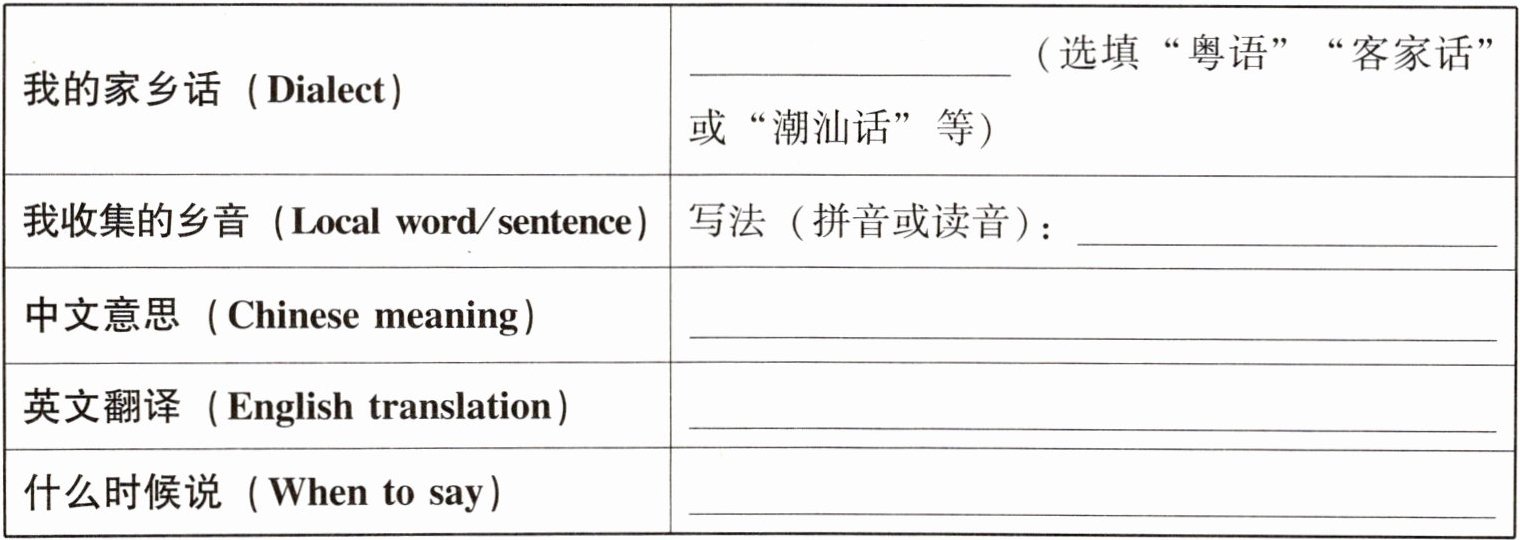
英文翻译(English translation):
什么时候说(When to say):
表三 乡音收集卡(My Local Sound Card)
我的家乡话(Dialect):(选填“粤语”“客家话”或“潮汕话”等)
我收集的乡音(Local word/sentence):写法(拼音或读音):
中文意思(Chinese meaning):
英文翻译(English translation):
什么时候说(When to say):
答案
我的家乡话:粤语
我收集的乡音写法(拼音或读音):leng3 zai2
中文意思:帅气的年轻小伙子,也可以作为对年轻男性的通用亲切称呼
英文翻译:Handsome young man
什么时候说:在路上遇到年轻男生、或者在店铺里称呼年轻的男店员时,都可以使用这个称呼。
我收集的乡音写法(拼音或读音):leng3 zai2
中文意思:帅气的年轻小伙子,也可以作为对年轻男性的通用亲切称呼
英文翻译:Handsome young man
什么时候说:在路上遇到年轻男生、或者在店铺里称呼年轻的男店员时,都可以使用这个称呼。
解析
本题为开放性实践活动题,需要结合采访长辈得到的方言内容填写,以下给出符合要求的参考示例,也可以根据自己家乡的真实方言内容调整作答。
