

 登录
一、完形填空
It was a hot, sunny day in a national forest. Unluckily, my best friend, Daniel, and I got 1. When we realized that we were separated(分开) from our group, we tried to find a safe place to 2 our tents at once. We found a small area next to a river. Then we started a 3 with some leaves.
While I was watching over the fire, Daniel brought more leaves. He put them in the water and then slowly threw them into the fire. The 4 leaves created a lot of smoke. Then we started to write some short notes, saying "WE ARE LOST! If you find this 5, you will find us upstream(在上游). We are keeping up a smoky fire. Please find us!" They were made into paper 6 and sent downstream, one every five minutes. We hoped that these boats would get somebody's 7.
Supposing our group was well on their way, we wanted to be ready for them. Daniel and I started to 8 two hollow logs(空心原木). Our small fire still produced plenty of smoke. Soon we heard someone shouting far in the forest. We were very 9. It must have been the smoke that worked. Now it was time to start beating the hollow logs we found. We enjoyed this part 10 much that we got to sing and shout along with the beat(节拍). Soon after, we were found by our group and we went back to our camp with an exciting story to tell.
1. A. hurt
B. enjoyed
C. missed
D. lost
2. A. set up
B. make up
C. give up
D. cut up
3. A. fire
B. lesson
C. fight
D. business
4. A. dry
B. wet
C. old
D. new
5. A. news
B. advice
C. message
D. answer
6. A. houses
B. boats
C. planes
D. animals
7. A. protection
B. invitation
C. notice
D. information
8. A. look at
B. look through
C. look after
D. look for
9. A. surprised
B. excited
C. angry
D. nervous
10. A. very
B. so
C. too
D. quite
答案
【文章大意】本文是一篇记叙文,主要介绍了“我”和最好的朋友 Daniel 在国家森林里迷路了,但“我们”没有慌张,采取了自救措施,最后“我们”的小组找到了“我们”。
1. D 根据上文“It was … in a national forest.”和“When we realized that we were separated from our group”可知,作者和他朋友迷路了。故选 D。
2. A 根据“we tried to find a safe place to … our tents at once”可知,此处指搭建帐篷。故选 A。
3. A 根据下文“While I was watching over the fire”可知,作者和朋友用树叶生火。故选 A。
4. B 根据上文“… Daniel brought more leaves. He put them in the water and then slowly threw them into the fire.”可知,这些树叶是湿的。故选 B。
5. C 此处指代“WE ARE LOST!”这个信息。故选 C。
6. B 根据下文“We hoped that these boats would get somebody's …”可知,他们把便条做成纸船。故选 B。
7. C 根据常识和小船上的信息“WE ARE LOST …”可知,作者希望这些船能引起人们的注意,来救他们。故选 C。
8. D 根据下文“Now it was time to start beating the hollow logs we found.”可知,Daniel 和作者开始寻找两根空心原木。故选 D。
9. B 根据“Soon we heard someone shouting far in the forest.”可知,作者他们听到远处森林里有人在大喊大叫,有人来救他们了,所以他们很兴奋。故选 B。
10. B 此处考查固定句式 so … that …,表示“如此……以至于……”。故选 B。
解析
【分析】
先通读全文,理解文章讲述“我”和朋友在国家森林迷路后,通过生火、放湿树叶产烟、做纸船传信息、找空心原木敲出信号等自救措施,最终被团队找到的故事。解题时需结合上下文语境、词义辨析、固定搭配逐一分析每个空:先定位空格前后的关键信息,再结合选项含义、常用搭配判断最符合语境的答案。
【解析】
1. 根据上文“在国家森林里”和后文“与团队分开”,可知作者和朋友迷路了,lost符合语境,故选D。
2. “搭建帐篷”的固定搭配是set up,此处指找安全地点搭帐篷,故选A。
3. 根据下文“照看火”可知,作者和朋友用树叶生火,fire符合,故选A。
4. 由前文“把树叶放进水里再扔到火里”可知,这些树叶是湿的,wet符合,故选B。
5. 此处指代“WE ARE LOST!”的信息,message指传递的信息,故选C。
6. 根据后文“these boats”可知,他们把便条做成纸船,故选B。
7. 结合常识,作者希望纸船能引起他人注意,notice符合,故选C。
8. 根据后文“找到空心原木”可知,此处是寻找空心原木,look for符合,故选D。
9. 听到远处有人喊,知道有人来救,所以很兴奋,excited符合,故选B。
10. 考查固定句式so...that...,表示“如此……以至于……”,故选B。
【答案】
1.D 2.A 3.A 4.B 5.C 6.B 7.C 8.D 9.B 10.B
【知识点】
完形填空解题技巧、词义辨析、固定搭配
【点评】
本文为记叙文,围绕迷路自救的主题展开,贴近生活实际,考查学生对语境的理解能力和词汇运用能力,需结合上下文逻辑及固定搭配解题,是常见的完形填空考查类型。
【难度系数】
0.4
二、阅读理解
A
A Fun Plant Experiment(实验) to Try at Home!
Without water, plants would die(死亡). How does water run from the roots(根) of a plant to the other parts of the plant? The water travels through "small pipes" to all parts of the plant. And here is a scientific experiment to show it.
What we need:
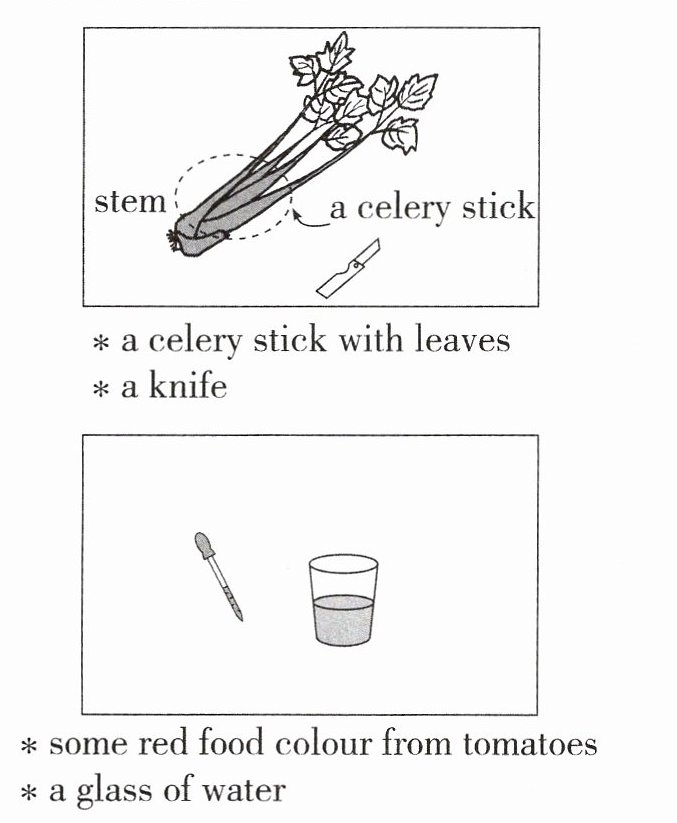
How we do it:
1. Put a few drops(几滴) of the red food colour in the glass of water.
2. Cut the bottom of the celery stick and place the celery in the water.
3. Leave the celery stick in the glass of water for a few hours.
4. Take the celery stick out of water and cut it into pieces across the stem.
What happens:
You can see red food colour in all cross parts, from the bottom of the celery stick right up to the leaves.
Why it happens:
The water, with the red food colour, has run in the celery stick through the small pipes in it. The experiment, therefore, shows that the small pipes in the plant allow water to reach all parts of it. The red food colour shows where the water has travelled in the celery stick.
1. According to the experiment, what can you see after cutting the celery stick into cross parts?
A. The inside of the celery stick has nothing.
B. The water in the celery stick is running.
C. The celery stick is bigger and taller.
D. All the cross parts are red.
2. Which shows the CORRECT order of the experiment?
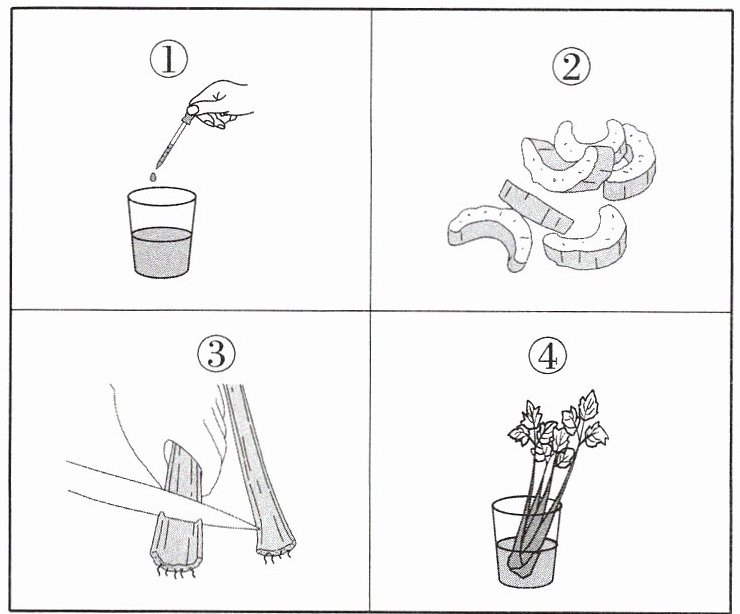
A. ①—③—②—④
B. ③—①—②—④
C. ①—③—④—②
D. ③—①—④—②
3. What is the aim(目的) of the experiment?
A. To tell us plants would die without water.
B. To tell us the way water runs through a plant.
C. To show doing a scientific experiment on plants is easy.
D. To show how to make colourful leaves by colouring the water.
A
A Fun Plant Experiment(实验) to Try at Home!
Without water, plants would die(死亡). How does water run from the roots(根) of a plant to the other parts of the plant? The water travels through "small pipes" to all parts of the plant. And here is a scientific experiment to show it.
What we need:
How we do it:
1. Put a few drops(几滴) of the red food colour in the glass of water.
2. Cut the bottom of the celery stick and place the celery in the water.
3. Leave the celery stick in the glass of water for a few hours.
4. Take the celery stick out of water and cut it into pieces across the stem.
What happens:
You can see red food colour in all cross parts, from the bottom of the celery stick right up to the leaves.
Why it happens:
The water, with the red food colour, has run in the celery stick through the small pipes in it. The experiment, therefore, shows that the small pipes in the plant allow water to reach all parts of it. The red food colour shows where the water has travelled in the celery stick.
1. According to the experiment, what can you see after cutting the celery stick into cross parts?
A. The inside of the celery stick has nothing.
B. The water in the celery stick is running.
C. The celery stick is bigger and taller.
D. All the cross parts are red.
2. Which shows the CORRECT order of the experiment?
A. ①—③—②—④
B. ③—①—②—④
C. ①—③—④—②
D. ③—①—④—②
3. What is the aim(目的) of the experiment?
A. To tell us plants would die without water.
B. To tell us the way water runs through a plant.
C. To show doing a scientific experiment on plants is easy.
D. To show how to make colourful leaves by colouring the water.
答案
【文章大意】本文是一篇说明文。文章通过一个实验证明水是如何在植物内部传输的。
1. D 细节理解题。根据“You can see red food colour in all cross parts, from the bottom of the celery stick right up to the leaves.”可知,你可以看到从芹菜杆底部到叶子所有横切面都是红色的食用色素。故选 D。
2. C 事件排序题。根据“Put a few drops of the red food colour in the glass of water.”可知,首先是在一杯水里滴几滴红色食用色素,即①;根据“Cut the bottom of the celery stick and place the celery in the water.”可知,然后是切芹菜杆的底部,并把芹菜放在水里,即③;根据“Leave the celery stick in the glass of water for a few hours.”可知,接下来是把芹菜杆置于水中几个小时,即④;根据“Take the celery stick out of water and cut it into pieces across the stem.”可知,最后是将芹菜杆从水中取出,从尾部切成小块,即②;因此正确的顺序为①-③-④-②。故选 C。
3. B 主旨大意题。根据“How does water run from the roots of a plant to the other parts of the plant … And here is a scientific experiment to show it.”及全文可知,本文通过一个实验证明水是如何在植物内部传输的。故选 B。
解析
【分析】
这是一篇关于植物输水实验的阅读理解题,包含细节理解、事件排序、主旨大意三类基础题型。解题时需先通读文章,明确实验内容、步骤、结果及目的;针对每道题,先定位题目关键词,再回到原文对应位置找依据,逐一排除错误选项得出答案。
【解析】
1. 第1题是细节理解题,根据原文“What happens”部分的“You can see red food colour in all cross parts, from the bottom of the celery stick right up to the leaves.”可知,芹菜杆的所有横切面都有红色食用色素,对应选项D。
2. 第2题是事件排序题,需按实验步骤的先后顺序判断:原文实验步骤依次为①在水中滴红色食用色素→③切芹菜杆底部并放入水中→④将芹菜杆置于水中数小时→②取出芹菜杆并横切,因此正确顺序为①—③—④—②,对应选项C。
3. 第3题是主旨大意题,根据原文开头“How does water run from the roots of a plant to the other parts of the plant? … And here is a scientific experiment to show it.”可知,实验目的是展示水在植物体内的运输方式,对应选项B。
【答案】
1. D 2. C 3. B
【知识点】
阅读理解-细节理解;阅读理解-事件排序;阅读理解-主旨大意
【点评】
本文是一篇介绍植物输水实验的说明文,题目均为基础阅读题型,侧重考查学生对原文细节的定位、实验步骤的梳理及主旨的把握,整体难度较低,只要认真阅读原文即可正确解答。
【难度系数】
0.8
