

 登录
登录
Ⅴ. 阅读理解
跨学科 物理 Rainbows are created by light shining through water or clear objects. In nature, rainbows usually appear where rain and sunlight meet. Rainbows are beautiful tricks of light. Science, though, has unlocked their mysteries.
Where and When Rainbows Appear
Notice the weather the next time you see a rainbow. There will be rain or mist(薄雾) in front of you, and the Sun will be shining from behind you. The rainbow will appear in the rain or mist. Water in the air and direct light are the two things needed to see a rainbow in nature. A rainbow won't appear if the sky is too cloudy.
The best time to see a rainbow is usually in the morning or late afternoon. That's when the Sun is in the best place to create one. If you're lucky, you might see a double or even a triple rainbow.
You can sometimes see rainbows in the mist of a waterfall too. A fountain(喷泉) can create a small rainbow, and a sprinkler(洒水器) on a sunny day may put on a colourful show. Rainbows can even form under a bright moon. These special rainbows are called moonbows.
To a viewer, a rainbow looks like a half circle. However, a rainbow actually forms a full circle. From the ground, most times we can only see a rainbow's top half. Sometimes though, lucky airline pilots may see a rainbow's complete circle from the sky.
How Rainbows Form
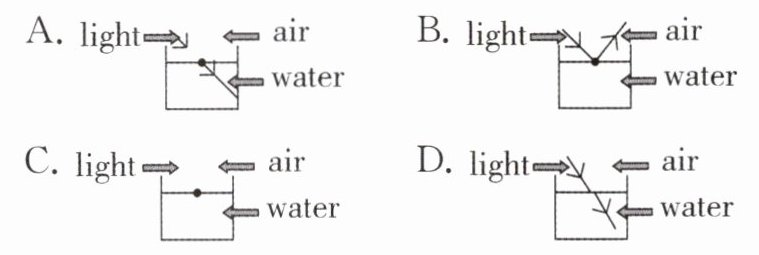
René Descartes was a French scientist. He was born over four hundred years ago. He was attracted by rainbows and wanted to learn more about them. He used sunlight and a big ball filled with water to do experiments. Descartes discovered that to see a rainbow, the viewer must be looking at the light from the right angle(角度). To understand rainbows, it helps to understand how light travels. Light moves at different speeds through different mediums(介质). Think of running on land. Then imagine running in knee-deep water. You move slower through water. In the same way, light moves faster through air than through water. This happens because water is thicker than air. When light enters water, it slows and changes its original path(路线). This process makes objects, such as a pencil sitting in a glass of water seem to bend(弯曲).
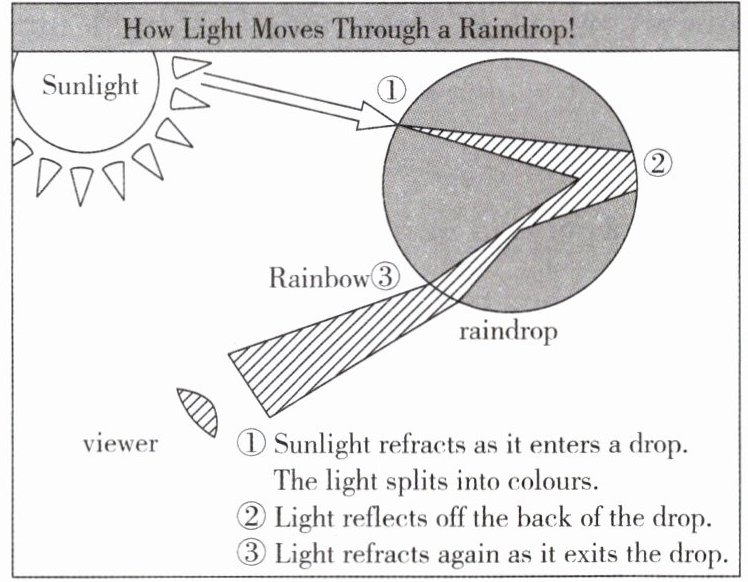
We can see rainbows in nature when direct light meets drops of rain. Sunlight refracts(折射) as it enters each drop. The light then reflects, or bounces, off the inside of each drop, like light off a mirror. The light refracts again as it exits the drop. Light refracts and reflects in millions of water droplets in the sky at the same time. This process makes all the colours of a rainbow.
1. Which sentence below can best explain the underlined sentence "Rainbows are beautiful tricks of light." in Paragraph 1?
A. Rainbows are tricks made by many scientists.
B. Someone lied to us about the truth of rainbows.
C. Rainbows are made by some unknown magic tricks.
D. The light plays tricks on people's eyes and makes rainbows.
2. In which of the following situations CAN'T a rainbow form?
A. Over a sprinkler on a very cloudy day.
B. On a misty morning.
C. Over a fountain under a bright moon.
D. In the mist of a waterfall.
3. 新考法 图示理解 Which could be [二维码] the best picture for the underlined sentence in Paragraph 6?
4. Which statement below is TRUE according to the article?
A. A rainbow can be a complete circle as well as a half circle.
B. You need to stand at a right angle to see a rainbow.
C. Light can actually make a pencil bend in water.
D. Light moves faster in thicker mediums like water.
跨学科 物理 Rainbows are created by light shining through water or clear objects. In nature, rainbows usually appear where rain and sunlight meet. Rainbows are beautiful tricks of light. Science, though, has unlocked their mysteries.
Where and When Rainbows Appear
Notice the weather the next time you see a rainbow. There will be rain or mist(薄雾) in front of you, and the Sun will be shining from behind you. The rainbow will appear in the rain or mist. Water in the air and direct light are the two things needed to see a rainbow in nature. A rainbow won't appear if the sky is too cloudy.
The best time to see a rainbow is usually in the morning or late afternoon. That's when the Sun is in the best place to create one. If you're lucky, you might see a double or even a triple rainbow.
You can sometimes see rainbows in the mist of a waterfall too. A fountain(喷泉) can create a small rainbow, and a sprinkler(洒水器) on a sunny day may put on a colourful show. Rainbows can even form under a bright moon. These special rainbows are called moonbows.
To a viewer, a rainbow looks like a half circle. However, a rainbow actually forms a full circle. From the ground, most times we can only see a rainbow's top half. Sometimes though, lucky airline pilots may see a rainbow's complete circle from the sky.
How Rainbows Form
René Descartes was a French scientist. He was born over four hundred years ago. He was attracted by rainbows and wanted to learn more about them. He used sunlight and a big ball filled with water to do experiments. Descartes discovered that to see a rainbow, the viewer must be looking at the light from the right angle(角度). To understand rainbows, it helps to understand how light travels. Light moves at different speeds through different mediums(介质). Think of running on land. Then imagine running in knee-deep water. You move slower through water. In the same way, light moves faster through air than through water. This happens because water is thicker than air. When light enters water, it slows and changes its original path(路线). This process makes objects, such as a pencil sitting in a glass of water seem to bend(弯曲).
We can see rainbows in nature when direct light meets drops of rain. Sunlight refracts(折射) as it enters each drop. The light then reflects, or bounces, off the inside of each drop, like light off a mirror. The light refracts again as it exits the drop. Light refracts and reflects in millions of water droplets in the sky at the same time. This process makes all the colours of a rainbow.
1. Which sentence below can best explain the underlined sentence "Rainbows are beautiful tricks of light." in Paragraph 1?
A. Rainbows are tricks made by many scientists.
B. Someone lied to us about the truth of rainbows.
C. Rainbows are made by some unknown magic tricks.
D. The light plays tricks on people's eyes and makes rainbows.
2. In which of the following situations CAN'T a rainbow form?
A. Over a sprinkler on a very cloudy day.
B. On a misty morning.
C. Over a fountain under a bright moon.
D. In the mist of a waterfall.
3. 新考法 图示理解 Which could be [二维码] the best picture for the underlined sentence in Paragraph 6?
4. Which statement below is TRUE according to the article?
A. A rainbow can be a complete circle as well as a half circle.
B. You need to stand at a right angle to see a rainbow.
C. Light can actually make a pencil bend in water.
D. Light moves faster in thicker mediums like water.
答案
1.D 2.A 3.D 4.B
【文章大意】本文是一篇说明文,主要解释了彩虹是如何形成的,以及在什么条件下可以看到彩虹。
1. D 解析:句意猜测题。根据“Rainbows are beautiful tricks of light.”可知,“彩虹是光的美丽把戏”,这句话的意思是光通过折射、反射等作用让我们看到彩虹,就好像在跟我们的眼睛玩把戏一样。因此 D 选项“光对人的眼睛玩把戏,从而形成彩虹”是最能解释这句话的。故选 D。
2. A 解析:细节理解题。根据“A fountain can create a small rainbow, and a sprinkler on a sunny day may put on a colourful show.”及“A rainbow won't appear if the sky is too cloudy.”可知,洒水器在天气晴朗时可以形成彩虹,在多云天气不能形成彩虹。故选 A。
3. D 解析:图示理解题。根据“When light enters water, it slows and changes its original path. This process makes objects, such as a pencil sitting in a glass of water seem to bend.”可知,当光进入水中时,它的速度会减慢,并且会改变其原本的传播路径。这一过程使得诸如放在水杯里的铅笔之类的物体看起来好像发生了弯曲。这里描述了光的折射现象,选项 D 显示了这个现象。故选 D。
4. B 解析:判断正误题。根据“Descartes discovered that to see a rainbow, the viewer must be looking at the light from the right angle.”可知,观看者要在正确的角度才能看到彩虹。选项 B“你需要站在正确的角度才能看到彩虹。”表述正确。故选 B。
【文章大意】本文是一篇说明文,主要解释了彩虹是如何形成的,以及在什么条件下可以看到彩虹。
1. D 解析:句意猜测题。根据“Rainbows are beautiful tricks of light.”可知,“彩虹是光的美丽把戏”,这句话的意思是光通过折射、反射等作用让我们看到彩虹,就好像在跟我们的眼睛玩把戏一样。因此 D 选项“光对人的眼睛玩把戏,从而形成彩虹”是最能解释这句话的。故选 D。
2. A 解析:细节理解题。根据“A fountain can create a small rainbow, and a sprinkler on a sunny day may put on a colourful show.”及“A rainbow won't appear if the sky is too cloudy.”可知,洒水器在天气晴朗时可以形成彩虹,在多云天气不能形成彩虹。故选 A。
3. D 解析:图示理解题。根据“When light enters water, it slows and changes its original path. This process makes objects, such as a pencil sitting in a glass of water seem to bend.”可知,当光进入水中时,它的速度会减慢,并且会改变其原本的传播路径。这一过程使得诸如放在水杯里的铅笔之类的物体看起来好像发生了弯曲。这里描述了光的折射现象,选项 D 显示了这个现象。故选 D。
4. B 解析:判断正误题。根据“Descartes discovered that to see a rainbow, the viewer must be looking at the light from the right angle.”可知,观看者要在正确的角度才能看到彩虹。选项 B“你需要站在正确的角度才能看到彩虹。”表述正确。故选 B。
解析
【分析】
拿到这篇跨学科说明文阅读,首先先通读全文把握核心内容:文章介绍了彩虹的出现条件、不同特殊彩虹的类型以及彩虹的光学形成原理。解题时按照“题干关键词定位原文→逐一比对选项→排除错误项”的思路推进:第1题句意猜测,结合后文彩虹的光学形成逻辑排除不符合文意的选项;第2题找无法形成彩虹的场景,先明确彩虹形成的两个必要条件是水雾/水滴+充足直射光,回原文定位对应场景的描述即可判断;第3题图示理解,定位划线句的内容,匹配对应的光的折射现象的图示;第4题判断正误,逐个选项回原文核对细节,避开偷换概念的陷阱选出正确项。
【解析】
1. 句意猜测题:定位第一段划线句,结合全文对彩虹形成原理的介绍,彩虹是光经过水滴折射、反射后产生的特殊视觉效果,是光的作用带来的奇妙现象。逐一排除错误选项:A选项称彩虹是科学家制造的把戏,完全不符合原文内容;B选项称有人隐瞒彩虹的真相,原文无相关表述;C选项称彩虹是未知魔法形成的,和原文“科学已经解开彩虹奥秘”的描述相悖;只有D选项“光对人眼呈现特殊效果从而形成彩虹”最贴合划线句含义,故选D。
2. 细节理解题:定位原文两处关键信息:①“A rainbow won't appear if the sky is too cloudy”,②“a sprinkler on a sunny day may put on a colourful show”,可知洒水器需要在晴天有充足直射光的条件下才能形成彩虹,多云天没有足够直射光无法形成彩虹。其余选项:薄雾清晨、亮月下的喷泉、瀑布水雾都满足彩虹形成的条件,只有A场景无法形成彩虹,故选A。
3. 图示理解题:定位第六段划线句,该句描述的是光从空气进入水中时速度变慢、传播路径改变的折射现象,最终呈现出水杯中的铅笔看起来弯折的效果,对应展示该现象的图示D,故选D。
4. 判断正误题:逐一核对选项:A选项表述错误,原文说明彩虹本身实际是完整的圆形,地面观测者大多只能看到上半部分的半圆,并非彩虹本身既是半圆又是整圆;B选项表述正确,完全匹配原文“观测者需要从正确的角度看向光线才能看到彩虹”的描述;C选项表述错误,原文说明水中的铅笔只是看起来弯折,并非真的被光掰弯;D选项表述错误,原文明确光在密度更大的水中传播速度比在空气中更慢,故选B。
【答案】
1.D 2.A 3.D 4.B
【知识点】
阅读细节定位,光的折射原理,句意猜测
【点评】
本题属于跨物理学科的英语阅读题型,兼顾英语阅读能力考查和基础光学常识的应用,新考法的图示理解题设计新颖,整体陷阱设置多为细节偷换,学生只要耐心回原文定位对应内容,结合基础常识就可以顺利解题,注意区分“视觉假象”和“实际现象”的细节差异即可避开易错点。
【难度系数】
0.7
拿到这篇跨学科说明文阅读,首先先通读全文把握核心内容:文章介绍了彩虹的出现条件、不同特殊彩虹的类型以及彩虹的光学形成原理。解题时按照“题干关键词定位原文→逐一比对选项→排除错误项”的思路推进:第1题句意猜测,结合后文彩虹的光学形成逻辑排除不符合文意的选项;第2题找无法形成彩虹的场景,先明确彩虹形成的两个必要条件是水雾/水滴+充足直射光,回原文定位对应场景的描述即可判断;第3题图示理解,定位划线句的内容,匹配对应的光的折射现象的图示;第4题判断正误,逐个选项回原文核对细节,避开偷换概念的陷阱选出正确项。
【解析】
1. 句意猜测题:定位第一段划线句,结合全文对彩虹形成原理的介绍,彩虹是光经过水滴折射、反射后产生的特殊视觉效果,是光的作用带来的奇妙现象。逐一排除错误选项:A选项称彩虹是科学家制造的把戏,完全不符合原文内容;B选项称有人隐瞒彩虹的真相,原文无相关表述;C选项称彩虹是未知魔法形成的,和原文“科学已经解开彩虹奥秘”的描述相悖;只有D选项“光对人眼呈现特殊效果从而形成彩虹”最贴合划线句含义,故选D。
2. 细节理解题:定位原文两处关键信息:①“A rainbow won't appear if the sky is too cloudy”,②“a sprinkler on a sunny day may put on a colourful show”,可知洒水器需要在晴天有充足直射光的条件下才能形成彩虹,多云天没有足够直射光无法形成彩虹。其余选项:薄雾清晨、亮月下的喷泉、瀑布水雾都满足彩虹形成的条件,只有A场景无法形成彩虹,故选A。
3. 图示理解题:定位第六段划线句,该句描述的是光从空气进入水中时速度变慢、传播路径改变的折射现象,最终呈现出水杯中的铅笔看起来弯折的效果,对应展示该现象的图示D,故选D。
4. 判断正误题:逐一核对选项:A选项表述错误,原文说明彩虹本身实际是完整的圆形,地面观测者大多只能看到上半部分的半圆,并非彩虹本身既是半圆又是整圆;B选项表述正确,完全匹配原文“观测者需要从正确的角度看向光线才能看到彩虹”的描述;C选项表述错误,原文说明水中的铅笔只是看起来弯折,并非真的被光掰弯;D选项表述错误,原文明确光在密度更大的水中传播速度比在空气中更慢,故选B。
【答案】
1.D 2.A 3.D 4.B
【知识点】
阅读细节定位,光的折射原理,句意猜测
【点评】
本题属于跨物理学科的英语阅读题型,兼顾英语阅读能力考查和基础光学常识的应用,新考法的图示理解题设计新颖,整体陷阱设置多为细节偷换,学生只要耐心回原文定位对应内容,结合基础常识就可以顺利解题,注意区分“视觉假象”和“实际现象”的细节差异即可避开易错点。
【难度系数】
0.7
