

 登录
登录
Ⅰ.根据句意及汉语提示写单词
1. The boss of the restaurant was a friend of
2. We need several
3. I pick up a hard
4. We have only one earth. It's our
5. Why do you ask him such a
1. The boss of the restaurant was a friend of
mine
(我的).2. We need several
steps
(步骤) to solve the problem.3. I pick up a hard
rock
(岩石) from the mountain.4. We have only one earth. It's our
common
(共同的) home.5. Why do you ask him such a
silly
(愚蠢的) question?答案
1. mine 2. steps 3. rock 4. common 5. silly
解析
【分析】
本题为根据汉语提示写单词的基础英语题,解题思路为:先分析每个句子的语法结构,结合汉语提示确定所需单词的词性,再根据语境(如可数名词的复数变化、物主代词的用法等)确定单词的正确形式。
【解析】
1. 句意为“这家餐厅的老板是我的一个朋友”,此处表示“我的(朋友)”,后无名词,需用名词性物主代词,故填mine;
2. several(几个)后接可数名词复数,“步骤”的复数形式为steps,故填steps;
3. “岩石”对应的英文为rock,此处用单数形式即可,故填rock;
4. 修饰名词home需用形容词,“共同的”对应的形容词为common,故填common;
5. 修饰名词question需用形容词,“愚蠢的”对应的形容词为silly,故填silly。
【答案】
1. mine 2. steps 3. rock 4. common 5. silly
【知识点】
名词性物主代词、可数名词复数、形容词用法
【点评】
本题考查基础词汇的运用,难度较低,主要检验学生对核心词汇的拼写和基本语法(如物主代词、名词复数)的掌握情况,是英语学习中的基础题型。
【难度系数】
0.9
本题为根据汉语提示写单词的基础英语题,解题思路为:先分析每个句子的语法结构,结合汉语提示确定所需单词的词性,再根据语境(如可数名词的复数变化、物主代词的用法等)确定单词的正确形式。
【解析】
1. 句意为“这家餐厅的老板是我的一个朋友”,此处表示“我的(朋友)”,后无名词,需用名词性物主代词,故填mine;
2. several(几个)后接可数名词复数,“步骤”的复数形式为steps,故填steps;
3. “岩石”对应的英文为rock,此处用单数形式即可,故填rock;
4. 修饰名词home需用形容词,“共同的”对应的形容词为common,故填common;
5. 修饰名词question需用形容词,“愚蠢的”对应的形容词为silly,故填silly。
【答案】
1. mine 2. steps 3. rock 4. common 5. silly
【知识点】
名词性物主代词、可数名词复数、形容词用法
【点评】
本题考查基础词汇的运用,难度较低,主要检验学生对核心词汇的拼写和基本语法(如物主代词、名词复数)的掌握情况,是英语学习中的基础题型。
【难度系数】
0.9
(
A.For
B.As
C.Of
D.At
B
)1. As
a teacher, I always take good care of my students.A.For
B.As
C.Of
D.At
答案
1. B
解析
【分析】这道题考查介词的词义辨析,需结合句意判断合适的介词。句子表达的是“作为一名老师,我总是好好照顾我的学生”,需要选表示“作为”含义的介词。
【解析】逐一分析选项:A选项For意为“为了;对于”,不符合句意;B选项As意为“作为”,契合句子语境;C选项Of意为“……的”,表所属关系,不合适;D选项At意为“在(某处、某时刻)”,不符合语义。根据句意,此处应选表示“作为”的介词,故答案为B。
【答案】B
【知识点】介词辨析
【点评】本题是基础介词词义考查,结合句子语境即可选出正确选项,属于英语基础题。
【难度系数】0.2
【解析】逐一分析选项:A选项For意为“为了;对于”,不符合句意;B选项As意为“作为”,契合句子语境;C选项Of意为“……的”,表所属关系,不合适;D选项At意为“在(某处、某时刻)”,不符合语义。根据句意,此处应选表示“作为”的介词,故答案为B。
【答案】B
【知识点】介词辨析
【点评】本题是基础介词词义考查,结合句子语境即可选出正确选项,属于英语基础题。
【难度系数】0.2
(
A.also
B.too
C.either
D.much
C
)2. I don't like coffee and I don't like tea either
.A.also
B.too
C.either
D.much
答案
2. C 【解析】also也,用于肯定句句中;too也,用于肯定句句尾;either也,用于否定句;much很多。根据“I don't like tea”可知,此处表示也不喜欢茶,句子是否定句。故选C。
解析
【分析】本题考查副词的用法辨析,解题思路为:首先判断句子类型,题干后半句“I don't like tea”是否定句;再回忆各选项副词的使用场景:also用于肯定句句中,too用于肯定句句尾,either用于否定句句尾,much表“很多”不符合“也”的语义;最后结合否定句语境,选出对应表达。
【解析】also意为“也”,用于肯定句句中;too意为“也”,用于肯定句句尾;either意为“也”,用于否定句句尾;much意为“很多”,不符合句意。题干为否定句,需用either,故选C。
【答案】C
【知识点】副词辨析
【点评】本题考查常用副词的用法辨析,属于基础知识点,需准确掌握also、too、either的使用场景。
【难度系数】0.6
【解析】also意为“也”,用于肯定句句中;too意为“也”,用于肯定句句尾;either意为“也”,用于否定句句尾;much意为“很多”,不符合句意。题干为否定句,需用either,故选C。
【答案】C
【知识点】副词辨析
【点评】本题考查常用副词的用法辨析,属于基础知识点,需准确掌握also、too、either的使用场景。
【难度系数】0.6
(
—It's Jane. She usually sings at this time every day.
A.sing
B.sings
C.is singing
D.singing
C
)3. —Listen! Who is singing
in the music room?—It's Jane. She usually sings at this time every day.
A.sing
B.sings
C.is singing
D.singing
答案
3. C
解析
【分析】首先,句首的“Listen!”是现在进行时的标志性提示词,说明动作正在发生,需使用现在进行时。现在进行时的结构为“am/is/are + 动词的现在分词”,句子主语是疑问词Who,视为单数,因此be动词用is,动词sing的现在分词是singing,结合选项即可选出正确答案。
【解析】根据句首的“Listen!”可知,此处描述的是正在进行的动作,应使用现在进行时。现在进行时的结构为“主语 + am/is/are + 现在分词”,本句主语Who为单数,故be动词用is,sing的现在分词是singing,因此填入“is singing”,对应选项C。
【答案】C
【知识点】现在进行时、动词时态
【点评】本题考查现在进行时的基本用法,重点在于识别“Listen!”这类现在进行时的标志词,属于基础语法题,需牢记时态结构。
【难度系数】0.5
【解析】根据句首的“Listen!”可知,此处描述的是正在进行的动作,应使用现在进行时。现在进行时的结构为“主语 + am/is/are + 现在分词”,本句主语Who为单数,故be动词用is,sing的现在分词是singing,因此填入“is singing”,对应选项C。
【答案】C
【知识点】现在进行时、动词时态
【点评】本题考查现在进行时的基本用法,重点在于识别“Listen!”这类现在进行时的标志词,属于基础语法题,需牢记时态结构。
【难度系数】0.5
(
A.For example
B.Such as
C.After all
D.What about
C
)4. He can't count from one to one hundred. After all
, he is only three years old.A.For example
B.Such as
C.After all
D.What about
答案
4. C 【解析】For example例如;Such as例如;After all毕竟;What about怎么样。根据“He can't count from one to one hundred..., he is only three years old.”可知,空格后强调他的年龄小,填After all符合语境。
解析
【分析】首先明确各选项短语的含义,再结合句子逻辑关系判断:句子前半部分说明“他不能从1数到100”,后半句“他只有三岁”是解释原因,需选择表“毕竟”的短语。A“例如”、B“例如(接名词短语)”用于举例,不符合语境;D“怎么样”用于提建议或询问,也不合适,只有C符合逻辑。
【解析】逐一分析选项:A.For example意为“例如”,用于举例,不符合此处解释原因的语境;B.Such as意为“例如”,后接名词或名词短语,用于举例,不符合语境;C.After all意为“毕竟”,用于引出理由,契合“他只有三岁所以不会数数”的逻辑;D.What about意为“怎么样”,用于询问或提建议,与语境不符。因此选C。
【答案】C
【知识点】介词短语辨析、语境运用
【点评】本题考查常用介词短语的词义辨析,需结合句子逻辑关系选择合适的短语,属于基础题型。
【难度系数】0.7
【解析】逐一分析选项:A.For example意为“例如”,用于举例,不符合此处解释原因的语境;B.Such as意为“例如”,后接名词或名词短语,用于举例,不符合语境;C.After all意为“毕竟”,用于引出理由,契合“他只有三岁所以不会数数”的逻辑;D.What about意为“怎么样”,用于询问或提建议,与语境不符。因此选C。
【答案】C
【知识点】介词短语辨析、语境运用
【点评】本题考查常用介词短语的词义辨析,需结合句子逻辑关系选择合适的短语,属于基础题型。
【难度系数】0.7
(
—It was great.
A.How; feel about
B.What; like
C.What; feel about
D.How; think of
A
)5. —How
did you feel about
the school trip?—It was great.
A.How; feel about
B.What; like
C.What; feel about
D.How; think of
答案
5. A
解析
【分析】
这道题考查询问对事物看法的固定交际句型,解题思路是先回忆英语中询问对某物看法的两种常用正确表达,再逐一分析选项的搭配是否符合句型要求,从而选出正确答案。
【解析】
英语中询问对事物看法的常用句型有两个:①How do you feel about sth?(你觉得某物怎么样?);②What do you think of sth?(你认为某物怎么样?)。逐一分析选项:A选项“How; feel about”,符合句型①的结构,正确;B选项“What; like”,正确表达应为“What do you like about sth?”,用于询问喜欢的具体内容,不符合语境;C选项“What; feel about”,搭配错误,应使用How而非What;D选项“How; think of”,搭配错误,应使用What而非How。因此正确答案为A。
【答案】
A
【知识点】
特殊疑问句(询问看法的句型)
【点评】
本题考查日常交际用语中询问对事物看法的固定句型,属于基础题型,需要学生牢记常用的表达结构,难度较低。
【难度系数】
0.7
这道题考查询问对事物看法的固定交际句型,解题思路是先回忆英语中询问对某物看法的两种常用正确表达,再逐一分析选项的搭配是否符合句型要求,从而选出正确答案。
【解析】
英语中询问对事物看法的常用句型有两个:①How do you feel about sth?(你觉得某物怎么样?);②What do you think of sth?(你认为某物怎么样?)。逐一分析选项:A选项“How; feel about”,符合句型①的结构,正确;B选项“What; like”,正确表达应为“What do you like about sth?”,用于询问喜欢的具体内容,不符合语境;C选项“What; feel about”,搭配错误,应使用How而非What;D选项“How; think of”,搭配错误,应使用What而非How。因此正确答案为A。
【答案】
A
【知识点】
特殊疑问句(询问看法的句型)
【点评】
本题考查日常交际用语中询问对事物看法的固定句型,属于基础题型,需要学生牢记常用的表达结构,难度较低。
【难度系数】
0.7
Ⅲ.在横线处填上一个适当的句子补全对话
A: Hello, Nick! This is Jason. 1.
B: It's snowing in my city, but the radio says it'll be sunny tomorrow.
A: 2.
B: Yes, it often snows in winter. And there is much ice on the road.
A: You must be careful to drive. 3.
B: It's from $-4°\mathrm{C}$ to $5°\mathrm{C}$ today. It's a little cold.
A: How is the weather in spring in your city? 4.
B: Yes, it is quite warm here in spring.
A: Which season do you like best?
B: 5.
A: I like spring better because it's warm and sunny. Everything begins to grow.
A: Hello, Nick! This is Jason. 1.
How is the weather today in your city
?B: It's snowing in my city, but the radio says it'll be sunny tomorrow.
A: 2.
Does it often snow in winter there
?B: Yes, it often snows in winter. And there is much ice on the road.
A: You must be careful to drive. 3.
What's the temperature today
?B: It's from $-4°\mathrm{C}$ to $5°\mathrm{C}$ today. It's a little cold.
A: How is the weather in spring in your city? 4.
Is it warm in spring
?B: Yes, it is quite warm here in spring.
A: Which season do you like best?
B: 5.
I like winter best
. Because I enjoy going skiing.A: I like spring better because it's warm and sunny. Everything begins to grow.
答案
1. How is the weather today in your city
2. Does it often snow in winter there
3. What's the temperature today
4. Is it warm in spring
5. I like winter best
2. Does it often snow in winter there
3. What's the temperature today
4. Is it warm in spring
5. I like winter best
解析
【分析】补全对话需结合上下文的问答逻辑,根据答语反推问句或根据问句确定答语内容。第1空,B回答城市的天气状况,故A询问当地天气;第2空,B回应冬天常下雪,故A询问当地冬天是否常下雪;第3空,B回答温度范围,故A询问当日气温;第4空,A询问春天情况,B答春天暖和,故A问春天是否暖和;第5空,A问最喜欢的季节,B因喜欢滑雪对应答喜欢的季节。
【解析】1. 由下文B的回答描述城市天气,可知A询问当地天气,故填How is the weather today in your city;2. 由下文B的肯定回答及“often snows in winter”,可知A询问当地冬天是否常下雪,故填Does it often snow in winter there;3. 由下文B回答温度范围,可知A询问当日气温,故填What's the temperature today;4. 由上文A问春天天气、下文B答春天暖和,可知A问春天是否暖和,故填Is it warm in spring;5. 由上文A问最喜欢的季节、下文B提到滑雪,可知B最喜欢冬天,故填I like winter best。
【答案】1. How is the weather today in your city 2. Does it often snow in winter there 3. What's the temperature today 4. Is it warm in spring 5. I like winter best
【知识点】情景交际、补全对话
【点评】本题考查日常情景对话的补全,需结合上下文语境及问答逻辑,属于基础题型,侧重考查学生日常用语的运用能力。
【难度系数】0.6
【解析】1. 由下文B的回答描述城市天气,可知A询问当地天气,故填How is the weather today in your city;2. 由下文B的肯定回答及“often snows in winter”,可知A询问当地冬天是否常下雪,故填Does it often snow in winter there;3. 由下文B回答温度范围,可知A询问当日气温,故填What's the temperature today;4. 由上文A问春天天气、下文B答春天暖和,可知A问春天是否暖和,故填Is it warm in spring;5. 由上文A问最喜欢的季节、下文B提到滑雪,可知B最喜欢冬天,故填I like winter best。
【答案】1. How is the weather today in your city 2. Does it often snow in winter there 3. What's the temperature today 4. Is it warm in spring 5. I like winter best
【知识点】情景交际、补全对话
【点评】本题考查日常情景对话的补全,需结合上下文语境及问答逻辑,属于基础题型,侧重考查学生日常用语的运用能力。
【难度系数】0.6
Ⅳ.阅读短文,完成下列表格
When we play a game with our classmates or friends, we usually need to make some rules first. I think it's very important to have rules.
There are lots of rules in my school.
We have to get to school on time. We have to wear the school uniform on Mondays and Thursdays. We can't run in the hallways. We can't fight. I think it's very good to have rules at school.
We have to follow traffic(交通) rules. We can go at green lights(灯) and have to stop at red lights. The traffic rules make us safe(安全的).
When we take a car or sit next to the driver, we have to wear the safety belts (安全带). Also, little children need to take the back seats. The car rules make us safe too.
Complete the chart according to the passage with only one word for each blank.
Rules
1.
● 2.
● Wear the school uniform on Mondays and Thursdays.
● 3.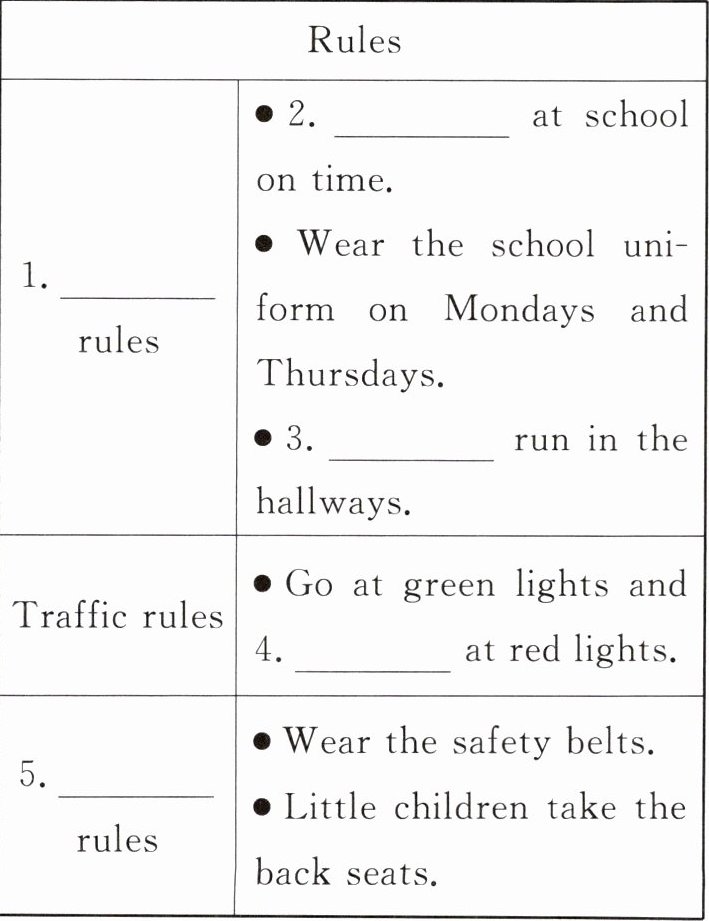 run in the hallways.
Traffic rules
● Go at green lights and 4.
5.
● Wear the safety belts.
● Little children take the back seats.
When we play a game with our classmates or friends, we usually need to make some rules first. I think it's very important to have rules.
There are lots of rules in my school.
We have to get to school on time. We have to wear the school uniform on Mondays and Thursdays. We can't run in the hallways. We can't fight. I think it's very good to have rules at school.
We have to follow traffic(交通) rules. We can go at green lights(灯) and have to stop at red lights. The traffic rules make us safe(安全的).
When we take a car or sit next to the driver, we have to wear the safety belts (安全带). Also, little children need to take the back seats. The car rules make us safe too.
Complete the chart according to the passage with only one word for each blank.
Rules
1.
school
rules● 2.
Arrive
at school on time.● Wear the school uniform on Mondays and Thursdays.
● 3.
run in the hallways.Traffic rules
● Go at green lights and 4.
stop
at red lights.5.
Car
rules● Wear the safety belts.
● Little children take the back seats.
答案
1. school 2. Arrive 3. Don't 4. stop
5. Car
5. Car
解析
【分析】本题要求根据短文内容完成表格填空,解题思路为:先通读短文,明确每个空格对应的规则类别及原文相关语句,再结合“每个空填一个词”的要求,提取原文关键信息确定答案。
【解析】1. 由短文第二段“There are lots of rules in my school”可知,第一类规则是学校规则,故填school;2. 对应原文“We have to get to school on time”,此处用祈使句表达,填Arrive;3. 对应原文“We can't run in the hallways”,祈使句否定形式,填Don't;4. 对应原文“have to stop at red lights”,故填stop;5. 最后一段介绍乘车相关规则,对应Car rules,故填Car。
【答案】1. school 2. Arrive 3. Don't 4. stop 5. Car
【知识点】阅读理解,细节提取
【点评】本题考查学生对短文细节信息的定位与提取能力,需准确匹配原文内容,难度适中。
【难度系数】0.6
【解析】1. 由短文第二段“There are lots of rules in my school”可知,第一类规则是学校规则,故填school;2. 对应原文“We have to get to school on time”,此处用祈使句表达,填Arrive;3. 对应原文“We can't run in the hallways”,祈使句否定形式,填Don't;4. 对应原文“have to stop at red lights”,故填stop;5. 最后一段介绍乘车相关规则,对应Car rules,故填Car。
【答案】1. school 2. Arrive 3. Don't 4. stop 5. Car
【知识点】阅读理解,细节提取
【点评】本题考查学生对短文细节信息的定位与提取能力,需准确匹配原文内容,难度适中。
【难度系数】0.6
