

 登录
登录
二、阅读理解。

Brief introduction: When the selfish Giant builds a high wall around his lovely garden to keep the children out, the North Wind blows, the Frost(霜) comes and the Snow dances through the trees. The Giant ▲ why spring never comes to his cold, white garden. Then one day, the Giant looks out of the window and sees a wonderful sight(景象)...
◆ From this story, I have learned that we shouldn't be selfish. We should be generous(慷慨的), kind and friendly to others. Just as an old saying goes, "Your happiness is my happiness." If we all share our pleasant things with others, the world will be better.
— Yu Junzhe
◆ After reading this story, I think being selfish is very bad behaviour(行为). We can't just enjoy good things by ourselves like the Giant. We should learn to share, so that we can make good friends and get real happiness.
— Fan Yuqi
◆ After reading this story, I've learned that we shouldn't be selfish. We need to share good things with other people. Only when a person is willing to share joy with others can a group of people have a lot of fun.
— Xu Ya'nan
1. Which of the following words can be put in the " ▲ "?
A. thinks B. believes
C. wonders D. knows
2. What CAN'T we learn from the three comments?
A. We should make more friends.
B. Sharing with others is joyful.
C. Your happiness is my happiness.
D. We should be friendly to others.
3. From the three comments we know that the Giant is ______ in the beginning.
A. happy B. friendly
C. generous D. selfish
深度阅读·回答问题
4. Why is it important to share with others according to the three students?
情境三 如何与他人友好相处是我们必须学会面对的问题。
Brief introduction: When the selfish Giant builds a high wall around his lovely garden to keep the children out, the North Wind blows, the Frost(霜) comes and the Snow dances through the trees. The Giant ▲ why spring never comes to his cold, white garden. Then one day, the Giant looks out of the window and sees a wonderful sight(景象)...
◆ From this story, I have learned that we shouldn't be selfish. We should be generous(慷慨的), kind and friendly to others. Just as an old saying goes, "Your happiness is my happiness." If we all share our pleasant things with others, the world will be better.
— Yu Junzhe
◆ After reading this story, I think being selfish is very bad behaviour(行为). We can't just enjoy good things by ourselves like the Giant. We should learn to share, so that we can make good friends and get real happiness.
— Fan Yuqi
◆ After reading this story, I've learned that we shouldn't be selfish. We need to share good things with other people. Only when a person is willing to share joy with others can a group of people have a lot of fun.
— Xu Ya'nan
1. Which of the following words can be put in the " ▲ "?
A. thinks B. believes
C. wonders D. knows
2. What CAN'T we learn from the three comments?
A. We should make more friends.
B. Sharing with others is joyful.
C. Your happiness is my happiness.
D. We should be friendly to others.
3. From the three comments we know that the Giant is ______ in the beginning.
A. happy B. friendly
C. generous D. selfish
深度阅读·回答问题
4. Why is it important to share with others according to the three students?
Because sharing makes us get real happiness and makes the world better.
情境三 如何与他人友好相处是我们必须学会面对的问题。
答案
1. C 句子还原题。根据“When the selfish Giant builds a high wall around his lovely garden to keep the children out, the North Wind blows, the Frost comes and the Snow dances through the trees.”可知,自私的巨人建起高墙把孩子们挡在外面后,花园变得寒冷且一片白色,此时巨人对于春天为何从不来到他寒冷、洁白的花园应是感到疑惑的。
2. A 推理判断题。根据于俊哲的评论“Just as an old saying goes, 'Your happiness is my happiness.' If we all share our pleasant things with others, the world will be better.”可知,C选项“你的幸福就是我的幸福”以及B选项“与他人分享是快乐的”均可在其评论中找到依据;根据范雨琪的评论“We should learn to share, so that we can make good friends and get real happiness.”以及许亚楠的评论“... we shouldn't be selfish. We need to share good things with other people.”可知,D选项“我们应该对他人友好”符合范和许的观点,本文并未提及我们应该交更多朋友。
3. D 推理判断题。根据于俊哲的评论“From this story, I have learned that we shouldn't be selfish.”,范雨琪的评论“After reading this story, I think being selfish is very bad behaviour. We can't just enjoy good things by ourselves like the Giant.”以及许亚楠的评论“... we shouldn't be selfish. We need to share good things with other people.”可知,三人都提到不应自私,且范雨琪明确指出巨人(一开始)的行为是自私的,只自己享受美好的事物,由此可推断出巨人一开始是自私的。
4. Because sharing makes us get real happiness and makes the world better.
2. A 推理判断题。根据于俊哲的评论“Just as an old saying goes, 'Your happiness is my happiness.' If we all share our pleasant things with others, the world will be better.”可知,C选项“你的幸福就是我的幸福”以及B选项“与他人分享是快乐的”均可在其评论中找到依据;根据范雨琪的评论“We should learn to share, so that we can make good friends and get real happiness.”以及许亚楠的评论“... we shouldn't be selfish. We need to share good things with other people.”可知,D选项“我们应该对他人友好”符合范和许的观点,本文并未提及我们应该交更多朋友。
3. D 推理判断题。根据于俊哲的评论“From this story, I have learned that we shouldn't be selfish.”,范雨琪的评论“After reading this story, I think being selfish is very bad behaviour. We can't just enjoy good things by ourselves like the Giant.”以及许亚楠的评论“... we shouldn't be selfish. We need to share good things with other people.”可知,三人都提到不应自私,且范雨琪明确指出巨人(一开始)的行为是自私的,只自己享受美好的事物,由此可推断出巨人一开始是自私的。
4. Because sharing makes us get real happiness and makes the world better.
解析
【分析】
1. 第1题是句子还原题,需结合上下文语境:巨人把孩子挡在花园外后,花园没有春天,他对这种反常情况感到疑惑,需选择表“疑惑”的词;
2. 第2题是推理判断题,需逐一核对选项与三位学生评论的内容,找出未提及的选项;
3. 第3题是推理判断题,根据三位学生的评论都提到巨人的自私行为,可推断巨人最初的性格;
4. 第4题是细节理解题,需从三位学生的评论中提取分享重要性的相关内容。
【解析】
1. 第1题:根据原文语境,巨人建起高墙挡走孩子后,花园变得寒冷且无春天,他应疑惑春天为何不来,wonders(疑惑)符合语境,故选C;
2. 第2题:于俊哲的评论提到“Your happiness is my happiness”及分享让世界更好,对应B、C;范雨琪和许亚楠的评论提到要对他人友好,对应D;原文未提及“交更多朋友”,故选A;
3. 第3题:三位学生的评论均指出巨人自私,只独自享受美好事物,因此巨人一开始是自私的,故选D;
4. 第4题:从三位学生的评论中可提取:分享能让我们获得真正的快乐,让世界变得更好,因此答案为Because sharing makes us get real happiness and makes the world better.
【答案】
1. C
2. A
3. D
4. Because sharing makes us get real happiness and makes the world better.
【知识点】
英语阅读理解、细节理解、推理判断
【点评】
本题围绕《自私的巨人》的故事展开,考查学生的语境理解、细节查找和推理判断能力,需结合原文及学生评论逐一分析选项,难度适中。
【难度系数】
0.5
1. 第1题是句子还原题,需结合上下文语境:巨人把孩子挡在花园外后,花园没有春天,他对这种反常情况感到疑惑,需选择表“疑惑”的词;
2. 第2题是推理判断题,需逐一核对选项与三位学生评论的内容,找出未提及的选项;
3. 第3题是推理判断题,根据三位学生的评论都提到巨人的自私行为,可推断巨人最初的性格;
4. 第4题是细节理解题,需从三位学生的评论中提取分享重要性的相关内容。
【解析】
1. 第1题:根据原文语境,巨人建起高墙挡走孩子后,花园变得寒冷且无春天,他应疑惑春天为何不来,wonders(疑惑)符合语境,故选C;
2. 第2题:于俊哲的评论提到“Your happiness is my happiness”及分享让世界更好,对应B、C;范雨琪和许亚楠的评论提到要对他人友好,对应D;原文未提及“交更多朋友”,故选A;
3. 第3题:三位学生的评论均指出巨人自私,只独自享受美好事物,因此巨人一开始是自私的,故选D;
4. 第4题:从三位学生的评论中可提取:分享能让我们获得真正的快乐,让世界变得更好,因此答案为Because sharing makes us get real happiness and makes the world better.
【答案】
1. C
2. A
3. D
4. Because sharing makes us get real happiness and makes the world better.
【知识点】
英语阅读理解、细节理解、推理判断
【点评】
本题围绕《自私的巨人》的故事展开,考查学生的语境理解、细节查找和推理判断能力,需结合原文及学生评论逐一分析选项,难度适中。
【难度系数】
0.5
三、选词填空。
try when feel always begin get
use you break mistake
Everyone needs friends. Friendship is very valuable to us. But some people don't think that it is easy 1. on well with friends. Here are some 2. tips on getting on well with others.
Be confident about yourself. You should believe in 3. and know that you have some qualities(品质) that others may like.
Be ready to share. When you are with your friends, you can share something interesting or something nice with them. It will help you 4. the silence.
Be humorous. Try to give a humorous reply when you or others make 5. . It is not easy at first. But keep 6. hard, and you will make it. You can try in front of your parents first. On the other hand, you can remember some funny stories.
Be honest and sincere(真诚). 7. you communicate with others, let your expressions be real and your words be true. It means that you can mention his or her strong points if you want to make the other person happy. But it must be your real 8. .
Be kind to others. Others will be kind as long as you are kind to them. So keep doing right things and 9. get ready to help others.
Everything is difficult in the 10. . Try hard and never give up. You will make it to have good friends as well as true friends.
深度阅读·完成思维导图(每空一词)
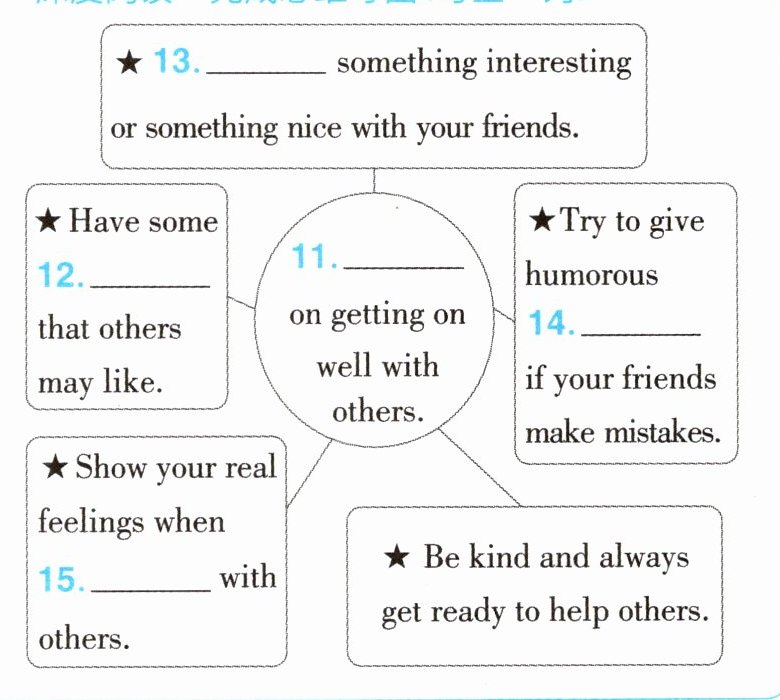
try when feel always begin get
use you break mistake
Everyone needs friends. Friendship is very valuable to us. But some people don't think that it is easy 1. on well with friends. Here are some 2. tips on getting on well with others.
Be confident about yourself. You should believe in 3. and know that you have some qualities(品质) that others may like.
Be ready to share. When you are with your friends, you can share something interesting or something nice with them. It will help you 4. the silence.
Be humorous. Try to give a humorous reply when you or others make 5. . It is not easy at first. But keep 6. hard, and you will make it. You can try in front of your parents first. On the other hand, you can remember some funny stories.
Be honest and sincere(真诚). 7. you communicate with others, let your expressions be real and your words be true. It means that you can mention his or her strong points if you want to make the other person happy. But it must be your real 8. .
Be kind to others. Others will be kind as long as you are kind to them. So keep doing right things and 9. get ready to help others.
Everything is difficult in the 10. . Try hard and never give up. You will make it to have good friends as well as true friends.
深度阅读·完成思维导图(每空一词)
答案
1. to get 2. useful 3. yourself 4. break
5. mistakes 6. trying 7. When 8. feeling
9. always 10. beginning 11. Tips/How
12. qualities 13. Share 14. replies
15. communicating
5. mistakes 6. trying 7. When 8. feeling
9. always 10. beginning 11. Tips/How
12. qualities 13. Share 14. replies
15. communicating
解析
【分析】
本题包含选词填空和思维导图填空两部分,解题思路为:先通读全文把握“如何与他人相处”的主旨,再结合每个空的前后语境、固定搭配,从给定词汇中筛选合适的词,同时根据语法规则(如词性变化、非谓语形式等)调整词汇形式,最后对应文章要点完成思维导图的填空。
【解析】
1. 固定搭配:it is + adj. + to do sth,get on well with是固定短语,故填to get;
2. 修饰名词tips需用形容词,use的形容词形式为useful,故填useful;
3. 固定搭配believe in oneself,主语为you,对应反身代词yourself,故填yourself;
4. 语境:分享能打破沉默,break the silence是固定搭配,help sb do sth,故填break;
5. 固定搭配make mistakes,故填mistakes;
6. 固定搭配keep doing sth,try的动名词形式为trying,故填trying;
7. 语境:当你和他人交流时,需用连词When,故填When;
8. 语境:此处指真实的感受,feel的名词形式为feeling,故填feeling;
9. 语境:表达“总是准备帮助他人”,故填always;
10. 固定搭配in the beginning,故填beginning;
11. 思维导图中心对应文章中“相处的建议”,故填Tips/How;
12. 对应文章中“you have some qualities”,故填qualities;
13. 对应文章中“share something interesting”,故填Share;
14. 对应文章中“give a humorous reply”,故填replies;
15. 对应文章中“when you communicate with others”,故填communicating。
【答案】
1. to get 2. useful 3. yourself 4. break 5. mistakes 6. trying 7. When 8. feeling 9. always 10. beginning 11. Tips/How 12. qualities 13. Share 14. replies 15. communicating
【知识点】
英语词汇运用、固定搭配、语境理解
【点评】
本题考查学生对英语词汇的掌握、固定搭配的运用及语境分析能力,通过选词填空和思维导图形式巩固“人际交往”相关表达,题型贴合基础英语学习要求。
【难度系数】
0.5
本题包含选词填空和思维导图填空两部分,解题思路为:先通读全文把握“如何与他人相处”的主旨,再结合每个空的前后语境、固定搭配,从给定词汇中筛选合适的词,同时根据语法规则(如词性变化、非谓语形式等)调整词汇形式,最后对应文章要点完成思维导图的填空。
【解析】
1. 固定搭配:it is + adj. + to do sth,get on well with是固定短语,故填to get;
2. 修饰名词tips需用形容词,use的形容词形式为useful,故填useful;
3. 固定搭配believe in oneself,主语为you,对应反身代词yourself,故填yourself;
4. 语境:分享能打破沉默,break the silence是固定搭配,help sb do sth,故填break;
5. 固定搭配make mistakes,故填mistakes;
6. 固定搭配keep doing sth,try的动名词形式为trying,故填trying;
7. 语境:当你和他人交流时,需用连词When,故填When;
8. 语境:此处指真实的感受,feel的名词形式为feeling,故填feeling;
9. 语境:表达“总是准备帮助他人”,故填always;
10. 固定搭配in the beginning,故填beginning;
11. 思维导图中心对应文章中“相处的建议”,故填Tips/How;
12. 对应文章中“you have some qualities”,故填qualities;
13. 对应文章中“share something interesting”,故填Share;
14. 对应文章中“give a humorous reply”,故填replies;
15. 对应文章中“when you communicate with others”,故填communicating。
【答案】
1. to get 2. useful 3. yourself 4. break 5. mistakes 6. trying 7. When 8. feeling 9. always 10. beginning 11. Tips/How 12. qualities 13. Share 14. replies 15. communicating
【知识点】
英语词汇运用、固定搭配、语境理解
【点评】
本题考查学生对英语词汇的掌握、固定搭配的运用及语境分析能力,通过选词填空和思维导图形式巩固“人际交往”相关表达,题型贴合基础英语学习要求。
【难度系数】
0.5
