

 登录
登录
四、(名师原创)信息还原(七选五)
Wax printing(蜡染)is an ancient way of producing dyed textiles(染色纺织品).
1.
3.
Today, wax printing is mainly used in some ethnic minority(少数民族) areas in Guizhou, Yunnan, Sichuan, and Guangxi. 5.
A. Wax printing has many steps
B. It is an important part of traditional Chinese culture
C. As students, we should learn more about it
D. Finally, wash the dyed cloth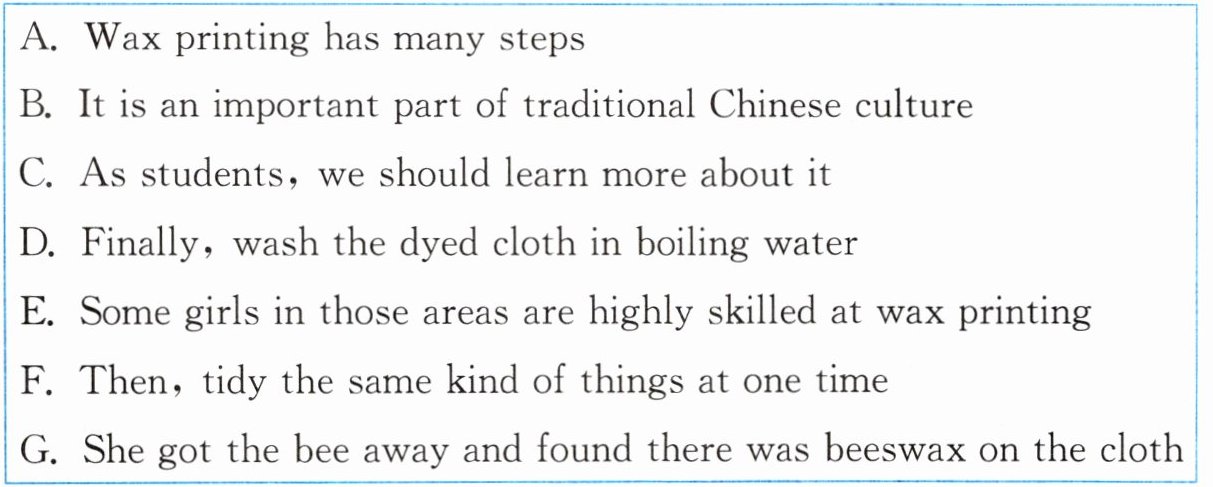 boiling water
E. Some girls in those areas are highly skilled at wax printing
F. Then, tidy the same kind of things at one time
G. She got the bee away and found there was beeswax on the cloth
Wax printing(蜡染)is an ancient way of producing dyed textiles(染色纺织品).
1.
B
. It is believed that wax printing appeared in China as early as the Qin and Han dynasties and got popular in the Sui and Tang dynasties. There is an interesting story about how wax printing was invented. Once upon a time, a girl was fond of dyeing(染色) white cloth blue and purple. One day, while she was working, a bee landed on her cloth. 2. G
. After she dyed the cloth, she saw a round white mark on the cloth. It looked very pretty. Her finding later led to the use of wax in dyeing.3.
A
. First, draw some pictures of flowers, birds, fish, etc. on a piece of white cloth. Then use a special knife-like tool to spread melted(熔化的) wax on the pictures. After that, put the cloth into a dye bath so that the unwaxed parts take on the colour. 4. D
and wait for the wax to melt(融化), leaving clear pictures in white on the dyed cloth.Today, wax printing is mainly used in some ethnic minority(少数民族) areas in Guizhou, Yunnan, Sichuan, and Guangxi. 5.
E
.A. Wax printing has many steps
B. It is an important part of traditional Chinese culture
C. As students, we should learn more about it
D. Finally, wash the dyed cloth
boiling waterE. Some girls in those areas are highly skilled at wax printing
F. Then, tidy the same kind of things at one time
G. She got the bee away and found there was beeswax on the cloth
答案
1.B 2.G 3.A 4.D 5.E
解析
【分析】
本题为七选五信息还原题,需结合上下文语境、逻辑关系选择合适选项。解题思路:先通读全文,明确文章围绕蜡染的历史、发明故事、制作步骤、现状展开;再逐个分析每个空前后内容,匹配衔接最紧密的句子:第1空需衔接蜡染的历史相关内容,第2空对应发明故事的发展,第3空引出制作步骤,第4空衔接染布后处理的步骤,第5空承接蜡染的现状。
【解析】
1. 第1空:前文介绍蜡染是古老染色工艺,后文讲述其历史,B选项“它是中国传统文化的重要部分”能衔接历史相关内容,故填B。
2. 第2空:前文提到蜜蜂落在布上,G选项“她把蜜蜂弄走发现布上有蜂蜡”符合发明故事的发展逻辑,故填G。
3. 第3空:后文开始介绍蜡染的具体制作步骤,A选项“蜡染有很多步骤”起到引出下文的作用,故填A。
4. 第4空:前文说将布放入染缸染色,后文提到蜡融化,D选项“最后用沸水清洗染好的布”,清洗时蜡会融化,符合步骤逻辑,故填D。
5. 第5空:前文说明蜡染主要用于少数民族地区,E选项“那些地区的一些女孩蜡染技艺高超”承接现状,故填E。
【答案】
1.B 2.G 3.A 4.D 5.E
【知识点】
信息还原(七选五)、语篇衔接
【点评】
本题围绕蜡染展开,考查学生对语篇逻辑和上下文衔接的理解,需结合语境推理,难度适中,能较好考查学生的阅读理解能力。
【难度系数】
0.5
本题为七选五信息还原题,需结合上下文语境、逻辑关系选择合适选项。解题思路:先通读全文,明确文章围绕蜡染的历史、发明故事、制作步骤、现状展开;再逐个分析每个空前后内容,匹配衔接最紧密的句子:第1空需衔接蜡染的历史相关内容,第2空对应发明故事的发展,第3空引出制作步骤,第4空衔接染布后处理的步骤,第5空承接蜡染的现状。
【解析】
1. 第1空:前文介绍蜡染是古老染色工艺,后文讲述其历史,B选项“它是中国传统文化的重要部分”能衔接历史相关内容,故填B。
2. 第2空:前文提到蜜蜂落在布上,G选项“她把蜜蜂弄走发现布上有蜂蜡”符合发明故事的发展逻辑,故填G。
3. 第3空:后文开始介绍蜡染的具体制作步骤,A选项“蜡染有很多步骤”起到引出下文的作用,故填A。
4. 第4空:前文说将布放入染缸染色,后文提到蜡融化,D选项“最后用沸水清洗染好的布”,清洗时蜡会融化,符合步骤逻辑,故填D。
5. 第5空:前文说明蜡染主要用于少数民族地区,E选项“那些地区的一些女孩蜡染技艺高超”承接现状,故填E。
【答案】
1.B 2.G 3.A 4.D 5.E
【知识点】
信息还原(七选五)、语篇衔接
【点评】
本题围绕蜡染展开,考查学生对语篇逻辑和上下文衔接的理解,需结合语境推理,难度适中,能较好考查学生的阅读理解能力。
【难度系数】
0.5
