登录
登录
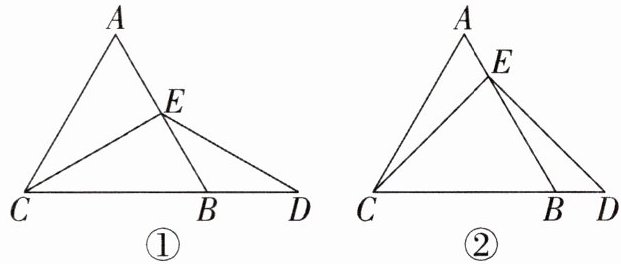
4. (2026·南京期中)在等边$△ ABC$中,点E是AB上的动点,点E与点A,B不重合,点D在CB的延长线上,且$EC=ED$.
(1)如图①,若点E是AB的中点,求证:$BD=AE$.
(2)如图②,若E不是AB的中点,(1)中的结论“$BD=AE$”能否成立?若不成立,请直接写出BD与AE的数量关系;若成立,请说明理由.
(1)如图①,若点E是AB的中点,求证:$BD=AE$.
(2)如图②,若E不是AB的中点,(1)中的结论“$BD=AE$”能否成立?若不成立,请直接写出BD与AE的数量关系;若成立,请说明理由.
答案
(1)$\because △ ABC$ 是等边三角形,点 E 是 AB 的中点,$\therefore ∠ ACB=∠ ABC=60°$,$CE$ 平分 $∠ ACB$,$AE=BE$,$\therefore ∠ ECB=30°.\because EC=ED$,$\therefore ∠ D=∠ ECB=30°$,$\therefore ∠ BED=∠ ABC-∠ D=60°-30°=30°$,$\therefore ∠ BED=∠ D=30°$,$\therefore BD=BE=AE$.
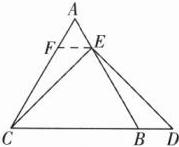
(2)$BD=AE$ 能成立.理由如下:如图,过 E 作 $EF// BC$ 交 AC 于点 F,$\therefore ∠ AFE=∠ ACB$.$\because △ ABC$ 为等边三角形,$\therefore ∠ A=∠ ACB=∠ ABC=60°$,$AC=AB$,$\therefore ∠ A=∠ AFE=60°$,$\therefore △ AEF$ 为等边三角形,$\therefore AF=AE=EF$,$\therefore CF=BE.\because EC=ED$,$\therefore ∠ ECB=∠ D$,$\therefore ∠ FCE=∠ ACB-∠ ECB=60°-∠ ECB$,$∠ BED=∠ ABC-∠ D=60°-∠ D$, $\therefore ∠ FCE = ∠ BED$. 在 $△ CFE$ 和 $△ EBD$ 中,$\begin{cases} CF=EB, \\ ∠ FCE=∠ BED, \\ CE=ED, \end{cases}$
$\therefore △ CFE ≌ △ EBD$,$\therefore EF = BD.\because EF = AE$,$\therefore BD=AE$.
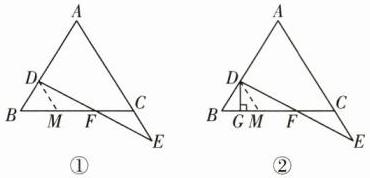
5. 如图①,$△ ABC$中,$AB=AC$,点D在AB边上,点E在AC的延长线上,且$CE=BD$,连结DE交BC于点F。
(1)求证:$EF=DF$;
(2)如图②,过点D作$DG ⊥ BC$,垂足为G,求证:$BC=2FG$。
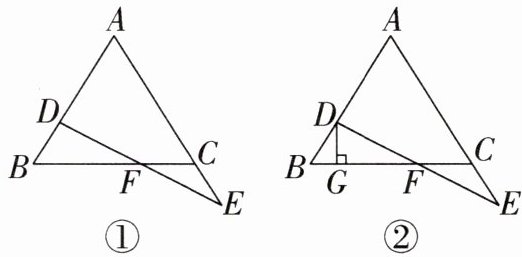
(1)求证:$EF=DF$;
(2)如图②,过点D作$DG ⊥ BC$,垂足为G,求证:$BC=2FG$。
答案
(1)过点 D 作 $DM// AC$ 交 BC 于点 M,如图①,$\therefore ∠ ACB=∠ DMB$,$∠ DMF=∠ ECF.\because AB=AC$,$\therefore ∠ B=∠ ACB$,$\therefore ∠ B=∠ DMB$,$\therefore BD=MD.\because CE=BD$,$\therefore CE=MD$. 在 $△ DMF$ 和 $△ ECF$ 中,$\because \begin{cases} ∠ DMF=∠ ECF, \\ ∠ MFD=∠ CFE, \\ MD=CE, \end{cases}$
$\therefore △ DMF≌△ ECF$(AAS),$\therefore EF=DF$.
(2)过点 D 作 $DM// AC$ 交 BC 于点 M,如图②,由(1)得 $BD=MD$,$△ DMF≌△ ECF$,$\therefore MF=CF$.
$\because DG⊥ BC$,$\therefore BG=MG$(等腰三角形三线合一),$\therefore BC=BM+CM=2(GM+FM)=2FG$.