

 登录
登录
7. 如图,在平面直角坐标系$xOy$中,已知抛物线$y=ax^2+bx+3$经过点$A(3,0)$,与$y$轴交于点$B$,且关于直线$x=1$对称.
(1)求该抛物线的表达式;
(2)当$-1≤x≤t$时,$y$的取值范围是$0≤y≤2t-1$,求$t$的值;
(3)点$C$是抛物线上位于第一象限的一个动点,过点$C$作$x$轴的垂线交直线$AB$于点$D$,在$y$轴上是否存在点$E$,使得以$B,C,D,E$为顶点的四边形是菱形?若存在,求出该菱形的边长;若不存在,说明理由.
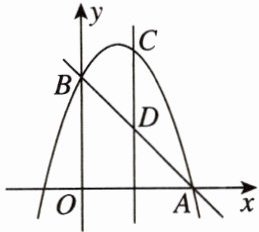
(1)求该抛物线的表达式;
(2)当$-1≤x≤t$时,$y$的取值范围是$0≤y≤2t-1$,求$t$的值;
(3)点$C$是抛物线上位于第一象限的一个动点,过点$C$作$x$轴的垂线交直线$AB$于点$D$,在$y$轴上是否存在点$E$,使得以$B,C,D,E$为顶点的四边形是菱形?若存在,求出该菱形的边长;若不存在,说明理由.
答案
(1)$\because$ 抛物线 $y=ax^2+bx+3$ 经过点 $A(3,0)$,关于直线 $x=1$ 对称,
$\therefore\begin{cases}-\frac{b}{2a}=1,\\9a+3b+3=0,\end{cases}$ 解得 $\begin{cases}a=-1,\\b=2,\end{cases}$
$\therefore y=-x^2+2x+3$.
(2)$\because$ 抛物线的开口向下,对称轴为直线 $x=1$,
$\therefore$ 抛物线上的点到对称轴的距离越远,函数值越小.
①当 $t≤1$ 时,则当 $x=t$ 时,函数有最大值,此时 $2t-1=-t^2+2t+3$,
解得 $t=-2$ 或 $t=2$,均不符合题意,舍去;
②当 $t>1$ 时,则当 $x=1$ 时,函数有最大值,此时 $2t-1=-1^2+2+3=4$,故 $t=\frac{5}{2}$.综上,$t$ 的值为 $\frac{5}{2}$.
(3)存在.当 $x=0$ 时,$y=3$,$\therefore B(0,3)$.
设直线 $AB$ 的表达式为 $y=kx+3$,
把 $A(3,0)$ 的坐标代入,得 $3k+3=0$,解得 $k=-1$,
$\therefore y=-x+3$.
设 $C(m,-m^2+2m+3)(0<m<3)$,则 $D(m,-m+3)$,
$\therefore CD=-m^2+2m+3+m-3=-m^2+3m$, $BD=\sqrt{m^2+(-m+3-3)^2}=\sqrt{2}m$,$BC^2=m^2+(-m^2+2m)^2$.
当以 $B,C,D,E$ 为顶点的四边形是菱形时,分两种情况:
①当 $BD$ 为边时,$BD=CD$,即 $\sqrt{2}m=-m^2+3m$,
解得 $m=0$(舍去)或 $m=3-\sqrt{2}$,
此时菱形的边长为 $\sqrt{2}m=3\sqrt{2}-2$;
②当 $BD$ 为对角线时,$BC=CD$,则 $BC^2=CD^2$,即 $m^2+(-m^2+2m)^2=(-m^2+3m)^2$,解得 $m=2$ 或 $m=0$(舍去),
此时菱形的边长为 $-2^2+3×2=2$.
综上,存在以 $B,C,D,E$ 为顶点的四边形是菱形,边长为 $3\sqrt{2}-2$ 或 $2$.
$\therefore\begin{cases}-\frac{b}{2a}=1,\\9a+3b+3=0,\end{cases}$ 解得 $\begin{cases}a=-1,\\b=2,\end{cases}$
$\therefore y=-x^2+2x+3$.
(2)$\because$ 抛物线的开口向下,对称轴为直线 $x=1$,
$\therefore$ 抛物线上的点到对称轴的距离越远,函数值越小.
①当 $t≤1$ 时,则当 $x=t$ 时,函数有最大值,此时 $2t-1=-t^2+2t+3$,
解得 $t=-2$ 或 $t=2$,均不符合题意,舍去;
②当 $t>1$ 时,则当 $x=1$ 时,函数有最大值,此时 $2t-1=-1^2+2+3=4$,故 $t=\frac{5}{2}$.综上,$t$ 的值为 $\frac{5}{2}$.
(3)存在.当 $x=0$ 时,$y=3$,$\therefore B(0,3)$.
设直线 $AB$ 的表达式为 $y=kx+3$,
把 $A(3,0)$ 的坐标代入,得 $3k+3=0$,解得 $k=-1$,
$\therefore y=-x+3$.
设 $C(m,-m^2+2m+3)(0<m<3)$,则 $D(m,-m+3)$,
$\therefore CD=-m^2+2m+3+m-3=-m^2+3m$, $BD=\sqrt{m^2+(-m+3-3)^2}=\sqrt{2}m$,$BC^2=m^2+(-m^2+2m)^2$.
当以 $B,C,D,E$ 为顶点的四边形是菱形时,分两种情况:
①当 $BD$ 为边时,$BD=CD$,即 $\sqrt{2}m=-m^2+3m$,
解得 $m=0$(舍去)或 $m=3-\sqrt{2}$,
此时菱形的边长为 $\sqrt{2}m=3\sqrt{2}-2$;
②当 $BD$ 为对角线时,$BC=CD$,则 $BC^2=CD^2$,即 $m^2+(-m^2+2m)^2=(-m^2+3m)^2$,解得 $m=2$ 或 $m=0$(舍去),
此时菱形的边长为 $-2^2+3×2=2$.
综上,存在以 $B,C,D,E$ 为顶点的四边形是菱形,边长为 $3\sqrt{2}-2$ 或 $2$.
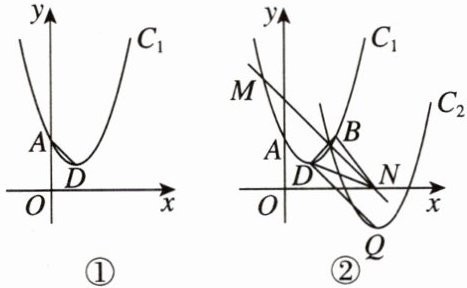
8. 在平面直角坐标系$xOy$中,抛物线$C_1:y=x^2+bx+c$经过点$A(0,2),B(2,2)$,顶点为$D$;抛物线$C_2:y=x^2-2mx+m^2-m+2(m≠1)$,顶点为$Q$.
(1)求抛物线$C_1$的表达式及顶点$D$的坐标;
(2)如图①,连接$AD$,点$E$是抛物线$C_1$对称轴右侧图象上一点,点$F$是抛物线$C_2$上一点,若四边形$ADFE$是面积为12的平行四边形,求$m$的值;
(3)如图②,连接$BD,DQ$,点$M$是抛物线$C_1$对称轴左侧图象上的动点(不与点$A$重合),过点$M$作$MN// DQ$交$x$轴于点$N$,连接$BN,DN$,求$△ BDN$面积的最小值.
(1)求抛物线$C_1$的表达式及顶点$D$的坐标;
(2)如图①,连接$AD$,点$E$是抛物线$C_1$对称轴右侧图象上一点,点$F$是抛物线$C_2$上一点,若四边形$ADFE$是面积为12的平行四边形,求$m$的值;
(3)如图②,连接$BD,DQ$,点$M$是抛物线$C_1$对称轴左侧图象上的动点(不与点$A$重合),过点$M$作$MN// DQ$交$x$轴于点$N$,连接$BN,DN$,求$△ BDN$面积的最小值.
答案
(1)$\because$ 抛物线 $y=x^2+bx+c$ 过点 $A(0,2),B(2,2)$,
$\therefore$ 把 $A,B$ 两点的坐标分别代入上式,得 $\begin{cases}c=2,\\4+2b+c=2,\end{cases}$
解得 $\begin{cases}b=-2,\\c=2,\end{cases}$ $\therefore$ 抛物线 $C_1$ 的表达式为 $y=x^2-2x+2$.
$\therefore$ 易得顶点 $D$ 的坐标为 $(1,1)$.
(2)如图①
 ,连接 $DE$,过点 $E$ 作 $EG// y$ 轴,交 $AD$ 延长线于点 $G$,过点 $D$ 作直线 $DH⊥ EG$,垂足为 $H$,与 $y$ 轴交于 $H'$,
设直线 $AD$ 的表达式为 $y=kx+b'$,
由题易知 $\begin{cases}b'=2,\\k+b'=1,\end{cases}$ 解得 $\begin{cases}k=-1,\\b'=2,\end{cases}$
$\therefore$ 直线 $AD$ 的表达式为 $y=-x+2$.
设点 $E$ 的横坐标为 $t$,则 $E(t,t^2-2t+2)$,$G(t,2-t)$,
$\therefore EG=t^2-t$.
$\because□ ADFE$ 的面积为 12,$\therefore S_{△ ADE}=\frac{1}{2}S_{□ ADFE}=6=S_{△ AGE}-S_{△ DGE}=\frac{1}{2}(H'H-DH)· EG=\frac{1}{2}EG· H'D$.
易知 $H'D=1$,$\therefore EG=12$,
$\therefore t^2-t=12$,解得 $t_1=4$,$t_2=-3$(舍去),$\therefore E(4,10)$.
$\because$ 四边形 $ADFE$ 是平行四边形,$\therefore$ 易得点 $E$ 先向右平移 1 个单位,再向下平移 1 个单位,得到点 $F$,$\therefore F(5,9)$.
将点 $F(5,9)$ 的坐标代入 $y=x^2-2mx+m^2-m+2(m≠1)$,得 $m^2-11m+18=0$,解得 $m_1=2$,$m_2=9$. $\therefore m$ 的值为 2 或 9.
(3)如图②
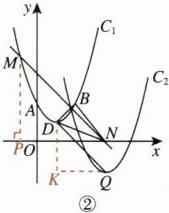 ,过点 $M$ 作 $MP⊥ x$ 轴,垂足为 $P$,过点 $D$ 作 $DK// y$ 轴,过点 $Q$ 作 $QK// x$ 轴,与 $DK$ 交于点 $K$,设 $M(h,h^2-2h+2)$,$h<1$ 且 $h≠0$,$N(n,0)$.
$\because y=x^2-2mx+m^2+2-m=(x-m)^2+2-m$,
$\therefore$ 抛物线 $C_2$ 的顶点 $Q$ 的坐标为 $(m,2-m)$.
$\therefore DK=|1-(2-m)|=|m-1|$,$KQ=|m-1|$.
$\therefore DK=KQ$,$\therefore$ 易得 $∠ DQK=45°$.
$\because MN// DQ$,$KQ// NP$,$\therefore$ 易得 $∠ MNP=∠ DQK=45°$.
$\because MP⊥ x$ 轴,$\therefore ∠ NMP=45°$,$\therefore MP=NP$.
$\therefore h^2-2h+2=n-h$. $\therefore n=h^2-h+2$.
$\therefore n=(h-\frac{1}{2})^2+\frac{7}{4}$.
$\therefore$ 当 $h=\frac{1}{2}$ 时,$n$ 有最小值为 $\frac{7}{4}$.
$\therefore$ 点 $N$ 横坐标的最小值为 $n=\frac{7}{4}$,此时点 $N$ 到直线 $BD$ 的距离最近,即 $△ BDN$ 的面积最小.
易得 $BD$ 所在直线的表达式为 $y=x$,$\therefore$ 点 $N$ 到直线 $BD$ 的最近距离即为边 $BD$ 上的高 $=\frac{7}{4}×\frac{\sqrt{2}}{2}=\frac{7\sqrt{2}}{8}$.
$\because B(2,2)$,$D(1,1)$,$\therefore BD=\sqrt{2}$.
$\therefore △ BDN$ 面积的最小值为 $\frac{1}{2}×\frac{7\sqrt{2}}{8}×\sqrt{2}=\frac{7}{8}$.
