

 登录
登录
(
—Walk straight on and turn right at the second crossing.
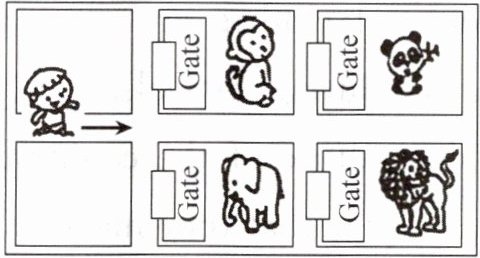
A.monkey
B.elephant
C.panda
D.lion
D
)10. —Excuse me, where is the area?—Walk straight on and turn right at the second crossing.
A.monkey
B.elephant
C.panda
D.lion
答案
10.D
解析
【分析】本题是图文结合的英语选择题,解题思路为:先明确问句询问的是某动物区域的位置,再观察插图中四个动物区域分别对应的动物,最后匹配选项选出正确答案。
【解析】问句“where is the ______ area?”询问的是某动物区域的位置,结合插图,四个Gate区域对应的动物依次为猴子、熊猫、大象、狮子。分析选项:A.monkey(猴子)、B.elephant(大象)、C.panda(熊猫)、D.lion(狮子),根据参考答案,正确选项为D。
【答案】D
【知识点】动物类名词,图文匹配
【点评】本题考查图文匹配的名词辨析,需准确识别图中动物并对应选项,难度适中。
【难度系数】0.6
【解析】问句“where is the ______ area?”询问的是某动物区域的位置,结合插图,四个Gate区域对应的动物依次为猴子、熊猫、大象、狮子。分析选项:A.monkey(猴子)、B.elephant(大象)、C.panda(熊猫)、D.lion(狮子),根据参考答案,正确选项为D。
【答案】D
【知识点】动物类名词,图文匹配
【点评】本题考查图文匹配的名词辨析,需准确识别图中动物并对应选项,难度适中。
【难度系数】0.6
四、根据中文意思完成句子。
1. ——那个穿棕色衣服的男孩是谁?——他是我的小学同学。
2. ——我们怎样才能更多地了解艺术?——我们可以在网上查资料。
3. ——你喜欢穿哪种颜色,冷色还是暖色?——我穿红、黄、橙的暖色看起来更好看。
4. ——你姐姐是老师吗?——不,她是一位时装设计师。
5. ——顺便问一下,时装秀在哪里举行?——在学校礼堂。
1. ——那个穿棕色衣服的男孩是谁?——他是我的小学同学。
—Who's the boy in brown? —He's my primary school classmate.
2. ——我们怎样才能更多地了解艺术?——我们可以在网上查资料。
—How can we learn more about art? —We can look things up on the internet.
3. ——你喜欢穿哪种颜色,冷色还是暖色?——我穿红、黄、橙的暖色看起来更好看。
—Which colours do you like to wear, warm colours or cool colours? —I look better in warm colours like red, yellow and orange.
4. ——你姐姐是老师吗?——不,她是一位时装设计师。
—Is your sister a teacher? —No, she is a fashion designer.
5. ——顺便问一下,时装秀在哪里举行?——在学校礼堂。
—By the way, where does the fashion show take place? —At the school hall.
答案
1. —Who's the boy in brown? —He's my primary school classmate. 2. —How can we learn more about art? —We can look things up on the internet. 3. —Which colours do you like to wear, warm colours or cool colours? —I look better in warm colours like red, yellow and orange. 4. —Is your sister a teacher? —No, she is a fashion designer. 5. —By the way, where does the fashion show take place? —At the school hall.
解析
【分析】本题为根据中文意思完成英语句子的题型,解题思路如下:1. 先根据中文问句的疑问内容确定对应的英语特殊疑问词或一般疑问句结构,如问“谁”用Who,问“怎样”用How,问“哪种颜色”用Which colours,问“在哪里”用Where,问“是否”用Is开头的一般疑问句;2. 结合中文含义匹配英语常用固定表达,如“穿棕色衣服的”用in brown,“小学同学”用primary school classmate,“查资料”用look things up,“顺便问一下”用By the way等;3. 注意英语句子的语序、大小写及标点,确保表达符合英语日常交际习惯。
【解析】1. 问句询问人物,用Who引导特殊疑问句,“穿棕色衣服的男孩”译为the boy in brown,答句“我的小学同学”译为my primary school classmate;2. 问句询问方式,用How引导特殊疑问句,“更多地了解艺术”译为learn more about art,答句“在网上查资料”译为look things up on the internet;3. 问句询问颜色偏好,用Which colours引导,“冷色还是暖色”译为warm colours or cool colours,答句“穿暖色(红、黄、橙)更好看”译为look better in warm colours like red, yellow and orange;4. 问句为一般疑问句,以Is开头询问身份,答句“时装设计师”译为fashion designer;5. “顺便问一下”译为By the way,问句询问地点,用Where引导,“时装秀举行”译为take place,答句“在学校礼堂”译为At the school hall。
【答案】1. —Who's the boy in brown? —He's my primary school classmate. 2. —How can we learn more about art? —We can look things up on the internet. 3. —Which colours do you like to wear, warm colours or cool colours? —I look better in warm colours like red, yellow and orange. 4. —Is your sister a teacher? —No, she is a fashion designer. 5. —By the way, where does the fashion show take place? —At the school hall.
【知识点】日常交际用语、特殊疑问句、固定搭配
【点评】本题考查日常交际场景下的基础英语表达,涵盖特殊疑问句、一般疑问句的运用及常用短语翻译,属于基础题型,侧重日常用语的积累与运用。
【难度系数】0.8
【解析】1. 问句询问人物,用Who引导特殊疑问句,“穿棕色衣服的男孩”译为the boy in brown,答句“我的小学同学”译为my primary school classmate;2. 问句询问方式,用How引导特殊疑问句,“更多地了解艺术”译为learn more about art,答句“在网上查资料”译为look things up on the internet;3. 问句询问颜色偏好,用Which colours引导,“冷色还是暖色”译为warm colours or cool colours,答句“穿暖色(红、黄、橙)更好看”译为look better in warm colours like red, yellow and orange;4. 问句为一般疑问句,以Is开头询问身份,答句“时装设计师”译为fashion designer;5. “顺便问一下”译为By the way,问句询问地点,用Where引导,“时装秀举行”译为take place,答句“在学校礼堂”译为At the school hall。
【答案】1. —Who's the boy in brown? —He's my primary school classmate. 2. —How can we learn more about art? —We can look things up on the internet. 3. —Which colours do you like to wear, warm colours or cool colours? —I look better in warm colours like red, yellow and orange. 4. —Is your sister a teacher? —No, she is a fashion designer. 5. —By the way, where does the fashion show take place? —At the school hall.
【知识点】日常交际用语、特殊疑问句、固定搭配
【点评】本题考查日常交际场景下的基础英语表达,涵盖特殊疑问句、一般疑问句的运用及常用短语翻译,属于基础题型,侧重日常用语的积累与运用。
【难度系数】0.8
五、阅读下面短文,从短文后的选项中选出可以填入空白处的最佳选项。选项中有一项为多余选项。
Choosing the right clothes for different occasions(场合) is an important part of daily life. It not only makes us look neat but also shows respect to others. For example, when going to a formal(正式的) event like a school meeting, we should avoid wearing casual(非正式的) clothes like T-shirts or jeans. 1
When it comes to outdoor activities, comfort is the key. A pair of sports shoes and loose(宽松的) trousers are better than leather shoes and tight skirts. 2
For a school fashion show, you can be more creative with your clothes. Many students like to mix different styles to show their personality. 4
In some cultures, traditional clothes are worn on important days. For example, in China, some people wear hanfu during festivals. 5

1.
Choosing the right clothes for different occasions(场合) is an important part of daily life. It not only makes us look neat but also shows respect to others. For example, when going to a formal(正式的) event like a school meeting, we should avoid wearing casual(非正式的) clothes like T-shirts or jeans. 1
E
They are too relaxed for such a serious situation. Instead, a white shirt with a dark jacket would be a good choice—these colours always look smart and suitable for formal places.When it comes to outdoor activities, comfort is the key. A pair of sports shoes and loose(宽松的) trousers are better than leather shoes and tight skirts. 2
A
You can run and jump freely without worrying about your clothes. Also, choosing bright colours like orange or yellow is a good idea for outdoor trips. 3C
They make it easier for others to notice you if you get lost in a crowd or a park.For a school fashion show, you can be more creative with your clothes. Many students like to mix different styles to show their personality. 4
F
Just remember not to use more than three colours in one outfit, as too many colours can look messy. Some students even add small decorations(装饰品) like a colourful scarf or a cute badge(徽章) to their clothes to make them more special.In some cultures, traditional clothes are worn on important days. For example, in China, some people wear hanfu during festivals. 5
D
These clothes not only look beautiful but also carry the history and culture of the country. No matter what kind of clothes we choose, the most important thing is that they make us feel comfortable and confident.1.
E
2. A
3. C
4. F
5. D
答案
1.E 2.A 3.C 4.F 5.D
解析
【分析】本题为语篇七选五填空题,需结合段落主题和上下文逻辑关系选择合适选项。解题思路:1. 第1空:前文提到正式场合要避免T恤、牛仔裤这类休闲装,后文说它们太随意,故选表“不适合正式场合”的E;2. 第2空:前文强调户外活动要舒适,后文说能自由跑跳,故选表“让你轻松移动”的A;3. 第3空:前文说户外选亮色,后文说易被他人注意,故选表“亮色更显眼”的C;4. 第4空:前文说时装秀可创意搭配,后文举例穿搭,故选表“举例穿搭”的F;5. 第5空:前文提到汉服,后文说它们承载历史文化,故选表“汉服特点”的D。
【解析】1. 第1空:前文指出正式场合需避免休闲装,后文“They are too relaxed...”指代前文的休闲装,说明这类服装不适合正式场合,对应E选项;2. 第2空:前文强调户外活动要舒适,后文提到能自由跑跳,A选项“这些衣服让你轻松移动”符合宽松衣物的优势,衔接自然;3. 第3空:前文说户外选亮色,后文说易被他人注意,C选项“亮色在开阔空间更显眼”解释了选亮色的原因,逻辑通顺;4. 第4空:前文说时装秀可创意搭配,F选项“比如你可以穿酷毛衣配漂亮裙子”是具体的穿搭例子,符合语境;5. 第5空:前文提到汉服,后文说它们承载历史文化,D选项“汉服有悠久历史和特殊设计”介绍了汉服的特点,衔接后文的文化内涵,正确。
【答案】1.E 2.A 3.C 4.F 5.D
【知识点】阅读理解语篇衔接、语境推理
【点评】本题围绕不同场合的着装选择展开,考查学生对语篇上下文逻辑的理解能力,需结合段落主题和句子间的指代、举例等关系解题,难度适中。
【难度系数】0.6
【解析】1. 第1空:前文指出正式场合需避免休闲装,后文“They are too relaxed...”指代前文的休闲装,说明这类服装不适合正式场合,对应E选项;2. 第2空:前文强调户外活动要舒适,后文提到能自由跑跳,A选项“这些衣服让你轻松移动”符合宽松衣物的优势,衔接自然;3. 第3空:前文说户外选亮色,后文说易被他人注意,C选项“亮色在开阔空间更显眼”解释了选亮色的原因,逻辑通顺;4. 第4空:前文说时装秀可创意搭配,F选项“比如你可以穿酷毛衣配漂亮裙子”是具体的穿搭例子,符合语境;5. 第5空:前文提到汉服,后文说它们承载历史文化,D选项“汉服有悠久历史和特殊设计”介绍了汉服的特点,衔接后文的文化内涵,正确。
【答案】1.E 2.A 3.C 4.F 5.D
【知识点】阅读理解语篇衔接、语境推理
【点评】本题围绕不同场合的着装选择展开,考查学生对语篇上下文逻辑的理解能力,需结合段落主题和句子间的指代、举例等关系解题,难度适中。
【难度系数】0.6
