

 登录
C KEY→P39
范畴:人与自然 主题:自然科学 体裁:说明文 难度:★★★★ 建议用时:10分钟 评价:/4
Recently, scientists have already found out how and why earthquakes happen.
Long ago, people believed that the Earth was solid, but today, scientists know that the Earth is made up of layers.
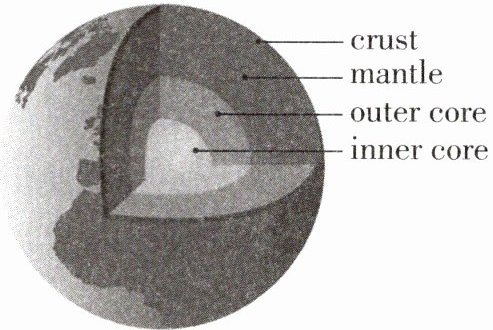
The centre of the Earth is called the core. The core is very hot. The inner core is a solid ball made of iron, and the outer core is made of iron that can flow(流动) slowly.
The mantle(地幔) around the core is made of very hot rock. The lower part of the mantle is soft and can move very slowly. The mantle makes up most of the Earth.
The top layer of the Earth is called the crust(地壳), and is made of rock. It is the thinnest of all the Earth's layers. It is thinnest under the sea and much thicker under the land.
The crust and the upper part of the mantle are made up of very big, plate-like pieces of rock that move slowly on the lower part of the mantle. Most of the time, they are moving so slowly that people cannot feel the movement.
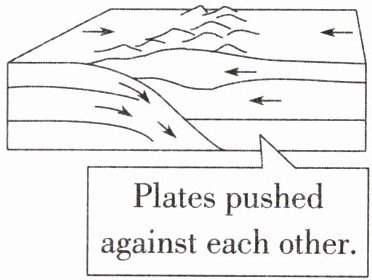
These big pieces of rock are called tectonic plates(构造板块). They are in different sizes, and each one has a name. When the plates meet, they can move to different directions, go past each other, or push against each other until part of one plate is under the other.
The movements of the plates make the Earth's cover break. These broken places are called faults(断层). Some faults are easy to see. Most faults don't move, but the plates keep moving slowly. Over time, this causes stress(压力) in the rocks.
When the stress is too much for the rocks, they break suddenly along the fault. This kind of shaking runs out in all directions, and makes the ground shake. This is an earthquake, and it is why most earthquakes happen near the sides of tectonic plates.
(
A. 2. B. 3. C. 4. D. 5.
(
A. the inner core B. the outer core
C. the mantle D. the crust
(新考法·代词指代 What does “they” in Paragraph 6 refer to?
A. Layers of the Earth.
B. Big and plate-like pieces of rock.
C. The lower part of the mantle.
D. The upper part of the mantle.
(
A. What an earthquake is.
B. Effects of earthquakes.
C. Movements of tectonic plates.
D. How and why earthquakes happen.
范畴:人与自然 主题:自然科学 体裁:说明文 难度:★★★★ 建议用时:10分钟 评价:/4
Recently, scientists have already found out how and why earthquakes happen.
Long ago, people believed that the Earth was solid, but today, scientists know that the Earth is made up of layers.
The centre of the Earth is called the core. The core is very hot. The inner core is a solid ball made of iron, and the outer core is made of iron that can flow(流动) slowly.
The mantle(地幔) around the core is made of very hot rock. The lower part of the mantle is soft and can move very slowly. The mantle makes up most of the Earth.
The top layer of the Earth is called the crust(地壳), and is made of rock. It is the thinnest of all the Earth's layers. It is thinnest under the sea and much thicker under the land.
The crust and the upper part of the mantle are made up of very big, plate-like pieces of rock that move slowly on the lower part of the mantle. Most of the time, they are moving so slowly that people cannot feel the movement.
These big pieces of rock are called tectonic plates(构造板块). They are in different sizes, and each one has a name. When the plates meet, they can move to different directions, go past each other, or push against each other until part of one plate is under the other.
The movements of the plates make the Earth's cover break. These broken places are called faults(断层). Some faults are easy to see. Most faults don't move, but the plates keep moving slowly. Over time, this causes stress(压力) in the rocks.
When the stress is too much for the rocks, they break suddenly along the fault. This kind of shaking runs out in all directions, and makes the ground shake. This is an earthquake, and it is why most earthquakes happen near the sides of tectonic plates.
(
C
)1. How many layers are there in the Earth according to the text?A. 2. B. 3. C. 4. D. 5.
(
B
)2. The sentences “I am now in the deep Earth. After going through the layer made of hot rock, I found hot iron around me flowing softly like water.” are describing B
.A. the inner core B. the outer core
C. the mantle D. the crust
(
B
)3. A. Layers of the Earth.
B. Big and plate-like pieces of rock.
C. The lower part of the mantle.
D. The upper part of the mantle.
(
D
)4. Which is the main idea of the passage?A. What an earthquake is.
B. Effects of earthquakes.
C. Movements of tectonic plates.
D. How and why earthquakes happen.
答案
本文解释了地震形成的方式和原因。
1. C 细节理解题。根据地球构造的图片和第三、四、五段可知,地球的内部结构一共有四层:内核、外核、地幔和地壳。
2. B 推理判断题。根据第三段中the outer core is made of iron that can flow slowly可知,外核是由可以缓慢流动的铁构成的。这跟题干中I found hot iron around me flowing softly like water描述的相符合,由此推测句子是描述地球的外核。
3. B 代词指代题。根据第六段“The crust and the upper part of the mantle are made up of very big, plate-like pieces of rock that move slowly on the lower part of the mantle ... the movement.”可知,地壳和地幔上部是由非常大的板状岩石块组成,这些岩石块在地幔下部之上缓慢移动。大部分时候,它们移动得太慢,令人难以察觉。they指代“大的板状岩石块”。
4. D 主旨大意题。根据文章第一段以及全文可知,这篇文章解释了地震形成的方式和原因。
