

 登录
四 阅读理解。(20分)
(A)
Loss(失去) makes people sad. How can we deal with it? The film The Boy and the Heron(《你想活出怎样的人生》) has something to say. It tells the story of a 12-year-old boy called Mahito. He loses his mother during a war and feels sad. One day, he meets a talking heron(苍鹭). They go on a journey in a dreamlike world.
Hayao Miyazaki(宫崎骏), a Japanese director, made this film for his grandson. It's his way of telling the little boy, “I won't be around forever, but I am leaving something here for you.”
At the end of the film, Mahito learns how to move on. He leaves the magical world. The real world can be tough(艰难的), but it's full of honesty and kindness. French writer Romain Rolland(罗曼·罗兰) once said, “There is only one heroism(英雄主义) in the world: to see the world as it is and to love it.”
阅读短文,判断正(T)误(F)。(5分)
(
(
(
(
(
(A)
Loss(失去) makes people sad. How can we deal with it? The film The Boy and the Heron(《你想活出怎样的人生》) has something to say. It tells the story of a 12-year-old boy called Mahito. He loses his mother during a war and feels sad. One day, he meets a talking heron(苍鹭). They go on a journey in a dreamlike world.
Hayao Miyazaki(宫崎骏), a Japanese director, made this film for his grandson. It's his way of telling the little boy, “I won't be around forever, but I am leaving something here for you.”
At the end of the film, Mahito learns how to move on. He leaves the magical world. The real world can be tough(艰难的), but it's full of honesty and kindness. French writer Romain Rolland(罗曼·罗兰) once said, “There is only one heroism(英雄主义) in the world: to see the world as it is and to love it.”
阅读短文,判断正(T)误(F)。(5分)
(
T
)1. The boy Mahito feels sad because he loses his mother during a war.(
F
)2. Mahito meets a talking heron and they go on a journey in the real world.(
T
)3. The film was made by a Japanese director for his grandson.(
F
)4. At the end of the film, Mahito stays in the magical world forever.(
T
)5. The writer uses a French writer's words to tell us to love the real world as it is.答案
1. T 2. F 3. T 4. F 5. T
解析
【分析】
本题是英语阅读理解正误判断题,解题思路为:先通读短文理解大意,再针对每道小题的题干,回到原文定位对应信息,对比题干与原文内容的细节是否一致,从而判断正误,需重点关注事件发生的地点、人物、原因等关键细节。
【解析】
1. 题干:Mahito因在战争中失去妈妈感到难过。原文第一段明确提到“He loses his mother during a war and feels sad.”,与题干表述一致,故判断为T。
2. 题干:Mahito遇到会说话的苍鹭后在现实世界旅行。原文第一段最后指出“They go on a journey in a dreamlike world.”,是梦境般的世界而非现实世界,与题干不符,故判断为F。
3. 题干:这部电影由日本导演为他的孙子制作。原文第二段提到“Hayao Miyazaki(宫崎骏), a Japanese director, made this film for his grandson.”,与题干表述一致,故判断为T。
4. 题干:电影结尾Mahito永远留在魔法世界。原文第三段说“He leaves the magical world.”,是离开而非留下,与题干不符,故判断为F。
5. 题干:作者用法国作家的话告诉我们要爱真实的世界。原文第三段最后引用罗曼·罗兰(法国作家)的话“to see the world as it is and to love it.”,结合前文提到真实世界的美好,与题干表述一致,故判断为T。
【答案】
1.T 2.F 3.T 4.F 5.T
【知识点】
阅读理解正误判断、细节理解题
【点评】
本题为基础的英语阅读理解细节题,主要考查学生对原文关键信息的定位与对比能力,难度较低,只要认真阅读原文、仔细核对细节即可正确作答。
【难度系数】
0.7
(B) 亮点原创
Most people are honest most of the time. But people tell lies sometimes. Studies show that 95% of people tell at least one lie in a week. That sounds bad. But most of these lies are "white lies". White lies are harmless. They don't hurt anyone.
People think differently about whether we should tell white lies. Let's have a look.
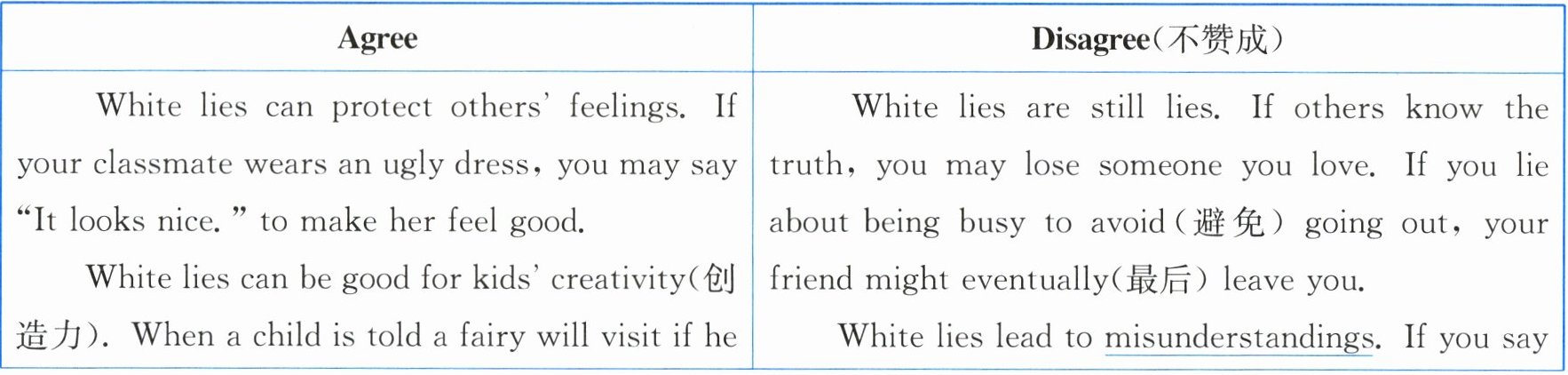
续表
cleans his room, he imagines a magic world when cleaning. White lies can give people hope too. If a friend fails an exam, you can say "You did much better than last time." to cheer him or her up.
"I don't like this game." to avoid hurting your friend, but he may think you don't want to spend time with him.
White lies stop people from growing. If they never know their real problems, how can they improve?
So, should we tell white lies or not? It is not an easy question. Sometimes white lies seem OK, but we must be careful. We need to think hard and make a good choice.
阅读材料,选择正确的答案。(5分)
(
A. tell a lie B. help a friend C. make a plan
(
A. Big lies that hurt people. B. Small lies that don't hurt anyone.
C. Lies that are always good to tell.
(
A. "I don't want to go out with you." B. "You are not good at this game."
C. "You did much better than last time."
(
A. 谬论 B. 争论 C. 误会
(
A. White lies may help people become honest.
B. White lies can help kids use their imagination.
C. People mainly tell white lies to protect themselves.
Most people are honest most of the time. But people tell lies sometimes. Studies show that 95% of people tell at least one lie in a week. That sounds bad. But most of these lies are "white lies". White lies are harmless. They don't hurt anyone.
People think differently about whether we should tell white lies. Let's have a look.
续表
cleans his room, he imagines a magic world when cleaning. White lies can give people hope too. If a friend fails an exam, you can say "You did much better than last time." to cheer him or her up.
"I don't like this game." to avoid hurting your friend, but he may think you don't want to spend time with him.
White lies stop people from growing. If they never know their real problems, how can they improve?
So, should we tell white lies or not? It is not an easy question. Sometimes white lies seem OK, but we must be careful. We need to think hard and make a good choice.
阅读材料,选择正确的答案。(5分)
(
A
)1. Studies show that 95% of people at least once a week.A. tell a lie B. help a friend C. make a plan
(
B
)2. What are "white lies"?A. Big lies that hurt people. B. Small lies that don't hurt anyone.
C. Lies that are always good to tell.
(
C
)3. Which is an example of a white lie from the "Agree" side?A. "I don't want to go out with you." B. "You are not good at this game."
C. "You did much better than last time."
(
C
)4. The underlined word "misunderstandings" means "" in Chinese.A. 谬论 B. 争论 C. 误会
(
B
)5. Which of the following is TRUE?A. White lies may help people become honest.
B. White lies can help kids use their imagination.
C. People mainly tell white lies to protect themselves.
答案
1. A 2. B 3. C 4. C 5. B
解析
【分析】
本题是关于“善意谎言(white lies)”的阅读理解选择题,需根据文章内容逐一分析每道题:第1题定位数据信息;第2题查找“善意谎言”的定义;第3题对应“赞成善意谎言”的例子;第4题结合语境猜测词义;第5题判断选项与文章内容是否相符。
【解析】
1. 细节理解题:根据第一段“Studies show that 95% of people tell at least one lie in a week.”可知,95%的人每周至少说一次谎,故选A。
2. 细节理解题:根据第一段“most of these lies are 'white lies'. White lies are harmless. They don't hurt anyone.”可知,善意谎言是不伤害人的小谎言,故选B。
3. 细节理解题:“Agree”部分最后提到“If a friend fails an exam, you can say 'You did much better than last time.' to cheer him or her up.”,这是赞成善意谎言的例子,故选C。
4. 词义猜测题:根据后文举例“你说不想和朋友出去玩,朋友可能认为你不想花时间陪他”,可知善意谎言会导致“误会”,故选C。
5. 细节理解题:A选项文章未提及善意谎言帮助人诚实;B选项“Agree”部分提到“White lies can be good for kids' creativity... imagines a magic world”,说明善意谎言能帮助孩子发挥想象力,正确;C选项文章说善意谎言是保护他人,不是保护自己,错误,故选B。
【答案】
1.A 2.B 3.C 4.C 5.B
【知识点】
阅读理解、细节理解、词义猜测
【点评】
本题围绕“善意谎言”主题,考查学生对文章细节的查找、词义推断和信息判断能力,需学生仔细阅读原文,定位关键信息完成作答。
【难度系数】
0.6
