

 登录
登录
D2025·泰州兴化期中
烦恼并不可怕,阅读下文来帮助你更好地管理情绪,化解烦
恼吧!
阅读下面材料,根据材料内容完成后面表格,每空填一个单词。
Everyone has worries, but what do you do with your worries?
Whether是否 your worries are big or small, you can take three
steps to deal with them.
◆Try to find out the causes
The first step is to find out what you're worried about.
Sometimes you know it. But sometimes you may not. If you can't
make sure what your worries are, you will have more and more
problems in your life. So remember that you must try to find out
the causes before you start to deal with them, even though尽管 it
might not be so easy.
◆Think of the ways
Something can be done to help you feel less worried. If you
only sit there and wait, you can't solve your problems.
Marks at school are often a top worry for students. If you have
such worries, don't complain抱怨. You should ask yourself these
questions:
◇How do I get ready for classes? Do I review my notes even
when there isn't a test?
◇Do I have a good way to do my homework?
◇Have I tried different ways of studying?
If your worry is about a scuffle冲突 with your friends, you
might write a note to him or her, or invite him or her to activities
such as a basketball game. If you do something like that, you can
get your friend back easily and won't fight with him or her again.
◆Ask for help
When you are worried, you need to find someone to
communicate with. You can ask your parents, friends, or teachers
for help. They will help you analyze分析 your worries carefully.
They are very glad to help you find the ways of solving them too.
They can always make solving problems much easier.
续表
烦恼并不可怕,阅读下文来帮助你更好地管理情绪,化解烦
恼吧!
阅读下面材料,根据材料内容完成后面表格,每空填一个单词。
Everyone has worries, but what do you do with your worries?
Whether是否 your worries are big or small, you can take three
steps to deal with them.
◆Try to find out the causes
The first step is to find out what you're worried about.
Sometimes you know it. But sometimes you may not. If you can't
make sure what your worries are, you will have more and more
problems in your life. So remember that you must try to find out
the causes before you start to deal with them, even though尽管 it
might not be so easy.
◆Think of the ways
Something can be done to help you feel less worried. If you
only sit there and wait, you can't solve your problems.
Marks at school are often a top worry for students. If you have
such worries, don't complain抱怨. You should ask yourself these
questions:
◇How do I get ready for classes? Do I review my notes even
when there isn't a test?
◇Do I have a good way to do my homework?
◇Have I tried different ways of studying?
If your worry is about a scuffle冲突 with your friends, you
might write a note to him or her, or invite him or her to activities
such as a basketball game. If you do something like that, you can
get your friend back easily and won't fight with him or her again.
◆Ask for help
When you are worried, you need to find someone to
communicate with. You can ask your parents, friends, or teachers
for help. They will help you analyze分析 your worries carefully.
They are very glad to help you find the ways of solving them too.
They can always make solving problems much easier.
续表
答案
D 【文章大意】本文介绍了生活中的一些烦恼及其处理办法。
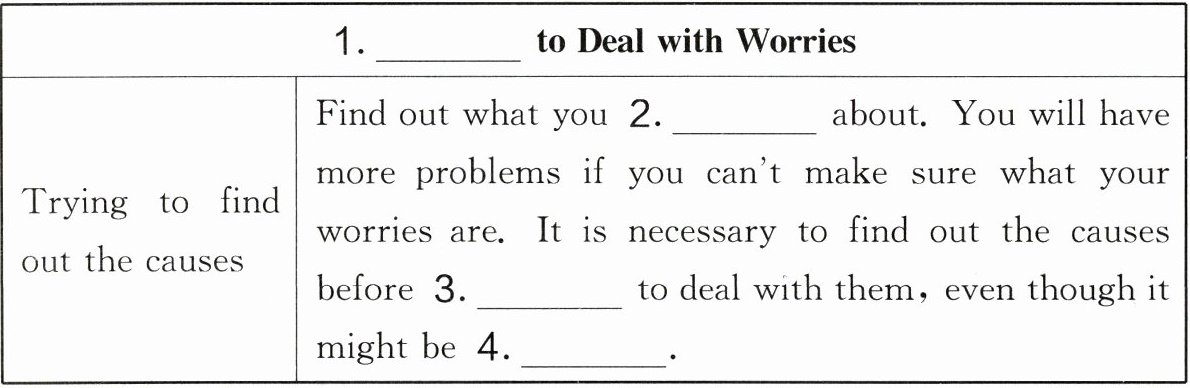
1. Steps/How/Ways [解析]根据"Whether(是否) your worries are big or small, you can take three steps to deal with them."可知,本文主要介绍了应对烦恼的三个步骤/方法,即如何应对烦恼。故填Steps/How/Ways。
deal with 意为"解决;处理;应付"。↩
2. worry [解析]根据"The first step is to find out what you're worried about."可知,第一步是找出你所担心的事情。worry about意为"担心"。故填worry。
3. starting [解析]根据原文"If you can't make sure what your worries are, you will have more and more problems in your life. So remember that you must try to find out the causes before you start to deal with them"可知,如果你不能确定你的烦恼是什么,那么你的生活中会有越来越多的问题。所以记住,在你开始着手处理之前,你必须先找出原因。介词"before"后面应接动名词形式。故填starting。
4. difficult/hard [解析]根据"So remember that you must try to find out the causes before you start to deal with them, even though(尽管) it might not be so easy."可知,在你开始着手处理之前,你必须先找出原因,尽管这可能并不容易或者很难。故填difficult/hard。
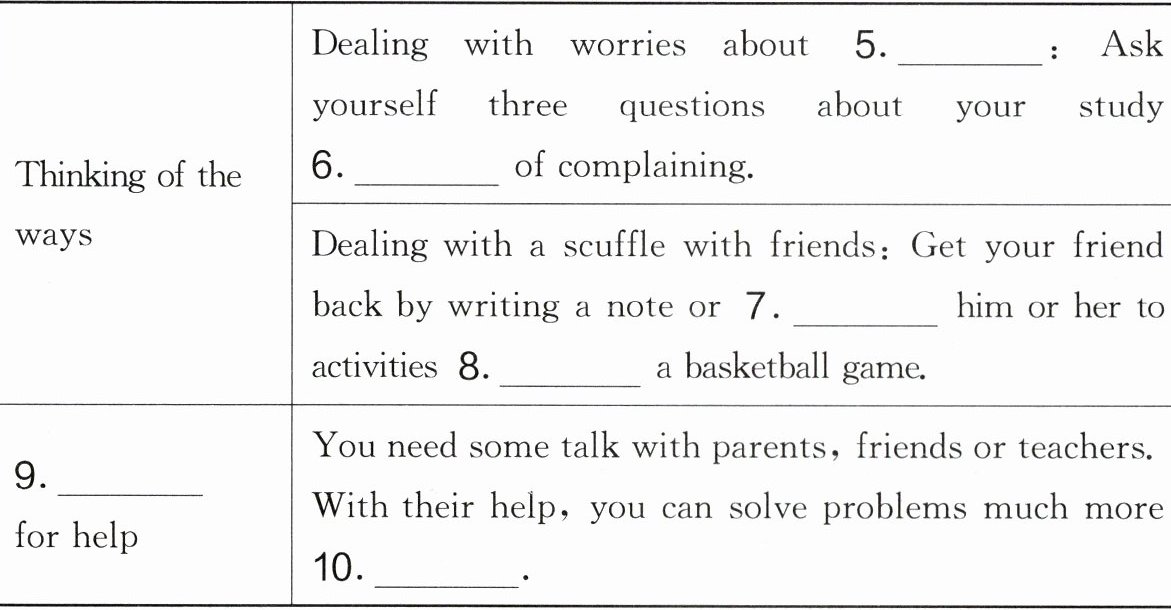
5. marks [解析]根据"Marks at school are often a top worry for students. If you have such worries, don't complain(抱怨). You should ask yourself these questions"可知,学校的分数往往是学生最担心的问题。如果你有这样的担忧,不要抱怨。你应该问自己这些问题。mark意为"分数",其复数形式是marks。故填marks。
6. instead [解析]根据"Marks at school are often a top worry for students. If you have such worries, don't complain(抱怨). You should ask yourself these questions"可知,学校的分数往往是学生最担心的问题。如果你有这样的担忧,不要抱怨,而是应该问自己这些问题。instead of意为"而不是"。故填instead。
7. inviting [解析]根据"If your worry is about a scuffle(冲突) with your friends, you might write a note to him or her, or invite him or her to activities such as a basketball game."可知,如果你担心的是和朋友冲突的事,你可以给他或她写张便条,或者邀请他或她参加篮球比赛等活动。invite意为"邀请";by是介词,其后跟动名词。故填inviting。
8. like [解析]根据"If your worry is about a scuffle(冲突) with your friends, you might write a note to him or her, or invite him or her to activities such as a basketball game."可知,你可以给他或她写张便条,或者邀请他或她参加篮球比赛等活动。like意为"像"。故填like。
9. Asking [解析]根据"Ask for help"可知,当我们担忧时,可以向他人寻求帮助。根据表格中的"Trying to find out the causes"和"Thinking of the ways"可知,空处应填动名词形式。注意首字母大写。故填Asking。
10. easily [解析]根据"They can always make solving problems much easier."可知,他们总是可以帮助我们更容易地解决问题。空处需要填副词修饰"solve",easily意为"容易地"。故填easily。
1. Steps/How/Ways [解析]根据"Whether(是否) your worries are big or small, you can take three steps to deal with them."可知,本文主要介绍了应对烦恼的三个步骤/方法,即如何应对烦恼。故填Steps/How/Ways。
deal with 意为"解决;处理;应付"。↩
2. worry [解析]根据"The first step is to find out what you're worried about."可知,第一步是找出你所担心的事情。worry about意为"担心"。故填worry。
3. starting [解析]根据原文"If you can't make sure what your worries are, you will have more and more problems in your life. So remember that you must try to find out the causes before you start to deal with them"可知,如果你不能确定你的烦恼是什么,那么你的生活中会有越来越多的问题。所以记住,在你开始着手处理之前,你必须先找出原因。介词"before"后面应接动名词形式。故填starting。
4. difficult/hard [解析]根据"So remember that you must try to find out the causes before you start to deal with them, even though(尽管) it might not be so easy."可知,在你开始着手处理之前,你必须先找出原因,尽管这可能并不容易或者很难。故填difficult/hard。
5. marks [解析]根据"Marks at school are often a top worry for students. If you have such worries, don't complain(抱怨). You should ask yourself these questions"可知,学校的分数往往是学生最担心的问题。如果你有这样的担忧,不要抱怨。你应该问自己这些问题。mark意为"分数",其复数形式是marks。故填marks。
6. instead [解析]根据"Marks at school are often a top worry for students. If you have such worries, don't complain(抱怨). You should ask yourself these questions"可知,学校的分数往往是学生最担心的问题。如果你有这样的担忧,不要抱怨,而是应该问自己这些问题。instead of意为"而不是"。故填instead。
7. inviting [解析]根据"If your worry is about a scuffle(冲突) with your friends, you might write a note to him or her, or invite him or her to activities such as a basketball game."可知,如果你担心的是和朋友冲突的事,你可以给他或她写张便条,或者邀请他或她参加篮球比赛等活动。invite意为"邀请";by是介词,其后跟动名词。故填inviting。
8. like [解析]根据"If your worry is about a scuffle(冲突) with your friends, you might write a note to him or her, or invite him or her to activities such as a basketball game."可知,你可以给他或她写张便条,或者邀请他或她参加篮球比赛等活动。like意为"像"。故填like。
9. Asking [解析]根据"Ask for help"可知,当我们担忧时,可以向他人寻求帮助。根据表格中的"Trying to find out the causes"和"Thinking of the ways"可知,空处应填动名词形式。注意首字母大写。故填Asking。
10. easily [解析]根据"They can always make solving problems much easier."可知,他们总是可以帮助我们更容易地解决问题。空处需要填副词修饰"solve",easily意为"容易地"。故填easily。
解析
【分析】
本题为任务型阅读,要求根据短文内容完成表格,每空填一个单词。解题思路:1. 通读全文,把握文章主旨(介绍应对烦恼的三个步骤);2. 针对每个空格,定位原文对应段落或句子;3. 分析空格所需词性(如名词、动名词、副词等);4. 结合原文信息确定单词,注意形式变化(如介词后接动名词、副词修饰动词等)。
【解析】
1. 定位原文第一段“you can take three steps to deal with them”,可知本文核心是应对烦恼的步骤/方法,故填Steps/How/Ways;
2. 定位原文“The first step is to find out what you're worried about”,be worried about对应worry about,故填worry;
3. 定位原文“before you start to deal with them”,before为介词,后接动名词,故填starting;
4. 定位原文“even though it might not be so easy”,easy的同义词为difficult/hard,故填difficult/hard;
5. 定位原文“Marks at school are often a top worry for students”,对应空格处名词,故填marks;
6. 定位原文“don't complain. You should ask yourself...”,表“而非”用instead,故填instead;
7. 定位原文“invite him or her to activities”,by为介词,后接动名词,故填inviting;
8. 定位原文“such as a basketball game”,such as对应like,故填like;
9. 定位原文“Ask for help”,对应前面动名词形式(Trying、Thinking),故填Asking;
10. 定位原文“make solving problems much easier”,修饰动词solve用副词,故填easily。
【答案】
1. Steps/How/Ways 2. worry 3. starting 4. difficult/hard 5. marks 6. instead 7. inviting 8. like 9. Asking 10. easily
【知识点】
任务型阅读、词汇运用、词性转换
【点评】
本题考查任务型阅读的细节查找与词汇运用,需结合原文定位信息,注意单词形式变化(如动名词、副词),整体难度适中,仔细阅读原文即可完成。
【难度系数】
0.7
本题为任务型阅读,要求根据短文内容完成表格,每空填一个单词。解题思路:1. 通读全文,把握文章主旨(介绍应对烦恼的三个步骤);2. 针对每个空格,定位原文对应段落或句子;3. 分析空格所需词性(如名词、动名词、副词等);4. 结合原文信息确定单词,注意形式变化(如介词后接动名词、副词修饰动词等)。
【解析】
1. 定位原文第一段“you can take three steps to deal with them”,可知本文核心是应对烦恼的步骤/方法,故填Steps/How/Ways;
2. 定位原文“The first step is to find out what you're worried about”,be worried about对应worry about,故填worry;
3. 定位原文“before you start to deal with them”,before为介词,后接动名词,故填starting;
4. 定位原文“even though it might not be so easy”,easy的同义词为difficult/hard,故填difficult/hard;
5. 定位原文“Marks at school are often a top worry for students”,对应空格处名词,故填marks;
6. 定位原文“don't complain. You should ask yourself...”,表“而非”用instead,故填instead;
7. 定位原文“invite him or her to activities”,by为介词,后接动名词,故填inviting;
8. 定位原文“such as a basketball game”,such as对应like,故填like;
9. 定位原文“Ask for help”,对应前面动名词形式(Trying、Thinking),故填Asking;
10. 定位原文“make solving problems much easier”,修饰动词solve用副词,故填easily。
【答案】
1. Steps/How/Ways 2. worry 3. starting 4. difficult/hard 5. marks 6. instead 7. inviting 8. like 9. Asking 10. easily
【知识点】
任务型阅读、词汇运用、词性转换
【点评】
本题考查任务型阅读的细节查找与词汇运用,需结合原文定位信息,注意单词形式变化(如动名词、副词),整体难度适中,仔细阅读原文即可完成。
【难度系数】
0.7
