

 登录
登录
一 从方框中选择正确的答语,将其序号写在括号内。
A. They are Reduce, Reuse and Recycle.
B. I’m going to buy a new schoolbag.
C. We can see m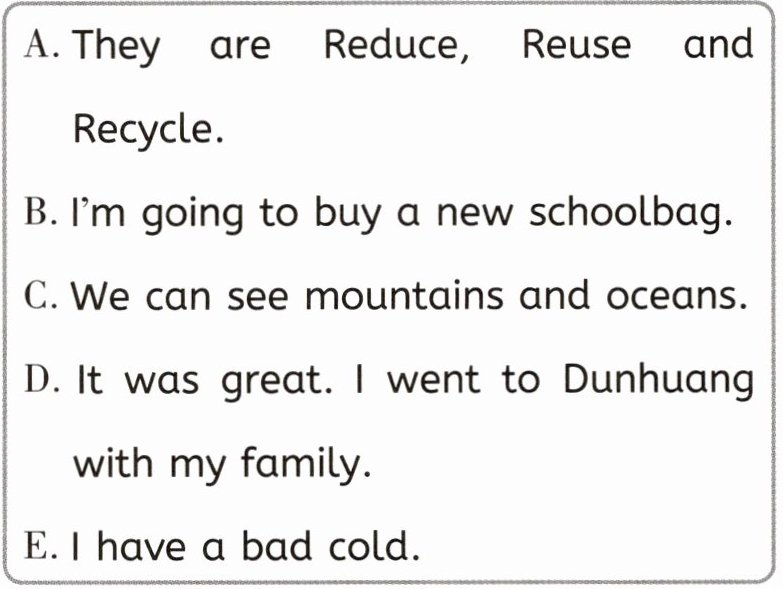 tains and oceans.
D. It was great. I went to Dunhuang with my family.
E. I have a bad cold.
(
(
(
(
(
A. They are Reduce, Reuse and Recycle.
B. I’m going to buy a new schoolbag.
C. We can see m
tains and oceans.D. It was great. I went to Dunhuang with my family.
E. I have a bad cold.
(
D
)1. How was your summer holiday?(
E
)2. What’s the matter with you?(
A
)3. What are the 3R rules?(
B
)4. How are you going to spend your money?(
C
)5. What can we see from outer space?答案
1. D 2. E 3. A 4. B 5. C
解析
【分析】
本题是英语情景交际的选答语题,解题思路为:先理解每个问句的语义,再匹配对应的答语内容:1.问句询问假期状况,需选描述假期感受的答语;2.问句询问自身状况,需选说明问题的答语;3.问句询问3R规则内容,需选对应规则的答语;4.问句询问花钱计划,需选对应计划的答语;5.问句询问外太空可见事物,需选对应事物的答语。
【解析】
1. 问句“How was your summer holiday?”询问假期的情况,答语需描述假期感受,D选项“It was great. I went to Dunhuang with my family.”符合,故1选D;
2. 问句“What’s the matter with you?”询问对方的状况,答语需说明自身问题,E选项“I have a bad cold.”符合,故2选E;
3. 问句“What are the 3R rules?”询问3R规则的内容,A选项“They are Reduce, Reuse and Recycle.”符合,故3选A;
4. 问句“How are you going to spend your money?”询问花钱的计划,B选项“I’m going to buy a new schoolbag.”符合,故4选B;
5. 问句“What can we see from outer space?”询问从外太空能看到的事物,C选项“We can see mountains and oceans.”符合,故5选C。
【答案】
1.D 2.E 3.A 4.B 5.C
【知识点】
英语情景交际、特殊疑问句答语匹配
【点评】
本题考查日常情景交际中特殊疑问句的答语匹配,属于基础题型,需要学生掌握常见问句的含义及对应答语,难度适中。
【难度系数】
0.6
本题是英语情景交际的选答语题,解题思路为:先理解每个问句的语义,再匹配对应的答语内容:1.问句询问假期状况,需选描述假期感受的答语;2.问句询问自身状况,需选说明问题的答语;3.问句询问3R规则内容,需选对应规则的答语;4.问句询问花钱计划,需选对应计划的答语;5.问句询问外太空可见事物,需选对应事物的答语。
【解析】
1. 问句“How was your summer holiday?”询问假期的情况,答语需描述假期感受,D选项“It was great. I went to Dunhuang with my family.”符合,故1选D;
2. 问句“What’s the matter with you?”询问对方的状况,答语需说明自身问题,E选项“I have a bad cold.”符合,故2选E;
3. 问句“What are the 3R rules?”询问3R规则的内容,A选项“They are Reduce, Reuse and Recycle.”符合,故3选A;
4. 问句“How are you going to spend your money?”询问花钱的计划,B选项“I’m going to buy a new schoolbag.”符合,故4选B;
5. 问句“What can we see from outer space?”询问从外太空能看到的事物,C选项“We can see mountains and oceans.”符合,故5选C。
【答案】
1.D 2.E 3.A 4.B 5.C
【知识点】
英语情景交际、特殊疑问句答语匹配
【点评】
本题考查日常情景交际中特殊疑问句的答语匹配,属于基础题型,需要学生掌握常见问句的含义及对应答语,难度适中。
【难度系数】
0.6
二 将下面的句子重新排序,组成一段有意义的对话。
(
(
(
(
(
(
(
(
4
)I'm going to buy a new schoolbag and some books.(
1
)Hi, Mike! How much pocket money do you have?(
5
)They are the things we need.(
6
)I also want to buy a microscope, but it's expensive.(
3
)What are you going to do with your pocket money?(
2
)I have 150 yuan.(
7
)That's a good idea! But you need to save money for it.答案
4 1 5 6 3 2 7
解析
【分析】首先梳理对话的日常交际逻辑:对话围绕零花钱的数量、用途展开,需按问答顺序和语义连贯性排序。第一步,找到起始句(打招呼并询问零花钱数量);第二步,对应回答零花钱数量;第三步,询问零花钱的用途;第四步,回答用途;第五步,补充额外想买的物品;第六步,说明这些物品是需要的;第七步,给出评价。据此对应序号即可得出正确排序。
【解析】根据日常对话的逻辑顺序:1. 起始句为“Hi, Mike! How much pocket money do you have?”(对应序号1);2. 回答零花钱数量:“I have 150 yuan.”(对应序号2);3. 询问用途:“What are you going to do with your pocket money?”(对应序号3);4. 回答用途:“I'm going to buy a new schoolbag and some books.”(对应序号4);5. 补充想买的物品:“I also want to buy a microscope, but it's expensive.”(对应序号5);6. 说明物品属性:“They are the things we need.”(对应序号6);7. 给出评价:“That's a good idea! But you need to save money for it.”(对应序号7)。因此正确排序为4 1 5 6 3 2 7。
【答案】4 1 5 6 3 2 7
【知识点】日常交际用语,句子排序
【点评】本题考查日常交际对话的逻辑排序,需把握对话的问答顺序和语义连贯性,属于基础题型。
【难度系数】0.5
【解析】根据日常对话的逻辑顺序:1. 起始句为“Hi, Mike! How much pocket money do you have?”(对应序号1);2. 回答零花钱数量:“I have 150 yuan.”(对应序号2);3. 询问用途:“What are you going to do with your pocket money?”(对应序号3);4. 回答用途:“I'm going to buy a new schoolbag and some books.”(对应序号4);5. 补充想买的物品:“I also want to buy a microscope, but it's expensive.”(对应序号5);6. 说明物品属性:“They are the things we need.”(对应序号6);7. 给出评价:“That's a good idea! But you need to save money for it.”(对应序号7)。因此正确排序为4 1 5 6 3 2 7。
【答案】4 1 5 6 3 2 7
【知识点】日常交际用语,句子排序
【点评】本题考查日常交际对话的逻辑排序,需把握对话的问答顺序和语义连贯性,属于基础题型。
【难度系数】0.5
三 看图,根据图片提示补全对话。
A: What are you 1.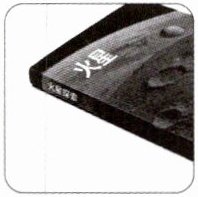
B: I'm reading a book about 2.
A: That's cool. 3.
B: Yes, there is. But there aren't any living 4.
A: Do you want to travel to Mars?
B: Yes, I do. Maybe I can go there 5.
A: What are you 1.
reading
? B: I'm reading a book about 2.
Mars
.A: That's cool. 3.
Is
there any water on Mars?B: Yes, there is. But there aren't any living 4.
things
.A: Do you want to travel to Mars?
B: Yes, I do. Maybe I can go there 5.
one day
.答案
1. reading 2. Mars 3. Is 4. things 5. one day
(答案不唯一)
(答案不唯一)
解析
【分析】
需结合对话语境、语法规则及图片提示补全空格:1. 根据答句的现在进行时结构,确定问句的动词形式;2. 图片为火星相关书籍,结合对话后续内容确定名词;3. 依据there be句型的就近原则,匹配be动词;4. 结合语境和固定搭配确定名词;5. 选择符合将来时间表达的短语。
【解析】
1. 答句为I'm reading,是现在进行时,问句需对应现在进行时结构,故填reading;
2. 图片显示是关于火星的书,对话后续也提到Mars,故填Mars;
3. there be句型中,主语water是不可数名词,be动词用Is,句首大写;
4. living things是固定短语,意为“生物”,符合语境;
5. one day表示“某一天”,用于将来时,符合对话中表达未来去火星的语境。
【答案】
1. reading 2. Mars 3. Is 4. things 5. one day
【知识点】
现在进行时、there be句型、固定搭配
【点评】
本题结合图片与对话语境,考查基础英语补全对话,涉及核心语法和常用短语,难度适中。
【难度系数】
0.3
需结合对话语境、语法规则及图片提示补全空格:1. 根据答句的现在进行时结构,确定问句的动词形式;2. 图片为火星相关书籍,结合对话后续内容确定名词;3. 依据there be句型的就近原则,匹配be动词;4. 结合语境和固定搭配确定名词;5. 选择符合将来时间表达的短语。
【解析】
1. 答句为I'm reading,是现在进行时,问句需对应现在进行时结构,故填reading;
2. 图片显示是关于火星的书,对话后续也提到Mars,故填Mars;
3. there be句型中,主语water是不可数名词,be动词用Is,句首大写;
4. living things是固定短语,意为“生物”,符合语境;
5. one day表示“某一天”,用于将来时,符合对话中表达未来去火星的语境。
【答案】
1. reading 2. Mars 3. Is 4. things 5. one day
【知识点】
现在进行时、there be句型、固定搭配
【点评】
本题结合图片与对话语境,考查基础英语补全对话,涉及核心语法和常用短语,难度适中。
【难度系数】
0.3
四 联系上下文,选择合适的句子补全对话。
(A)
A. What is it used for?
B. I’ll buy some lanterns.
C. What is this called in Chinese?
D. What is it made of?
E. Why is it red?
Sarah: Wow! 1.
Chen Jie: Oh, it’s “灯笼”.
Sarah: I see. We call it “lantern” in English. 2.
Chen Jie: It’s made of paper and plastic.
Sarah: 3.
Chen Jie: We use it for fun. But it is said that people used it for driving off the evil genius(邪魔) in the ancient times.
Sarah: I see. 4.
Chen Jie: When Chinese people see red, they always think of happiness.
Sarah: How interesting! 5.
(B)
A. Do I need to take any medicine?
B. I have a headache.
C. But now it hurts a lot.
D. You’re welcome.
E. When did it happen?
Doctor: Hello, Mike. What’s wrong with you?
Mike: 1.
Doctor: What happened to you?
Mike: I fell over and hurt my head when I was running.
Doctor: 2.
Mike: About two days ago. At first, it didn’t hurt so much. 3.
Doctor: Well, let me have a look. Don’t worry. There is nothing serious.
Mike: How lucky! 4.
Doctor: Yes, you do. You should take this medicine three times a day.
Mike: OK. Thank you.
Doctor: 5.
(C)
A. Would you like to go with me?
B. Can you give me some advice?
C. See you then.
D. Yes, I have.
E. When does it start?
David: Have you read the news about Shenzhou-22?
John: 1.
David: You’re right. Do you have any plans to learn more about space?
John: Not really. 2.
David: The space club will have a show tomorrow. 3.
John: Of course. Maybe we can join the space club and make more friends.
David: Cool. I believe it will be a good chance to experience space science.
John: You’re right. 4.
David: It starts at 9:00 a.m.
John: Great. Let’s meet at the school gate at 8:40 a.m.
David: OK. 5.
John: See you.
(A)
A. What is it used for?
B. I’ll buy some lanterns.
C. What is this called in Chinese?
D. What is it made of?
E. Why is it red?
Sarah: Wow! 1.
C
Chen Jie: Oh, it’s “灯笼”.
Sarah: I see. We call it “lantern” in English. 2.
D
Chen Jie: It’s made of paper and plastic.
Sarah: 3.
A
Chen Jie: We use it for fun. But it is said that people used it for driving off the evil genius(邪魔) in the ancient times.
Sarah: I see. 4.
E
Chen Jie: When Chinese people see red, they always think of happiness.
Sarah: How interesting! 5.
B
I’m sure my parents will like them.(B)
A. Do I need to take any medicine?
B. I have a headache.
C. But now it hurts a lot.
D. You’re welcome.
E. When did it happen?
Doctor: Hello, Mike. What’s wrong with you?
Mike: 1.
B
Doctor: What happened to you?
Mike: I fell over and hurt my head when I was running.
Doctor: 2.
E
Mike: About two days ago. At first, it didn’t hurt so much. 3.
C
Doctor: Well, let me have a look. Don’t worry. There is nothing serious.
Mike: How lucky! 4.
A
Doctor: Yes, you do. You should take this medicine three times a day.
Mike: OK. Thank you.
Doctor: 5.
D
Hope you feel better soon.(C)
A. Would you like to go with me?
B. Can you give me some advice?
C. See you then.
D. Yes, I have.
E. When does it start?
David: Have you read the news about Shenzhou-22?
John: 1.
D
It’s really exciting. China has made great progress in space.David: You’re right. Do you have any plans to learn more about space?
John: Not really. 2.
B
David: The space club will have a show tomorrow. 3.
A
John: Of course. Maybe we can join the space club and make more friends.
David: Cool. I believe it will be a good chance to experience space science.
John: You’re right. 4.
E
David: It starts at 9:00 a.m.
John: Great. Let’s meet at the school gate at 8:40 a.m.
David: OK. 5.
C
John: See you.
答案
(A)1. C 2. D 3. A 4. E 5. B
(B)1. B 2. E 3. C 4. A 5. D
(C)1. D 2. B 3. A 4. E 5. C
(B)1. B 2. E 3. C 4. A 5. D
(C)1. D 2. B 3. A 4. E 5. C
解析
【分析】
补全对话需结合上下文语境,根据答句内容匹配对应的问句或句子。先通读每组对话明确主题:(A)组围绕灯笼的名称、材质、用途等展开;(B)组是看病的日常对话;(C)组是关于神舟22号的活动邀请。逐空分析时,需关注问句与答句的逻辑对应关系,以及句子间的语义衔接。
【解析】
(A)1. 答句为物品名称“灯笼”,对应问句“这个中文叫什么”,选C;2. 答句说明制作材料,对应问句“它由什么制成”,选D;3. 答句说明用途,对应问句“它用来做什么”,选A;4. 答句解释红色的原因,对应问句“为什么是红色”,选E;5. 后句提到父母会喜欢,对应表达买灯笼的意愿,选B。
(B)1. 问句问“你怎么了”,对应回答身体状况“我头疼”,选B;2. 答句是时间,对应问句“什么时候发生的”,选E;3. 前句说一开始不疼,对应说明现在疼痛变化“但现在疼得厉害”,选C;4. 答句提到需要吃药,对应问句“我需要吃药吗”,选A;5. 前句说“谢谢”,对应回应感谢“不客气”,选D。
(C)1. 问句是现在完成时的一般疑问句,对应肯定回答“是的,我看过”,选D;2. 前句说没计划,对应表达需要建议“你能给我一些建议吗”,选B;3. 前句提到太空俱乐部的展览,对应邀请对方“你想和我一起去吗”,选A;4. 答句是时间,对应问句“它什么时候开始”,选E;5. 前句说“再见”,对应告别语“到时候见”,选C。
【答案】
(A)1. C 2. D 3. A 4. E 5. B (B)1. B 2. E 3. C 4. A 5. D (C)1. D 2. B 3. A 4. E 5. C
【知识点】
英语情景交际、补全对话
【点评】
本题考查日常情景对话的理解与运用,需结合上下文逻辑匹配句子,是基础题型,注重学生的语境分析能力。
【难度系数】
0.7
补全对话需结合上下文语境,根据答句内容匹配对应的问句或句子。先通读每组对话明确主题:(A)组围绕灯笼的名称、材质、用途等展开;(B)组是看病的日常对话;(C)组是关于神舟22号的活动邀请。逐空分析时,需关注问句与答句的逻辑对应关系,以及句子间的语义衔接。
【解析】
(A)1. 答句为物品名称“灯笼”,对应问句“这个中文叫什么”,选C;2. 答句说明制作材料,对应问句“它由什么制成”,选D;3. 答句说明用途,对应问句“它用来做什么”,选A;4. 答句解释红色的原因,对应问句“为什么是红色”,选E;5. 后句提到父母会喜欢,对应表达买灯笼的意愿,选B。
(B)1. 问句问“你怎么了”,对应回答身体状况“我头疼”,选B;2. 答句是时间,对应问句“什么时候发生的”,选E;3. 前句说一开始不疼,对应说明现在疼痛变化“但现在疼得厉害”,选C;4. 答句提到需要吃药,对应问句“我需要吃药吗”,选A;5. 前句说“谢谢”,对应回应感谢“不客气”,选D。
(C)1. 问句是现在完成时的一般疑问句,对应肯定回答“是的,我看过”,选D;2. 前句说没计划,对应表达需要建议“你能给我一些建议吗”,选B;3. 前句提到太空俱乐部的展览,对应邀请对方“你想和我一起去吗”,选A;4. 答句是时间,对应问句“它什么时候开始”,选E;5. 前句说“再见”,对应告别语“到时候见”,选C。
【答案】
(A)1. C 2. D 3. A 4. E 5. B (B)1. B 2. E 3. C 4. A 5. D (C)1. D 2. B 3. A 4. E 5. C
【知识点】
英语情景交际、补全对话
【点评】
本题考查日常情景对话的理解与运用,需结合上下文逻辑匹配句子,是基础题型,注重学生的语境分析能力。
【难度系数】
0.7
