

 登录
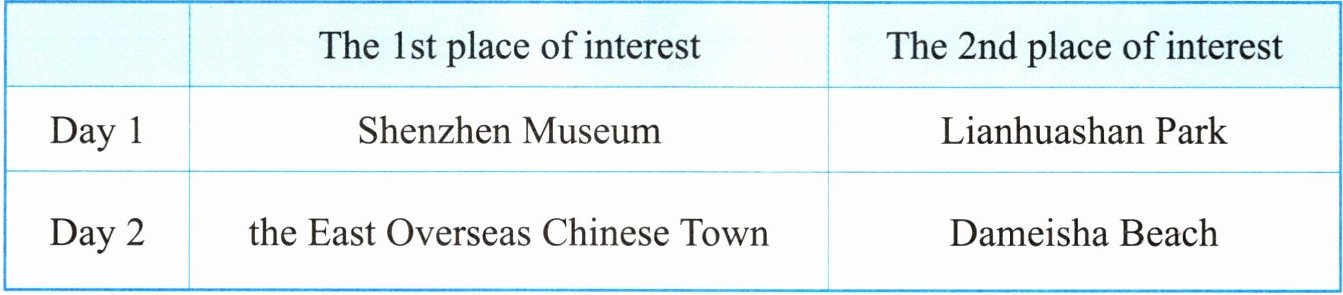
Ⅳ.Your American e-friend Bob is coming to visit Shenzhen for two days. Make a travel plan according to the table below, then send an email to him about your plan.
Dear Bob,
I’ve already made a two-day visit plan.
I hope you’ll enjoy your stay in Shenzhen.
Dear Bob,
I’ve already made a two-day visit plan.
I hope you’ll enjoy your stay in Shenzhen.
答案
On the first day, we will go to Shenzhen Museum in the morning first. You can learn about the past and changes of Shenzhen there. After that, we will visit Lianhuashan Park. We can climb the hill and enjoy the nice view of the city. On the second day, we plan to go to the East Overseas Chinese Town in the morning. There are many interesting shows and fun activities for us to try. In the afternoon, we will head to Dameisha Beach. We can walk on the soft sand, enjoy the sea wind and taste fresh local seafood together.
解析
【分析】
本题要求给美国笔友Bob写一封介绍深圳两天旅行计划的邮件,需依据表格中的景点信息完成写作。解题思路:1. 明确邮件结构,结合已给开头,分两天梳理行程;2. 对应表格内容,提取第一天(深圳博物馆、莲花山公园)和第二天(东部华侨城、大梅沙海滩)的景点;3. 用一般将来时描述行程,补充符合实际的活动,语言需友好自然,符合邮件交际语气。
【解析】
先介绍第一天行程:上午先去深圳博物馆,说明可了解深圳的过去与变化;之后前往莲花山公园,爬山欣赏城市景观。再介绍第二天行程:上午去东部华侨城,提及有有趣的表演和活动;下午前往大梅沙海滩,描述在海滩散步、吹海风、品尝海鲜等活动,最后衔接结尾句。
【答案】
On the first day, we will go to Shenzhen Museum in the morning first. You can learn about the past and changes of Shenzhen there. After that, we will visit Lianhuashan Park. We can climb the hill and enjoy the nice view of the city. On the second day, we plan to go to the East Overseas Chinese Town in the morning. There are many interesting shows and fun activities for us to try. In the afternoon, we will head to Dameisha Beach. We can walk on the soft sand, enjoy the sea wind and taste fresh local seafood together.
【知识点】
一般将来时;英文书信写作;景点描述
【点评】
本题结合生活实际,考察学生运用英语制定旅行计划并进行书面交流的能力,要求学生准确提取表格信息,用通顺的英文表达合理行程,语言需符合邮件的交际语境。
【难度系数】
0.5
I Reading comprehension.
Slow travel is a different way of seeing the world. It is not just about visiting famous places. It is about living a little like the local people and really feeling their culture. The longer you stay, the more you can understand.
I tried slow travel in India in 2012. I lived with a local family. Every day, I heard a loud, regular chant(吟唱). On the first day, I asked about it and people told me that it was a call to prayer(祷告). I believed that, but I was wrong. On the fourth day, I found out it was actually the doorbell! If I had had a fast trip and left earlier, I would have kept the wrong idea in my mind.
Slow travel also lets you have unexpected experiences. Once, during a three-week stay in Italy, I went to a cinema. There, I met some friendly people. After the movie, they invited me to a local restaurant. It was a special place. There was no menu. The waiter just talked with us and then decided what we would eat. It was a real local experience that most tourists never get.
If you want to try slow travel, here are some tips:
※ ▲ to avoid crowds. Some tourist spots might be closed, but you can see more real local life.
※ Stay where the locals live. This helps you learn about authentic life quickly.
※ Shop at local markets and small stores. You can find interesting things and food there.
(
A. Visiting as many tourist spots as possible.
B. Experiencing local life and culture deeply.
C. Travelling quickly to save time and money.
D. Staying in expensive hotels for comfort.
(
A. Travel in the busy season
B. Travel with a big group
C. Travel during the off-season
D. Travel to the nearest city
(
A. Expensive. B. Real. C. Modern. D. Famous.
(
A. By giving some numbers and facts about tourism.
B. By sharing personal experiences in India and Italy.
C. By comparing travel costs between fast and slow travel.
D. By listing famous tourist attractions in different countries.
(
A. Supportive. B. Disliked. C. Unsure. D. Interested.
Slow travel is a different way of seeing the world. It is not just about visiting famous places. It is about living a little like the local people and really feeling their culture. The longer you stay, the more you can understand.
I tried slow travel in India in 2012. I lived with a local family. Every day, I heard a loud, regular chant(吟唱). On the first day, I asked about it and people told me that it was a call to prayer(祷告). I believed that, but I was wrong. On the fourth day, I found out it was actually the doorbell! If I had had a fast trip and left earlier, I would have kept the wrong idea in my mind.
Slow travel also lets you have unexpected experiences. Once, during a three-week stay in Italy, I went to a cinema. There, I met some friendly people. After the movie, they invited me to a local restaurant. It was a special place. There was no menu. The waiter just talked with us and then decided what we would eat. It was a real local experience that most tourists never get.
If you want to try slow travel, here are some tips:
※ ▲ to avoid crowds. Some tourist spots might be closed, but you can see more real local life.
※ Stay where the locals live. This helps you learn about authentic life quickly.
※ Shop at local markets and small stores. You can find interesting things and food there.
(
B
) 1. What is “slow travel” according to the passage?A. Visiting as many tourist spots as possible.
B. Experiencing local life and culture deeply.
C. Travelling quickly to save time and money.
D. Staying in expensive hotels for comfort.
(
C
) 2. Which of the following is the best to put in ▲?A. Travel in the busy season
B. Travel with a big group
C. Travel during the off-season
D. Travel to the nearest city
(
B
) 3. What does the underlined word “authentic” mean?A. Expensive. B. Real. C. Modern. D. Famous.
(
B
) 4. How does the author explain the idea of “slow travel” to us?A. By giving some numbers and facts about tourism.
B. By sharing personal experiences in India and Italy.
C. By comparing travel costs between fast and slow travel.
D. By listing famous tourist attractions in different countries.
(
A
) 5. What is the writer’s opinion on “slow travel”?A. Supportive. B. Disliked. C. Unsure. D. Interested.
答案
1.B 2.C 3.B 4.B 5.A
解析
【分析】
1. 第1题需定位原文对“slow travel”的定义,匹配核心含义选答案;
2. 第2题需结合“避开人群”的要求,选择符合逻辑的旅行时间;
3. 第3题通过上下文语境推断生词“authentic”的含义;
4. 第4题梳理作者的写作手法,判断论证方式;
5. 第5题根据作者分享的内容和给出的建议,判断其对慢旅行的态度。
【解析】
1. 细节理解题:根据文章第一段“Slow travel is...It is about living a little like the local people and really feeling their culture.”可知,慢旅行的核心是深入体验当地生活与文化,对应选项B。A、C、D均不符合慢旅行的定义,故选B。
2. 细节理解题:▲后要求“avoid crowds(避开人群)”,“Travel during the off-season(淡季旅行)”可避开旅游旺季的人流,符合要求,故选C。A、B、D均无法达到避开人群的目的,排除。
3. 词义猜测题:结合前文“Stay where the locals live(住在当地人居住的地方)”及原文提到的“real local experience”,可推断“authentic”意为“真实的”,对应选项B。A、C、D不符合语境,排除。
4. 写作手法题:作者通过分享在印度(吟唱误会)和意大利(当地餐厅经历)的亲身经历解释慢旅行,故选B。A、C、D均未在文中提及,排除。
5. 作者态度题:作者分享慢旅行的美好经历并给出实用建议,可见其对慢旅行持支持态度,故选A。
【答案】
1.B 2.C 3.B 4.B 5.A
【知识点】
英语阅读理解、词义猜测、细节理解
【点评】
本文围绕慢旅行展开,通过作者的亲身经历和实用建议考查学生对文章细节、词义、写作手法及作者态度的理解,贴近生活,难度适中,需学生精准定位原文信息。
【难度系数】
0.6
