登录
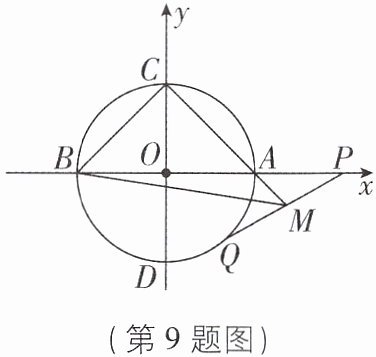
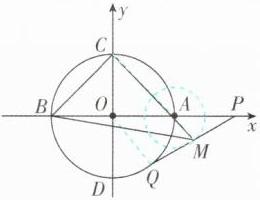
9[2025山东烟台期中,较难]如图,在平面直角坐标系xOy中,半径为4的⊙O与x轴交于点A,B,与y轴交于点C,D,连接BC,已知x轴上一点P(8,0),点Q是⊙O上一动点,连接PQ,点M为PQ的中点,连接BM,CM,则△BCM面积的最小值为
$16-4\sqrt{2}$
.答案
9. $\underline{16-4\sqrt{2}}$ 【解析】如图,连接 $OQ$,$AM$,$AC$. 由题意得 $OA=OQ=AP=4$,$PM = MQ$,$\therefore AM$ 是 $△ POQ$ 的中位线,$\therefore AM = \frac{1}{2} OQ = 2$. $\because AB$ 为 $\odot O$ 直径,$\therefore ∠ ACB = 90°$.由题意知,点 $M$ 在以 $A$ 为圆心,$2$ 为半径的 $\odot A$ 上运动. 当 $M$ 点为线段 $AC$ 与 $\odot A$ 的交点时,点 $M$ 到 $BC$ 的距离最短,为 $AC-2=\sqrt{4^2+4^2}-2=4\sqrt{2}-2$. $\because BC=\sqrt{4^2+4^2}=4\sqrt{2}$,$\therefore △ BCM$ 面积的最小值为 $\frac{1}{2} BC · CM = \frac{1}{2} ×4\sqrt{2} ×(4\sqrt{2} -2) = 16-4\sqrt{2}$. 故答案为 $16-4\sqrt{2}$.
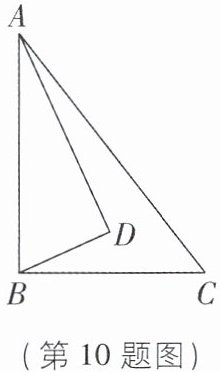
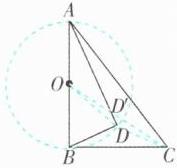
10[中]如图,在$Rt△ ABC$中,$∠ ABC=90°$,$BC=3$,$AC=5$,点$D$是其内部一动点,且$∠ DBC=∠ BAD$,则$C,D$两点间的最小距离为 (
A.3
B.4
C.$\sqrt{13}-2$
D.$\sqrt{13}$
(第10题图)
(第11题图)
C
)A.3
B.4
C.$\sqrt{13}-2$
D.$\sqrt{13}$
(第10题图)
(第11题图)
答案
10. $\underline{C}$ 【解析】$\because \mathrm{Rt}△ABC$ 中,$∠ ABC=90°$,$BC=3$,$AC=5$,$\therefore$ 由勾股定理,得 $AB=\sqrt{AC^2-BC^2}=\sqrt{5^2-3^2}=4$. 如图,取 $AB$ 的中点 $O$.$\because ∠ DBC=∠ BAD$,$∠ DBC + ∠ ABD = 90°$,$\therefore ∠ BAD+∠ ABD = 90°$,$\therefore ∠ ADB = 90°$,$\therefore D$ 点在以 $O$ 为圆心,$OA$ 为半径的圆弧上运动. 连接 $OC$ 交 $\odot O$ 于点 $D'$,连接 $OD$,$DC$. 当点 $D$ 与点 $D'$ 重合时,$C,D$ 间的距离最小,为 $CD'$ 的长,此时 $OD'=OB=\frac{1}{2} AB=2$. 在 $\mathrm{Rt}△OCB$ 中,由勾股定理,得 $OC = \sqrt{BC^2+OB^2} = \sqrt{3^2+2^2} = \sqrt{13}$,故 $CD$ 的最小值为 $OC-OD' = \sqrt{13}-2$,故选 C.
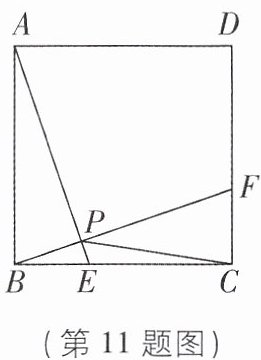
11[2025河南开封期末,较难]如图,正方形ABCD的边长为4,点E,F分别是BC,CD上的动点,且$BE=CF$,连接AE,BF交于点P,连接CP,则CP的最小值是 (
A.$2\sqrt{5}-2$
B.$3\sqrt{2}-2$
C.$2\sqrt{2}$
D.$\sqrt{2}+2$
A
)A.$2\sqrt{5}-2$
B.$3\sqrt{2}-2$
C.$2\sqrt{2}$
D.$\sqrt{2}+2$
答案
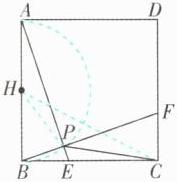
11. $\underline{A}$ 【解析】如图,取 $AB$ 中点 $H$,连接 $HP$,$HC$. 在正方形 $ABCD$ 中,$AB = BC$,$∠ ABC = ∠ BCD = 90°$.在 $△ ABE$ 和 $△ BCF$ 中,$\begin{cases} AB=BC, \\ ∠ ABE=∠ BCF, \\ BE=CF, \end{cases}$$\therefore △ ABE ≌ △ BCF(\mathrm{SAS})$,$\therefore ∠ BAE = ∠ CBF$,$\therefore ∠ BAE + ∠ ABP = ∠ CBF + ∠ ABP = 90°$,$\therefore ∠ APB = 90°$,$\therefore HP = \frac{1}{2} AB = 2$,$\therefore$ 点 $P$ 在以点 $H$ 为圆心,以 $HP$ 为半径的半圆上运动,$\therefore$ 当 $H,P,C$ 三点在同一条直线上时,$CP$ 取最小值. 在 $\mathrm{Rt}△BCH$ 中,$HC = \sqrt{2^2+4^2} = 2\sqrt{5}$,$\therefore CP$ 的最小值为 $HC-HP=2\sqrt{5}-2$,故选 A.
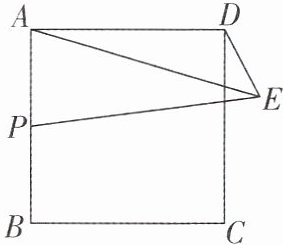
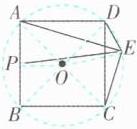
12[中]如图,正方形ABCD的边长为6,点E是正方形外一动点,且点E在CD的右侧,∠AED=45°,P为AB的中点,连接PE,当E运动时,线段PE的最大值为(
A.$6\sqrt{3}$
B.$6\sqrt{2}$
C.$3+3\sqrt{3}$
D.$3+3\sqrt{2}$
D
)A.$6\sqrt{3}$
B.$6\sqrt{2}$
C.$3+3\sqrt{3}$
D.$3+3\sqrt{2}$
答案
12. $\underline{D}$ 【解析】如图,连接 $AC$,$BD$ 交于点 $O$,连接 $PO$,$EO$.$\because ∠ AED = 45°$,$∠ ACD = 45°$,$\therefore A,C,E,D$ 四点共圆. $\because$ 正方形 $ABCD$ 的边长为 $6$,$\therefore BD=\sqrt{6^2+6^2}=6\sqrt{2}$,$\therefore OE=OD=\frac{1}{2} BD=3\sqrt{2}$. $\because P$ 为 $AB$ 的中点,$O$ 是 $BD$ 的中点,$\therefore OP = \frac{1}{2} AD = 3$. $\because PE ≤ OP + OE=3+3\sqrt{2}$,$\therefore$ 当 $P,O,E$ 三点共线时,$PE$ 的值最大,为 $OP+OE=3+3\sqrt{2}$,即线段 $PE$ 的最大值为 $3+3\sqrt{2}$. 故选 D.
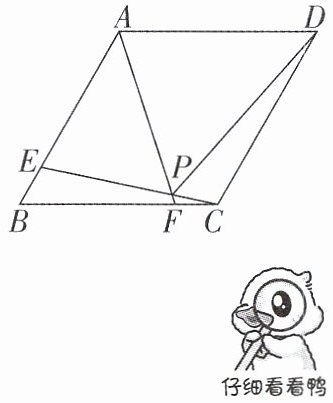
13[2025黑龙江绥化期末,较难]如图,已知菱形ABCD中,∠BAD=120°,点E,F分别在AB,BC上,BE=CF,AF与CE交于点P,连接DP.
(1)求证:∠APE=60°;
(2)当PC=1,PA=5时,求PD的长;
(3)当AB=2√3时,求PD的最大值.
(1)求证:∠APE=60°;
(2)当PC=1,PA=5时,求PD的长;
(3)当AB=2√3时,求PD的最大值.
答案
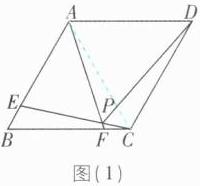
13.(1)【证明】如图(1)所示,连接 $AC$. $\because$ 四边形 $ABCD$ 是菱形,$\therefore AB = BC$,$AD // BC$,$AB // CD$.$\because ∠ BAD=120°$,$\therefore ∠ B = ∠ ADC=60°$,$\therefore △ ABC$ 是等边三角形,$\therefore ∠ ACF = ∠ CBE = 60°$,$AC = CB$. 又$\because CF = BE$,$\therefore △ ACF ≌ △ CBE(\mathrm{SAS})$,$\therefore ∠ CAF = ∠ BCE$,$\therefore ∠ APE = ∠ ACE + ∠ CAF = ∠ BCE + ∠ ACE = ∠ ACB = 60°$.
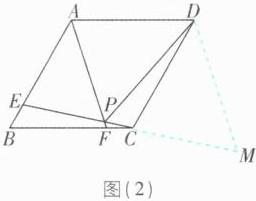
(2)【解】如图(2),延长 $PC$ 到 $M$,使得 $CM = AP$,连接 $DM$. 由(1)易得$∠ AFC = ∠ CEB$. $\because$ 菱形 $ABCD$ 中,$AD // BC$,$AB // CD$,$\therefore ∠ DAF + ∠ AFC = 180°$,$∠ DCM = ∠ AEC$,$\therefore ∠ CEB + ∠ DAF = 180°$. $\because ∠ AEC + ∠ CEB = 180°$,$\therefore ∠ DAF = ∠ AEC = ∠ DCM$. 又$\because AP = CM$,$AD = CD$,$\therefore △ ADP ≌ △ CDM(\mathrm{SAS})$,$\therefore DP = DM$,$∠ ADP = ∠ CDM$,$\therefore ∠ ADC = ∠ PDM$. $\because ∠ ADC = 60°$,$\therefore ∠ PDM = 60°$,$\therefore △ PDM$ 是等边三角形,$\therefore PD = PM = PC+CM = PC+PA = 6$.
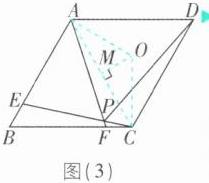
(3)$\because ∠ APE = 60°$,$\therefore ∠ APC = 120°$.$\because ∠ ADC = 60°$,$\therefore ∠ APC + ∠ ADC = 180°$,$\therefore A,P,C,D$ 四点共圆,$\therefore$ 当 $PD$ 为直径时,$PD$ 的值最大. 连接 $AC$,设圆心为 $O$,连接 $OA$,$OC$,过点 $O$ 作 $OM ⊥ AC$ 于 $M$,如图(3),$\therefore ∠ AOC = 2∠ ADC = 120°$. 又$\because OA = OC$,$\therefore ∠ OCM = ∠ OAM = 30°$,$\therefore OA = 2OM$. $\because AC=AB=2\sqrt{3}$,$OM ⊥ AC$,$\therefore AM = \frac{1}{2} AC = \sqrt{3}$,$\therefore OM^2+AM^2=(2OM)^2$,解得 $OM = 1$(负值已舍去),$\therefore OA = 2$,$\therefore PD$ 的最大值为 $4$.
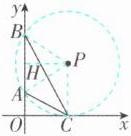
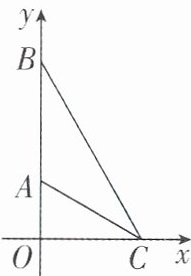
14[中]如图,已知点A,B的坐标分别是(0,1),(0,3),点C为x轴正半轴上一动点,当∠ACB最大时,点C的坐标是 (
A.(2,0)
B.($\sqrt{3}$,0)
C.($\sqrt{2}$,0)
D.(1,0)
B
)A.(2,0)
B.($\sqrt{3}$,0)
C.($\sqrt{2}$,0)
D.(1,0)
答案
14. $\underline{B}$ 【解析】过点 $A,B$ 作 $\odot P$,当 $\odot P$ 与 $x$ 轴相切于点 $C$ 时,$∠ ACB$ 最大,连接 $PA,PB,PC$,作 $PH ⊥ y$ 轴于 $H$,如图. $\because$ 点 $A,B$ 的坐标分别是$(0,1),(0,3)$,$\therefore OA=1$,$AB=3-1=2$. $\because PH ⊥ AB$,$\therefore AH=BH=1$,$\therefore OH=2$. $\because \odot P$ 与 $x$ 轴相切于点 $C$,$\therefore PC ⊥ x$ 轴,$\therefore$ 四边形 $PCOH$ 为矩形,$\therefore PC = OH = 2$,$\therefore PA = 2$. 在 $\mathrm{Rt}△PAH$ 中,$PH = \sqrt{PA^2-AH^2} = \sqrt{2^2-1^2} = \sqrt{3}$,$\therefore C$ 点坐标为 $(\sqrt{3},0)$. 故选 B.