

 登录
登录
6.如图,在$Rt△ ABC$中,$∠ ACB=90°$,$CD⊥ AB$于点D.如果$AC=3$,$AB=6$,那么AD的值为 (
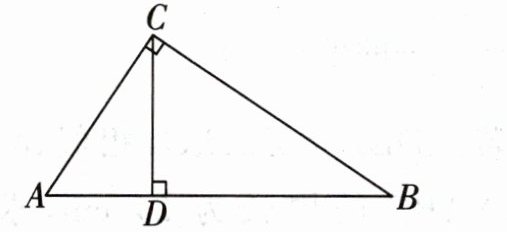
A.$\frac{3}{2}$
B.$\frac{9}{2}$
C.$\frac{3\sqrt{3}}{2}$
D.$3\sqrt{3}$
A
)A.$\frac{3}{2}$
B.$\frac{9}{2}$
C.$\frac{3\sqrt{3}}{2}$
D.$3\sqrt{3}$
答案
6.A
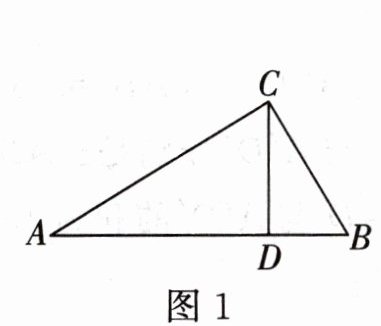
7.【问题情境】如图1,Rt△ABC中,∠ACB=90°,CD⊥AB,我们可以利用△ABC与△ACD相似证明$AC^2=AD· AB$,这个结论我们称之为射影定理,试证明这个定理;
【结论运用】如图2,正方形ABCD的边长为6,点O是对角线AC,BD的交点,点E在CD上,过点C作CF⊥BE,垂足为F,连接OF.
(1)试利用射影定理证明△BOF∽△BED;
(2)若DE=2CE,求OF的长.
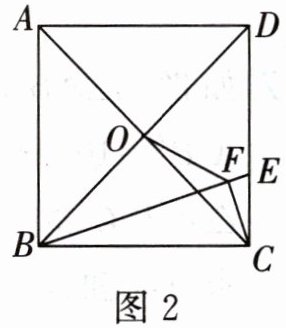
【结论运用】如图2,正方形ABCD的边长为6,点O是对角线AC,BD的交点,点E在CD上,过点C作CF⊥BE,垂足为F,连接OF.
(1)试利用射影定理证明△BOF∽△BED;
(2)若DE=2CE,求OF的长.
答案
[问题情境]证明: $\because CD ⊥ AB, \therefore ∠ ADC = 90°$. 又 $\because ∠ CAD =$
$∠ BAC, \therefore \mathrm{Rt}△ ACD ∽ \mathrm{Rt}△ ABC, \therefore AC: AB = AD: AC$,
$\therefore AC^2 = AD · AB$.
[结论运用](1)证明: $\because$ 四边形 $ABCD$ 为正方形, $\therefore OC ⊥ BO$,
$∠ BCD = 90°, \therefore BC^2 = BO · BD. \because CF ⊥ BE, \therefore BC^2 = BF ·$
$BE, \therefore BO · BD = BF · BE, \mathrm{即} \frac{BO}{BE} = \frac{BF}{BD}, \mathrm{而} ∠ OBF = ∠ EBD$,
$\therefore △ BOF ∽ △ BED$.
(2)解: $\because BC = CD = 6$, 而 $DE = 2CE, \therefore DE = 4, CE = 2$. 在
$\mathrm{Rt}△ BCE$ 中, $BE = \sqrt{2^2 + 6^2} = 2\sqrt{10}$, 在 $\mathrm{Rt}△ OBC$ 中, $OB =$
$\frac{\sqrt{2}}{2}BC = 3\sqrt{2}. \because △ BOF ∽ △ BED, \therefore \frac{OF}{DE} = \frac{BO}{BE}, \mathrm{即} \frac{OF}{4} = \frac{3\sqrt{2}}{2\sqrt{10}}$,
$\therefore OF = \frac{6\sqrt{5}}{5}$.
$∠ BAC, \therefore \mathrm{Rt}△ ACD ∽ \mathrm{Rt}△ ABC, \therefore AC: AB = AD: AC$,
$\therefore AC^2 = AD · AB$.
[结论运用](1)证明: $\because$ 四边形 $ABCD$ 为正方形, $\therefore OC ⊥ BO$,
$∠ BCD = 90°, \therefore BC^2 = BO · BD. \because CF ⊥ BE, \therefore BC^2 = BF ·$
$BE, \therefore BO · BD = BF · BE, \mathrm{即} \frac{BO}{BE} = \frac{BF}{BD}, \mathrm{而} ∠ OBF = ∠ EBD$,
$\therefore △ BOF ∽ △ BED$.
(2)解: $\because BC = CD = 6$, 而 $DE = 2CE, \therefore DE = 4, CE = 2$. 在
$\mathrm{Rt}△ BCE$ 中, $BE = \sqrt{2^2 + 6^2} = 2\sqrt{10}$, 在 $\mathrm{Rt}△ OBC$ 中, $OB =$
$\frac{\sqrt{2}}{2}BC = 3\sqrt{2}. \because △ BOF ∽ △ BED, \therefore \frac{OF}{DE} = \frac{BO}{BE}, \mathrm{即} \frac{OF}{4} = \frac{3\sqrt{2}}{2\sqrt{10}}$,
$\therefore OF = \frac{6\sqrt{5}}{5}$.
8.如图,将等边△ABC折叠,折痕为MN,使点A落在BC边上得到点D.若$BD=\frac{2}{3}BC$,则$\frac{AM}{AN}=$
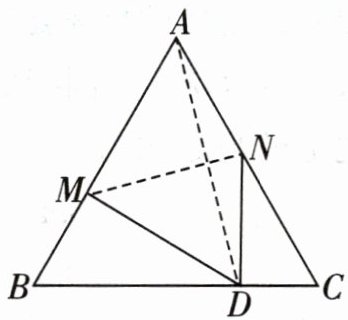
$\frac{5}{4}$
.答案
8.$\frac{5}{4}$ [解析]$\because BD = \frac{2}{3}BC, \therefore$ 设 $BD = 2a$, 则 $BC = 3a, CD =$
$BC - BD = a. \because △ ABC$ 为等边三角形, $\therefore ∠ BAC = ∠ B =$
$∠ C = 60°, AB = BC = AC = 3a$, 根据折叠的性质可得, $AM =$
$DM, AN = DN, ∠ MAN = ∠ MDN = 60°, \therefore ∠ BDM +$
$∠ MDN + ∠ CDN = 180°$, 即 $∠ BDM + ∠ CDN = 120°$.
$\because ∠ BMD + ∠ BDM + ∠ MBD = 180°$, 即 $∠ BMD + ∠ BDM =$
$120°, \therefore ∠ BMD = ∠ CDN, \therefore △ BMD ∽ △ CDN, \therefore \frac{DM}{DN} =$
$\frac{C_{△ BMD}}{C_{△ CDN}}, \mathrm{即} \frac{AM}{AN} = \frac{C_{△ BMD}}{C_{△ CDN}}. \because C_{△ BMD} = BD + BM + DM = BD +$
$BM + AM = BD + AB = 5a, C_{△ CDN} = CD + CN + DN = CD +$
$CN + AN = CD + AC = 4a, \therefore \frac{AM}{AN} = \frac{C_{△ BMD}}{C_{△ CDN}} = \frac{5a}{4a} = \frac{5}{4}$.
$BC - BD = a. \because △ ABC$ 为等边三角形, $\therefore ∠ BAC = ∠ B =$
$∠ C = 60°, AB = BC = AC = 3a$, 根据折叠的性质可得, $AM =$
$DM, AN = DN, ∠ MAN = ∠ MDN = 60°, \therefore ∠ BDM +$
$∠ MDN + ∠ CDN = 180°$, 即 $∠ BDM + ∠ CDN = 120°$.
$\because ∠ BMD + ∠ BDM + ∠ MBD = 180°$, 即 $∠ BMD + ∠ BDM =$
$120°, \therefore ∠ BMD = ∠ CDN, \therefore △ BMD ∽ △ CDN, \therefore \frac{DM}{DN} =$
$\frac{C_{△ BMD}}{C_{△ CDN}}, \mathrm{即} \frac{AM}{AN} = \frac{C_{△ BMD}}{C_{△ CDN}}. \because C_{△ BMD} = BD + BM + DM = BD +$
$BM + AM = BD + AB = 5a, C_{△ CDN} = CD + CN + DN = CD +$
$CN + AN = CD + AC = 4a, \therefore \frac{AM}{AN} = \frac{C_{△ BMD}}{C_{△ CDN}} = \frac{5a}{4a} = \frac{5}{4}$.
9.如图,已知△ABC与△BDE都是等边三角形,点D在CA上(不与A,C重合),DE与AB相交于点F.
(1)求证:△BCD∽△DAF;
(2)若BC=2,设CD=x,AF=y.
①求y关于x的函数表达式及自变量的取值范围;
②当AF最大时,判断△ADF的形状.
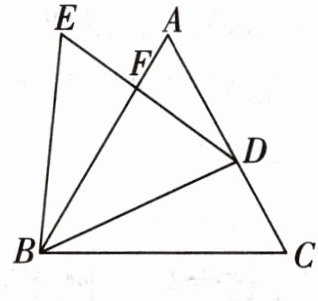
(1)求证:△BCD∽△DAF;
(2)若BC=2,设CD=x,AF=y.
①求y关于x的函数表达式及自变量的取值范围;
②当AF最大时,判断△ADF的形状.
答案
(1)证明: $\because △ ABC$ 与 $△ BDE$ 都是等边三角形, $\therefore ∠ A =$
$∠ C = ∠ BDE = 60°. \because ∠ ADF + ∠ BDE = ∠ C + ∠ DBC$,
$\therefore ∠ ADF = ∠ DBC, \therefore △ BCD ∽ △ DAF$.
(2)解:① $\because △ BCD ∽ △ DAF, \therefore \frac{BC}{AD} = \frac{CD}{AF}. \because BC = 2, CD = x$,
$AF = y, \therefore AD = 2 - x, \therefore \frac{2}{2 - x} = \frac{x}{y}, \therefore y = -\frac{1}{2}x^2 + x \ (0 <$
$x < 2)$.
②$△ ADF$ 为直角三角形. 理由: 由①可得 $y = -\frac{1}{2}x^2 + x =$
$-\frac{1}{2}(x - 1)^2 + \frac{1}{2}, \therefore$ 当 $x = 1$ 时, $y$ 存在最大值 $\frac{1}{2}$, 即当 $AF$
最大时, $CD = 1, \therefore CD = AD = \frac{1}{2}AC. \because △ ABC$ 是等边三角形,
$\therefore BD ⊥ AC, \therefore ∠ ADB = 90°. \because ∠ BDE = 60°, \therefore ∠ ADF = 30°$.
$\because ∠ A = 60°, \therefore ∠ AFD = 90°$, 即 $DF ⊥ AF, \therefore △ ADF$ 为直角三角形.
$∠ C = ∠ BDE = 60°. \because ∠ ADF + ∠ BDE = ∠ C + ∠ DBC$,
$\therefore ∠ ADF = ∠ DBC, \therefore △ BCD ∽ △ DAF$.
(2)解:① $\because △ BCD ∽ △ DAF, \therefore \frac{BC}{AD} = \frac{CD}{AF}. \because BC = 2, CD = x$,
$AF = y, \therefore AD = 2 - x, \therefore \frac{2}{2 - x} = \frac{x}{y}, \therefore y = -\frac{1}{2}x^2 + x \ (0 <$
$x < 2)$.
②$△ ADF$ 为直角三角形. 理由: 由①可得 $y = -\frac{1}{2}x^2 + x =$
$-\frac{1}{2}(x - 1)^2 + \frac{1}{2}, \therefore$ 当 $x = 1$ 时, $y$ 存在最大值 $\frac{1}{2}$, 即当 $AF$
最大时, $CD = 1, \therefore CD = AD = \frac{1}{2}AC. \because △ ABC$ 是等边三角形,
$\therefore BD ⊥ AC, \therefore ∠ ADB = 90°. \because ∠ BDE = 60°, \therefore ∠ ADF = 30°$.
$\because ∠ A = 60°, \therefore ∠ AFD = 90°$, 即 $DF ⊥ AF, \therefore △ ADF$ 为直角三角形.
