

 登录
登录
Ⅲ. 阅读理解(每小题2分,共20分)
A
(2026·广州月考) The scientific method is a way to ask and answer questions. Scientists research and make observations(观察). They also do experiments. Here are the steps for the scientific method.
First, think about what things make you curious to learn more. Make an observation. For
example, you may have noticed that mold(霉) grows on most kinds of foods. Then, you may ask yourself a question, “What conditions make the mold grow best?” It helps you focus on what you want to know. Next, you need to make a hypothesis. It comes from what you already know. So here, you may guess that mold grows best in cold and dark conditions. After that, it's time to run an experiment to test your hypothesis! You could put the food in different conditions to see what will happen. Finally, the results come out and you'll draw a conclusion—Are the results the same as your hypothesis or different from it?
Lab Report Name: Kevin Somers
Date: May 24, 2025
Project Title: Testing How Mold Grows
Question: I wonder what conditions make mold grow best
2. I prepared two pieces of bread. I put one piece in a closed paper bag and left the bag on the top of the fridge because it's warm there. I put the other piece in the fridge because it's dark and cold there.
Hypothesis: Mold grows best in cold and dark conditions
Experiment:
→materials:
■ 4 pieces of white bread
■ water
■1 paper bag
■ fridge
→ experiment time: two weeks
→method:
1. I put two pieces of bread on the dinner table. Some water was added to one piece of bread every day while the other remained dry.
3. I examined these four pieces of bread every day for two weeks. I recorded every change on the bread.
Result:
1. The wet bread developed mold more quickly than the dry bread.
2. The bread on the top of the fridge developed mold more quickly than the bread in the fridge.
Conclusion:
1. Mold will finally develop on all of the bread.
2.
21. What does the word “hypothesis” mean?
A. A guess that can be tested.
B. A record of an experiment.
C. A question about the world.
D. A final answer to a problem.
22. 新考法 写作手法 How does the writer explain the scientific method in Paragraph 2?
A. By listing numbers.
B. By comparing things.
C. By asking questions.
D. By giving an example.
23. Which one shows the RIGHT order of the scientific method?
A.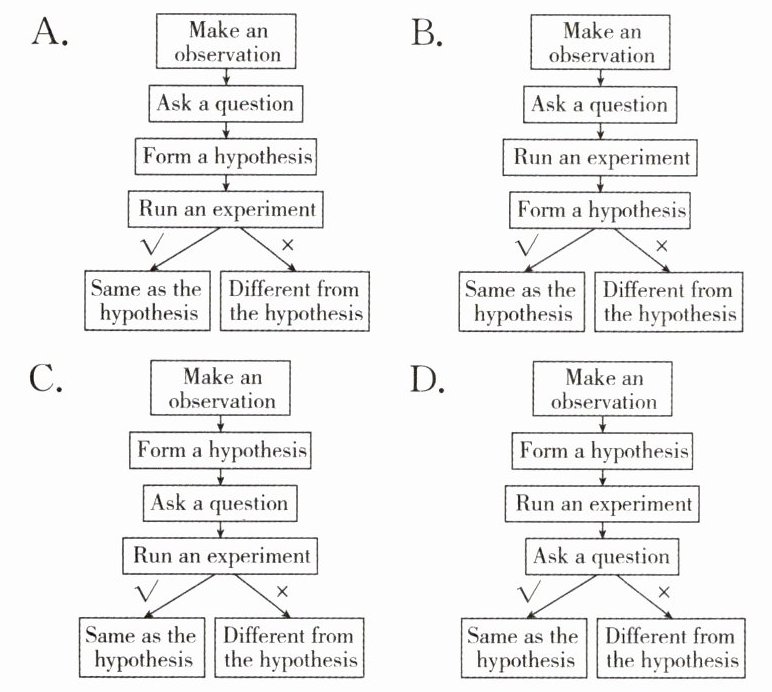
24. 新考法 图示理解 How did Kevin set up the two pieces of bread to show whether mold prefers a warm environment?

25. 新考法 补全文章 Which can be put into Conclusion 2?
A. Mold grows best in dark and cold conditions.
B. Mold grows best in dark and dry conditions.
C. Mold grows best in warm and dry conditions.
D. Mold grows best in warm and wet conditions.
A
(2026·广州月考) The scientific method is a way to ask and answer questions. Scientists research and make observations(观察). They also do experiments. Here are the steps for the scientific method.
First, think about what things make you curious to learn more. Make an observation. For
example, you may have noticed that mold(霉) grows on most kinds of foods. Then, you may ask yourself a question, “What conditions make the mold grow best?” It helps you focus on what you want to know. Next, you need to make a hypothesis. It comes from what you already know. So here, you may guess that mold grows best in cold and dark conditions. After that, it's time to run an experiment to test your hypothesis! You could put the food in different conditions to see what will happen. Finally, the results come out and you'll draw a conclusion—Are the results the same as your hypothesis or different from it?
Lab Report Name: Kevin Somers
Date: May 24, 2025
Project Title: Testing How Mold Grows
Question: I wonder what conditions make mold grow best
2. I prepared two pieces of bread. I put one piece in a closed paper bag and left the bag on the top of the fridge because it's warm there. I put the other piece in the fridge because it's dark and cold there.
Hypothesis: Mold grows best in cold and dark conditions
Experiment:
→materials:
■ 4 pieces of white bread
■ water
■1 paper bag
■ fridge
→ experiment time: two weeks
→method:
1. I put two pieces of bread on the dinner table. Some water was added to one piece of bread every day while the other remained dry.
3. I examined these four pieces of bread every day for two weeks. I recorded every change on the bread.
Result:
1. The wet bread developed mold more quickly than the dry bread.
2. The bread on the top of the fridge developed mold more quickly than the bread in the fridge.
Conclusion:
1. Mold will finally develop on all of the bread.
2.
Mold grows best in warm and wet conditions.
▲21. What does the word “hypothesis” mean?
A. A guess that can be tested.
B. A record of an experiment.
C. A question about the world.
D. A final answer to a problem.
22. 新考法 写作手法 How does the writer explain the scientific method in Paragraph 2?
A. By listing numbers.
B. By comparing things.
C. By asking questions.
D. By giving an example.
23. Which one shows the RIGHT order of the scientific method?
A.
24. 新考法 图示理解 How did Kevin set up the two pieces of bread to show whether mold prefers a warm environment?
25. 新考法 补全文章 Which can be put into Conclusion 2?
A. Mold grows best in dark and cold conditions.
B. Mold grows best in dark and dry conditions.
C. Mold grows best in warm and dry conditions.
D. Mold grows best in warm and wet conditions.
答案
Ⅲ. 21.A 22.D 23.A 24.D 25.D
A
【语篇解读】本文是一篇说明文,介绍了科学方法的步骤,并通过 Kevin 的霉菌实验报告展示了如何运用这一方法进行探究。
21. A 解析:词义猜测题。根据第二段“It comes from what you already know ... run an experiment to test your hypothesis”可知,hypothesis 是需要通过实验验证的“猜测”。故选 A。
22. D 解析:写作手法题。第二段通过“For example, you may have noticed that mold grows on most kinds of foods.”举例说明科学方法的步骤。故选 D。
23. A 解析:细节理解题。根据第二段可知科学方法的正确步骤顺序为:First, make an observation; Then, ask a question(提出问题); Next, make a hypothesis(做出假设); After that, run an experiment(进行实验); Finally, draw a conclusion(得出结论)。对应选项 A 的图示顺序。故选 A。
24. D 解析:图示理解题。根据实验报告的 Method 部分“I put one piece in a closed paper bag and left the bag on the top of the fridge because it's warm there. I put the other piece in the fridge because it's dark and cold there.”可知,为了验证霉菌是否更喜欢温暖环境,Kevin 将一片面包放在冰箱顶部(温暖、纸袋封闭),另一片放入冰箱内部(寒冷、无纸袋)。对应选项 D 的图示内容。故选 D。
25. D 解析:补全文章题。根据实验结果 Result“The wet bread developed mold more quickly than the dry bread.”和“The bread on the top of the fridge developed mold more quickly than the bread in the fridge.”可知,湿面包比干面包发霉快,温暖处比寒冷处发霉快。结合假设“Mold grows best in cold and dark conditions”与结果不同,可推断结论是霉菌在温暖、潮湿的环境下生长得最好,即选项 D。故选 D。
A
【语篇解读】本文是一篇说明文,介绍了科学方法的步骤,并通过 Kevin 的霉菌实验报告展示了如何运用这一方法进行探究。
21. A 解析:词义猜测题。根据第二段“It comes from what you already know ... run an experiment to test your hypothesis”可知,hypothesis 是需要通过实验验证的“猜测”。故选 A。
22. D 解析:写作手法题。第二段通过“For example, you may have noticed that mold grows on most kinds of foods.”举例说明科学方法的步骤。故选 D。
23. A 解析:细节理解题。根据第二段可知科学方法的正确步骤顺序为:First, make an observation; Then, ask a question(提出问题); Next, make a hypothesis(做出假设); After that, run an experiment(进行实验); Finally, draw a conclusion(得出结论)。对应选项 A 的图示顺序。故选 A。
24. D 解析:图示理解题。根据实验报告的 Method 部分“I put one piece in a closed paper bag and left the bag on the top of the fridge because it's warm there. I put the other piece in the fridge because it's dark and cold there.”可知,为了验证霉菌是否更喜欢温暖环境,Kevin 将一片面包放在冰箱顶部(温暖、纸袋封闭),另一片放入冰箱内部(寒冷、无纸袋)。对应选项 D 的图示内容。故选 D。
25. D 解析:补全文章题。根据实验结果 Result“The wet bread developed mold more quickly than the dry bread.”和“The bread on the top of the fridge developed mold more quickly than the bread in the fridge.”可知,湿面包比干面包发霉快,温暖处比寒冷处发霉快。结合假设“Mold grows best in cold and dark conditions”与结果不同,可推断结论是霉菌在温暖、潮湿的环境下生长得最好,即选项 D。故选 D。
解析
【分析】
1. 第21题(词义猜测题):需定位到第二段关于hypothesis的描述,结合上下文“来自已知信息,需要实验验证”的线索判断词义;
2. 第22题(写作手法题):需分析第二段的论证方式,判断是否通过举例说明科学方法的步骤;
3. 第23题(细节理解题):需梳理第二段中科学方法的步骤顺序,匹配选项图示;
4. 第24题(图示理解题):需从实验报告中找到关于温暖环境设置的实验操作,对应图示内容;
5. 第25题(补全文章题):需结合实验结果(湿面包发霉快、温暖处发霉快)推断结论。
【解析】
21. A 解析:根据第二段“It comes from what you already know... run an experiment to test your hypothesis”可知,hypothesis是需要通过实验验证的猜测,故选A;
22. D 解析:第二段通过“For example, you may have noticed that mold grows on most kinds of foods.”举例说明科学方法的步骤,故选D;
23. A 解析:根据第二段,科学方法的正确顺序为:观察→提出问题→做出假设→进行实验→得出结论,对应选项A的图示,故选A;
24. D 解析:根据实验报告Method部分,为验证霉菌是否喜欢温暖环境,Kevin将一片面包放在冰箱顶部(温暖处),另一片放入冰箱内部(寒冷处),对应选项D的图示,故选D;
25. D 解析:实验结果显示湿面包比干面包发霉快,温暖处比寒冷处发霉快,结合假设与结果不符,可知结论为霉菌在温暖、潮湿环境生长最好,故选D。
【答案】
21.A 22.D 23.A 24.D 25.D
【知识点】
英语阅读理解、词义猜测、细节理解
【点评】
本文以科学方法为主题,结合具体实验案例设置不同类型的阅读题目,涵盖常规题型和新考法题型,重点考查学生的信息定位、词义猜测、写作手法分析及逻辑推理能力,是一篇典型的初中英语阅读理解题。
【难度系数】
0.6
1. 第21题(词义猜测题):需定位到第二段关于hypothesis的描述,结合上下文“来自已知信息,需要实验验证”的线索判断词义;
2. 第22题(写作手法题):需分析第二段的论证方式,判断是否通过举例说明科学方法的步骤;
3. 第23题(细节理解题):需梳理第二段中科学方法的步骤顺序,匹配选项图示;
4. 第24题(图示理解题):需从实验报告中找到关于温暖环境设置的实验操作,对应图示内容;
5. 第25题(补全文章题):需结合实验结果(湿面包发霉快、温暖处发霉快)推断结论。
【解析】
21. A 解析:根据第二段“It comes from what you already know... run an experiment to test your hypothesis”可知,hypothesis是需要通过实验验证的猜测,故选A;
22. D 解析:第二段通过“For example, you may have noticed that mold grows on most kinds of foods.”举例说明科学方法的步骤,故选D;
23. A 解析:根据第二段,科学方法的正确顺序为:观察→提出问题→做出假设→进行实验→得出结论,对应选项A的图示,故选A;
24. D 解析:根据实验报告Method部分,为验证霉菌是否喜欢温暖环境,Kevin将一片面包放在冰箱顶部(温暖处),另一片放入冰箱内部(寒冷处),对应选项D的图示,故选D;
25. D 解析:实验结果显示湿面包比干面包发霉快,温暖处比寒冷处发霉快,结合假设与结果不符,可知结论为霉菌在温暖、潮湿环境生长最好,故选D。
【答案】
21.A 22.D 23.A 24.D 25.D
【知识点】
英语阅读理解、词义猜测、细节理解
【点评】
本文以科学方法为主题,结合具体实验案例设置不同类型的阅读题目,涵盖常规题型和新考法题型,重点考查学生的信息定位、词义猜测、写作手法分析及逻辑推理能力,是一篇典型的初中英语阅读理解题。
【难度系数】
0.6
