

 登录
登录
情境一 本文探讨了植物世界的复杂性、竞争合作及其对生态的重要性。
一、完形填空。
Many people think plants are quiet. They can't talk. They can't walk. And they can't think like us. 1, they are wrong. A new TV show 2 us a new look at plants. It tells the lives of plants and how plants 3.
Plants compete(竞争) against each other to live. In the rainforests, different kinds of plants race for 4. Only 2% of the sunlight gets to the forest floor. Some plants spread(延伸) their big 5 to reach light. Some trees may give out something to 6 themselves.
Plants also help each other. In deserts(沙漠), if a tree finds 7, it will share it with others. If a tomato plant gets a leaf 8, it can tell other plants around it to make them healthy.
The TV show not only makes us amazed at the plant world but also tells us that plants are 9. Plants are the needs of all life. They give food and 10 to animals and humans. It's time to look after wild plants.
1. A. Finally B. Actually C. Correctly D. Directly
2. A. describes B. gives C. checks D. collects
3. A. send B. rise C. work D. breathe
4. A. sunlight B. time C. sugar D. oxygen
5. A. seeds B. roots C. stems D. leaves
6. A. hunt B. protect C. regret D. stay
7. A. water B. culture C. pollution D. stone
8. A. workshop B. product C. disease D. peace
9. A. boring B. bad C. simple D. important
10. A. milk B. air C. money D. surprise
深度阅读·选出正确答案
11. What can we learn about plants?
A. Plants only compete with each other.
B. Plants are able to help one another.
C. All plants live in rainforests.
D. Plants can live without sunlight.
一、完形填空。
Many people think plants are quiet. They can't talk. They can't walk. And they can't think like us. 1, they are wrong. A new TV show 2 us a new look at plants. It tells the lives of plants and how plants 3.
Plants compete(竞争) against each other to live. In the rainforests, different kinds of plants race for 4. Only 2% of the sunlight gets to the forest floor. Some plants spread(延伸) their big 5 to reach light. Some trees may give out something to 6 themselves.
Plants also help each other. In deserts(沙漠), if a tree finds 7, it will share it with others. If a tomato plant gets a leaf 8, it can tell other plants around it to make them healthy.
The TV show not only makes us amazed at the plant world but also tells us that plants are 9. Plants are the needs of all life. They give food and 10 to animals and humans. It's time to look after wild plants.
1. A. Finally B. Actually C. Correctly D. Directly
2. A. describes B. gives C. checks D. collects
3. A. send B. rise C. work D. breathe
4. A. sunlight B. time C. sugar D. oxygen
5. A. seeds B. roots C. stems D. leaves
6. A. hunt B. protect C. regret D. stay
7. A. water B. culture C. pollution D. stone
8. A. workshop B. product C. disease D. peace
9. A. boring B. bad C. simple D. important
10. A. milk B. air C. money D. surprise
深度阅读·选出正确答案
11. What can we learn about plants?
A. Plants only compete with each other.
B. Plants are able to help one another.
C. All plants live in rainforests.
D. Plants can live without sunlight.
答案
1~2. BB
3. C 由下文可知,这个新的电视节目讲述了植物的生活和它们是如何运转、工作的。
4. A 由下文“Only 2% of the sunlight gets to the forest floor.”可推知,植物争抢阳光。
5. D 由 reach light 可推知,一些植物延伸大的叶子来够到阳光。
6. B 有些树可能会散发一些东西来保护自己。
7. A 由 In deserts 和语境可推知,最有可能分享水。
8. C 由 it can tell other plants around it to make them healthy 可推知,此处指叶子得了病。
9. D 由“Plants are the needs of all life.”可推知,这个电视节目不仅让我们惊叹于植物世界,而且告诉我们植物很重要。
10~11. BB
3. C 由下文可知,这个新的电视节目讲述了植物的生活和它们是如何运转、工作的。
4. A 由下文“Only 2% of the sunlight gets to the forest floor.”可推知,植物争抢阳光。
5. D 由 reach light 可推知,一些植物延伸大的叶子来够到阳光。
6. B 有些树可能会散发一些东西来保护自己。
7. A 由 In deserts 和语境可推知,最有可能分享水。
8. C 由 it can tell other plants around it to make them healthy 可推知,此处指叶子得了病。
9. D 由“Plants are the needs of all life.”可推知,这个电视节目不仅让我们惊叹于植物世界,而且告诉我们植物很重要。
10~11. BB
解析
【分析】
这是一篇科普类完形填空,围绕植物的竞争、合作及重要性展开。解题时需先通读全文把握主旨,再逐题分析:1. 结合转折逻辑选副词;2. 考查固定搭配;3. 根据下文语境选动词;4. 依据下文阳光的提示选名词;5. 结合“够阳光”的动作选名词;6. 结合语境选动词;7. 依据沙漠环境选名词;8. 结合“让周围植物健康”选名词;9. 依据下文“植物是所有生命的需求”选形容词;10. 结合植物的作用选名词;11. 考查细节理解,判断选项正误。
【解析】
1. 选B(Actually):前文提出人们对植物的错误认知,后文转折说明他们错了,Actually(实际上)符合转折逻辑。
2. 选B(gives):固定搭配give sb a new look at...(给某人新视角看待……),符合语境。
3. 选C(work):下文讲述植物的竞争、合作等运作方式,节目介绍植物的生活及运转规律,work(运转)符合。
4. 选A(sunlight):下文提到“仅2%的阳光到达森林地面”,可知植物争抢阳光,sunlight符合提示。
5. 选D(leaves):要获取阳光,植物会延伸大叶子,leaves(叶子)符合动作逻辑。
6. 选B(protect):有些树散发物质的目的是保护自身,protect(保护)符合语境。
7. 选A(water):沙漠环境缺水,树找到水后会与其他植物分享,water符合场景。
8. 选C(disease):叶子生病时,植物会向周围传递信号让其保持健康,disease(疾病)符合逻辑。
9. 选D(important):下文明确“植物是所有生命的需求”,可知植物很重要,important符合主旨。
10. 选B(air):植物为动植物提供食物和空气,air是植物的产物之一,符合常识。
11. 选B:第三段提到植物会互相帮助,A(仅竞争)错误;C(都生活在雨林)错误;D(无阳光也能活)错误,故选B。
【答案】
1~2.BB;3.C;4.A;5.D;6.B;7.A;8.C;9.D;10~11.BB
【知识点】
完形填空解题、词汇辨析、阅读理解细节判断
【点评】
本题结合植物科普知识,考查学生的语境理解、词汇运用及细节推理能力,需梳理文章逻辑并结合上下文提示解题,难度适中。
【难度系数】
0.5
这是一篇科普类完形填空,围绕植物的竞争、合作及重要性展开。解题时需先通读全文把握主旨,再逐题分析:1. 结合转折逻辑选副词;2. 考查固定搭配;3. 根据下文语境选动词;4. 依据下文阳光的提示选名词;5. 结合“够阳光”的动作选名词;6. 结合语境选动词;7. 依据沙漠环境选名词;8. 结合“让周围植物健康”选名词;9. 依据下文“植物是所有生命的需求”选形容词;10. 结合植物的作用选名词;11. 考查细节理解,判断选项正误。
【解析】
1. 选B(Actually):前文提出人们对植物的错误认知,后文转折说明他们错了,Actually(实际上)符合转折逻辑。
2. 选B(gives):固定搭配give sb a new look at...(给某人新视角看待……),符合语境。
3. 选C(work):下文讲述植物的竞争、合作等运作方式,节目介绍植物的生活及运转规律,work(运转)符合。
4. 选A(sunlight):下文提到“仅2%的阳光到达森林地面”,可知植物争抢阳光,sunlight符合提示。
5. 选D(leaves):要获取阳光,植物会延伸大叶子,leaves(叶子)符合动作逻辑。
6. 选B(protect):有些树散发物质的目的是保护自身,protect(保护)符合语境。
7. 选A(water):沙漠环境缺水,树找到水后会与其他植物分享,water符合场景。
8. 选C(disease):叶子生病时,植物会向周围传递信号让其保持健康,disease(疾病)符合逻辑。
9. 选D(important):下文明确“植物是所有生命的需求”,可知植物很重要,important符合主旨。
10. 选B(air):植物为动植物提供食物和空气,air是植物的产物之一,符合常识。
11. 选B:第三段提到植物会互相帮助,A(仅竞争)错误;C(都生活在雨林)错误;D(无阳光也能活)错误,故选B。
【答案】
1~2.BB;3.C;4.A;5.D;6.B;7.A;8.C;9.D;10~11.BB
【知识点】
完形填空解题、词汇辨析、阅读理解细节判断
【点评】
本题结合植物科普知识,考查学生的语境理解、词汇运用及细节推理能力,需梳理文章逻辑并结合上下文提示解题,难度适中。
【难度系数】
0.5
二、阅读理解。
情境二 本文介绍了红树林的独特生长环境、生态功能,并呼吁人们保护这种珍贵的海岸植被。
A 跨学科 生物
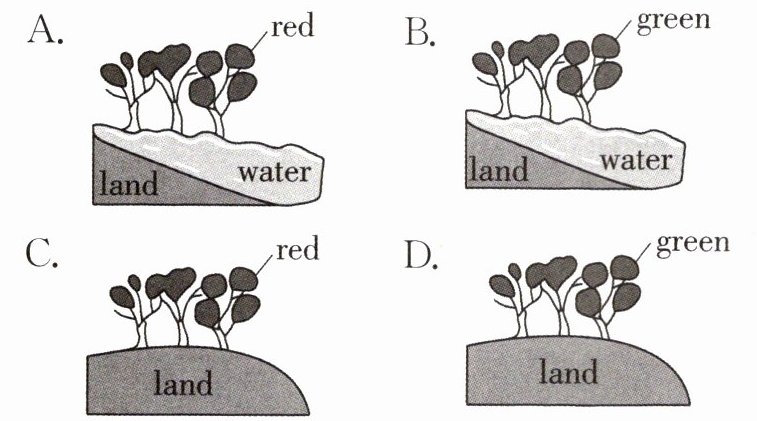
Do you know a special kind of forest in China? We call it “the mangrove(红树林)” or “the red forest”. Are the mangroves red? No. Mangroves don't have red leaves. They are green.
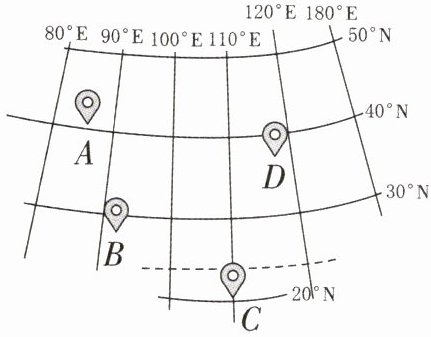
Mangroves grow in the water on the coast. The place of mangrove planting in China is between $20° ∼ 30° \mathrm{N}$ and $108° ∼ 120° \mathrm{E}$. Some parts of the trees are out of the water. They are home to mammals like monkeys. The other parts in the water make great homes for baby sea animals, like baby fish.
Mangroves can grow as high as 10 metres. They keep the land away from strong winds and waves(海浪). Like other trees, mangroves take in $\mathrm{CO}_2$ to make $\mathrm{O}_2$. They are helping to make air clean on the earth. But now there are fewer and fewer mangroves. We need to do more to protect them.
1.(创新考法·图片理解)Which picture shows the mangroves?
2.(创新考法·图片理解)Which place in the map can grow mangroves?
A. A B. B C. C D. D
3.(创新考法·组合选择)How can mangroves be good for us?
① They can keep air clean.
② They can make $\mathrm{CO}_2$.
③ They can protect the land from winds.
④ They provide homes for some animals.
A. ①②③ B. ①②④ C. ②③④ D. ①③④
深度阅读·回答问题
4. Where do mangroves grow?
5. Why do we need to protect mangroves?
情境二 本文介绍了红树林的独特生长环境、生态功能,并呼吁人们保护这种珍贵的海岸植被。
A 跨学科 生物
Do you know a special kind of forest in China? We call it “the mangrove(红树林)” or “the red forest”. Are the mangroves red? No. Mangroves don't have red leaves. They are green.
Mangroves grow in the water on the coast. The place of mangrove planting in China is between $20° ∼ 30° \mathrm{N}$ and $108° ∼ 120° \mathrm{E}$. Some parts of the trees are out of the water. They are home to mammals like monkeys. The other parts in the water make great homes for baby sea animals, like baby fish.
Mangroves can grow as high as 10 metres. They keep the land away from strong winds and waves(海浪). Like other trees, mangroves take in $\mathrm{CO}_2$ to make $\mathrm{O}_2$. They are helping to make air clean on the earth. But now there are fewer and fewer mangroves. We need to do more to protect them.
1.(创新考法·图片理解)Which picture shows the mangroves?
2.(创新考法·图片理解)Which place in the map can grow mangroves?
A. A B. B C. C D. D
3.(创新考法·组合选择)How can mangroves be good for us?
① They can keep air clean.
② They can make $\mathrm{CO}_2$.
③ They can protect the land from winds.
④ They provide homes for some animals.
A. ①②③ B. ①②④ C. ②③④ D. ①③④
深度阅读·回答问题
4. Where do mangroves grow?
They grow in the water on the coast.
5. Why do we need to protect mangroves?
They protect land, clean air and offer homes to animals.
答案
1. B 图片理解题。根据“Are the mangroves red? No. Mangroves don't have red leaves. They are green.”和“Mangroves grow in the water on the coast.”可知,红树林的叶子是绿色的,并且生长在海岸的水中。
2. C 图片理解题。根据“The place of mangrove planting in China is between $20°~30^\mathrm{N}$ and $108°~120^\mathrm{E}$.”可知,红树林的生长纬度在北纬20度到30度之间,东经108度到120度之间。
3. D 组合选择题。根据“They are helping to make air clean on the earth.”可知,红树林可以净化空气,①正确;根据“Like other trees, mangroves take in $\mathrm{CO}_2$ to make $\mathrm{O}_2$.”可知,红树林吸收二氧化碳,制造氧气,而不是制造二氧化碳,②错误;根据“They keep the land away from strong winds and waves.”可知,红树林可以保护陆地免受强风和海浪的侵袭,③正确;根据“They are home to mammals like monkeys. The other parts in the water make great homes for baby sea animals, like baby fish.”可知,红树林为一些动物提供了栖息地,④正确。
4. They grow in the water on the coast.
5. They protect land, clean air and offer homes to animals.
2. C 图片理解题。根据“The place of mangrove planting in China is between $20°~30^\mathrm{N}$ and $108°~120^\mathrm{E}$.”可知,红树林的生长纬度在北纬20度到30度之间,东经108度到120度之间。
3. D 组合选择题。根据“They are helping to make air clean on the earth.”可知,红树林可以净化空气,①正确;根据“Like other trees, mangroves take in $\mathrm{CO}_2$ to make $\mathrm{O}_2$.”可知,红树林吸收二氧化碳,制造氧气,而不是制造二氧化碳,②错误;根据“They keep the land away from strong winds and waves.”可知,红树林可以保护陆地免受强风和海浪的侵袭,③正确;根据“They are home to mammals like monkeys. The other parts in the water make great homes for baby sea animals, like baby fish.”可知,红树林为一些动物提供了栖息地,④正确。
4. They grow in the water on the coast.
5. They protect land, clean air and offer homes to animals.
解析
【分析】
1. 第1题为图片理解题,需从原文提取红树林的核心特征(叶子为绿色、生长在海岸水中),匹配对应图片得出答案。
2. 第2题需根据原文给出的中国红树林生长经纬度范围,结合地图定位符合该范围的地点。
3. 第3题是组合选择题,需逐一核对每个描述是否符合原文内容,排除错误选项后确定正确组合。
4. 第4题是细节查找题,直接从原文中提取红树林的生长地点即可。
5. 第5题需总结原文中红树林的生态功能,提炼出需要保护它的原因。
【解析】
1. 第1题:根据原文“Mangroves don't have red leaves. They are green.”可知红树林叶子为绿色,且“Mangroves grow in the water on the coast.”说明其生长在海岸的水中,结合图片特征,确定答案为B。
2. 第2题:原文明确中国红树林的种植地在20°~30°N和108°~120°E之间,据此定位地图中符合该经纬度范围的地点为C,故答案为C。
3. 第3题:逐一分析各描述:①根据“They are helping to make air clean”可知红树林可净化空气,正确;②根据“Like other trees, mangroves take in CO₂ to make O₂”可知红树林是吸收二氧化碳而非制造,错误;③根据“They keep the land away from strong winds and waves”可知红树林可保护陆地免受强风侵袭,正确;④根据“They are home to mammals like monkeys... make great homes for baby sea animals”可知红树林为动物提供栖息地,正确。排除含错误项②的选项,答案为D。
4. 第4题:直接从原文“Mangroves grow in the water on the coast.”提取答案。
5. 第5题:从原文总结红树林的核心作用:保护陆地免受风浪侵袭、净化空气、为动物提供栖息地,这些是需要保护的原因,故答案为此。
【答案】
1. B 2. C 3. D 4. They grow in the water on the coast. 5. They protect land, clean air and offer homes to animals.
【知识点】
英语阅读理解、细节信息提取、图文匹配
【点评】
本题是初中英语阅读理解的综合考查题型,涵盖图片理解、经纬度定位、组合选择和信息提取,要求学生精准定位原文关键信息,排除干扰项,注重对文本细节的把握,是常见的阅读考查形式。
【难度系数】
0.6
1. 第1题为图片理解题,需从原文提取红树林的核心特征(叶子为绿色、生长在海岸水中),匹配对应图片得出答案。
2. 第2题需根据原文给出的中国红树林生长经纬度范围,结合地图定位符合该范围的地点。
3. 第3题是组合选择题,需逐一核对每个描述是否符合原文内容,排除错误选项后确定正确组合。
4. 第4题是细节查找题,直接从原文中提取红树林的生长地点即可。
5. 第5题需总结原文中红树林的生态功能,提炼出需要保护它的原因。
【解析】
1. 第1题:根据原文“Mangroves don't have red leaves. They are green.”可知红树林叶子为绿色,且“Mangroves grow in the water on the coast.”说明其生长在海岸的水中,结合图片特征,确定答案为B。
2. 第2题:原文明确中国红树林的种植地在20°~30°N和108°~120°E之间,据此定位地图中符合该经纬度范围的地点为C,故答案为C。
3. 第3题:逐一分析各描述:①根据“They are helping to make air clean”可知红树林可净化空气,正确;②根据“Like other trees, mangroves take in CO₂ to make O₂”可知红树林是吸收二氧化碳而非制造,错误;③根据“They keep the land away from strong winds and waves”可知红树林可保护陆地免受强风侵袭,正确;④根据“They are home to mammals like monkeys... make great homes for baby sea animals”可知红树林为动物提供栖息地,正确。排除含错误项②的选项,答案为D。
4. 第4题:直接从原文“Mangroves grow in the water on the coast.”提取答案。
5. 第5题:从原文总结红树林的核心作用:保护陆地免受风浪侵袭、净化空气、为动物提供栖息地,这些是需要保护的原因,故答案为此。
【答案】
1. B 2. C 3. D 4. They grow in the water on the coast. 5. They protect land, clean air and offer homes to animals.
【知识点】
英语阅读理解、细节信息提取、图文匹配
【点评】
本题是初中英语阅读理解的综合考查题型,涵盖图片理解、经纬度定位、组合选择和信息提取,要求学生精准定位原文关键信息,排除干扰项,注重对文本细节的把握,是常见的阅读考查形式。
【难度系数】
0.6
