

 登录
登录
3Ⅰ. Complete the sentences with that, if or whether.
1. Now scientists are sure
2. Amber can tell us
3. We are not sure
4. The discovery shows
5. Old beliefs said
6. We still wonder
1. Now scientists are sure
that
this old idea about dinosaurs is wrong.2. Amber can tell us
whether
dinosaurs had feathers or not.3. We are not sure
if/whether
this flower species will grow in this area again.4. The discovery shows
that
more than 300 unknown species have been found in amber.5. Old beliefs said
that
ants only came from the northern half of the earth.6. We still wonder
if/whether
we can unlock more secrets of nature.答案
Ⅰ. 1. that 2. whether 3. if/whether 4. that 5. that 6. if/whether
解析
【解析】
1. be sure后接陈述句作宾语从句,引导词用that。
2. 句中有or not,需与whether搭配使用,故填whether。
3. be not sure后接表不确定的宾语从句,表疑问含义,可用if或whether。
4. shows后接陈述句作宾语从句,引导词用that。
5. said后接陈述句作宾语从句,引导词用that。
6. wonder后接表疑问的宾语从句,表不确定,可用if或whether。
【答案】
Ⅰ. 1. that 2. whether 3. if/whether 4. that 5. that 6. if/whether
【知识点】
宾语从句引导词;if与whether用法
【点评】
本题考查that、if、whether引导宾语从句的用法,需结合宾语从句的语气(陈述或疑问)及固定搭配来选择引导词,是宾语从句的基础考点,需明确三者的使用场景。
【难度系数】
0.8
1. be sure后接陈述句作宾语从句,引导词用that。
2. 句中有or not,需与whether搭配使用,故填whether。
3. be not sure后接表不确定的宾语从句,表疑问含义,可用if或whether。
4. shows后接陈述句作宾语从句,引导词用that。
5. said后接陈述句作宾语从句,引导词用that。
6. wonder后接表疑问的宾语从句,表不确定,可用if或whether。
【答案】
Ⅰ. 1. that 2. whether 3. if/whether 4. that 5. that 6. if/whether
【知识点】
宾语从句引导词;if与whether用法
【点评】
本题考查that、if、whether引导宾语从句的用法,需结合宾语从句的语气(陈述或疑问)及固定搭配来选择引导词,是宾语从句的基础考点,需明确三者的使用场景。
【难度系数】
0.8
Ⅱ. Match the beginnings(1-6) of the sentences with the proper endings(A-F). Then answer the question.
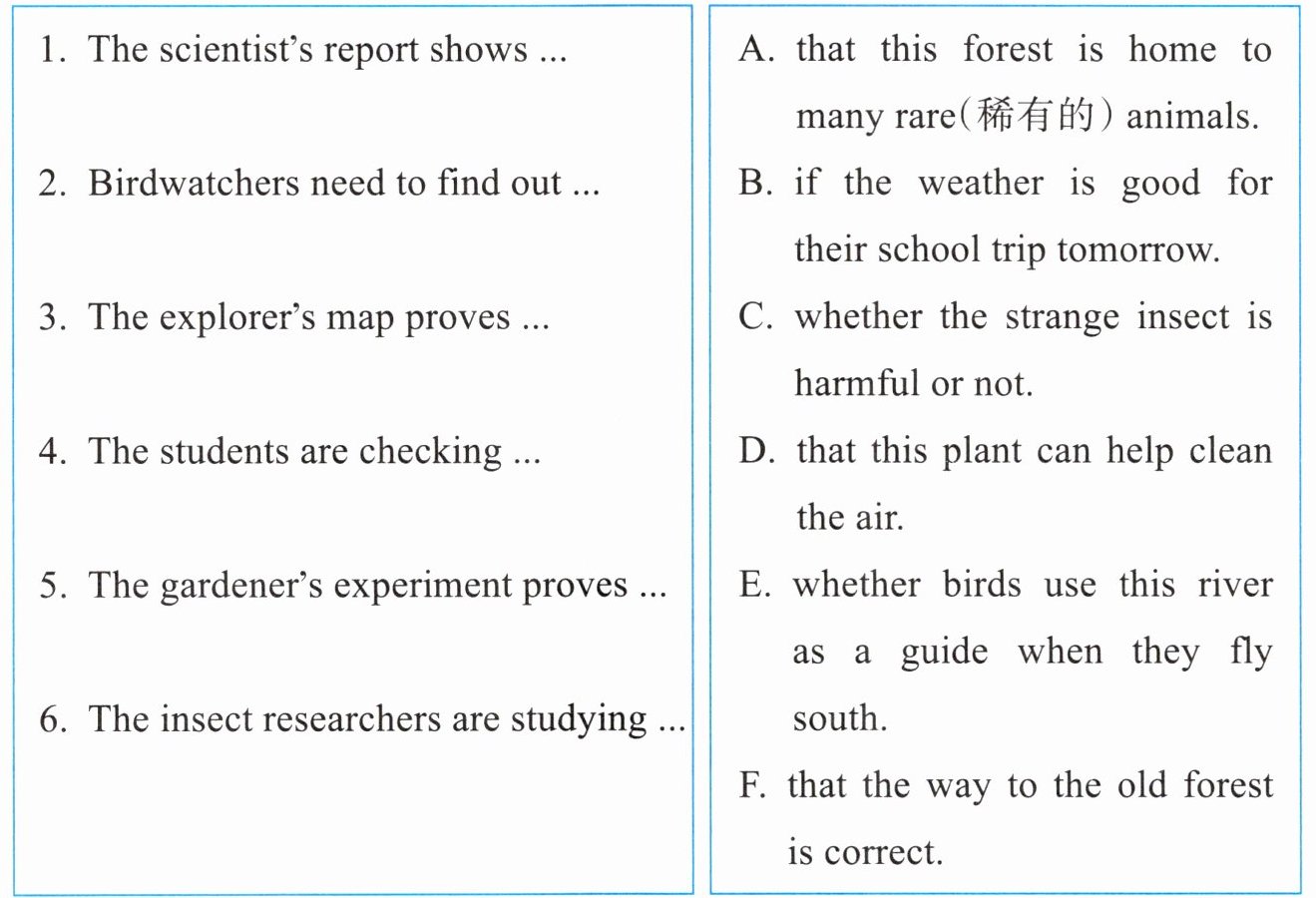
7. Imagine you are a young nature explorer. What is one thing in nature you would like to find out? Write about it using that, if or whether.
7. Imagine you are a young nature explorer. What is one thing in nature you would like to find out? Write about it using that, if or whether.
One possible version: I'd like to find out if ants always follow lines to find food or their home.
答案
Ⅱ. 1. A 2. E 3. F 4. B 5. D 6. C
7. One possible version: I'd like to find out if ants always follow lines to find food or their home.
7. One possible version: I'd like to find out if ants always follow lines to find food or their home.
解析
【解析】
1. 科学家的报告围绕自然生态研究,与A选项“这片森林是许多珍稀动物的栖息地”匹配;
2. 观鸟者的研究对象是鸟类行为,E选项“鸟类南飞时是否以这条河为向导”符合其研究内容;
3. 探险家的地图用于确认路线,F选项“去老森林的路线是正确的”与地图作用匹配;
4. 学生们关注学校旅行的天气情况,B选项“明天的天气是否适合他们的学校旅行”符合学生的活动场景;
5. 园丁的实验围绕植物相关研究,D选项“这种植物有助于净化空气”符合园丁的研究方向;
6. 昆虫研究者的研究对象是昆虫的特性,C选项“这种奇怪的昆虫是否有害”是其研究内容;
第7题为开放性写作题,需用that/if/whether引导宾语从句表达自己想探索的自然问题,参考示例给出了合理的表达。
【答案】
Ⅱ. 1. A 2. E 3. F 4. B 5. D 6. C
7. One possible version: I'd like to find out if ants always follow lines to find food or their home.
【知识点】
宾语从句运用,情景话题匹配,英语书面表达
【点评】
本题结合自然探索主题,通过情景匹配考查宾语从句连接词的语境运用,同时设置开放性写作任务,既巩固语法知识,又提升学生的英语表达能力,题型贴合生活实际,考查全面。
【难度系数】
0.7
1. 科学家的报告围绕自然生态研究,与A选项“这片森林是许多珍稀动物的栖息地”匹配;
2. 观鸟者的研究对象是鸟类行为,E选项“鸟类南飞时是否以这条河为向导”符合其研究内容;
3. 探险家的地图用于确认路线,F选项“去老森林的路线是正确的”与地图作用匹配;
4. 学生们关注学校旅行的天气情况,B选项“明天的天气是否适合他们的学校旅行”符合学生的活动场景;
5. 园丁的实验围绕植物相关研究,D选项“这种植物有助于净化空气”符合园丁的研究方向;
6. 昆虫研究者的研究对象是昆虫的特性,C选项“这种奇怪的昆虫是否有害”是其研究内容;
第7题为开放性写作题,需用that/if/whether引导宾语从句表达自己想探索的自然问题,参考示例给出了合理的表达。
【答案】
Ⅱ. 1. A 2. E 3. F 4. B 5. D 6. C
7. One possible version: I'd like to find out if ants always follow lines to find food or their home.
【知识点】
宾语从句运用,情景话题匹配,英语书面表达
【点评】
本题结合自然探索主题,通过情景匹配考查宾语从句连接词的语境运用,同时设置开放性写作任务,既巩固语法知识,又提升学生的英语表达能力,题型贴合生活实际,考查全面。
【难度系数】
0.7
Ⅲ. Read and answer the questions.
The deep sea is one of the last places on earth for nature exploration. The Mariana Trench is the deepest part of the ocean. It is so deep that if you put Mount Qomolangma inside it, the peak would still be over a mile underwater.
For a long time, people thought this dark, cold and high-pressure place had no life. But developments in technology, like specially designed submarines(潜艇) and cameras, have allowed us to observe this hidden world. Scientists were surprised to find many strange animals there. There are fish that can produce their own light, called bioluminescence, to attract food or find mates. There are also huge squid(鱿鱼) and strange jellyfish(水母).
Exploring the deep ocean shows us that life is really strong. It can live in the most special environments. Every dive into the deep brings new discoveries and reminds us how much we still have to learn about our planet.
(
A. To discuss the water pressure in the ocean.
B. To explain how deep the Mariana Trench is.
C. To describe the strange animals living in the deep sea.
D. To introduce the technology used in deep-sea exploration.
(
A. To warm up the cold water. B. To see the submarines.
C. To get food and partners. D. To fight against huge squid.
(
A. Technology is more important than nature.
B. Life is strong and can fit special environments.
C. Every new discovery in the deep sea is not easy.
D. The Mariana Trench is the deepest place on earth.
4. "Every dive into the deep brings new discoveries." If you are interested in the deep sea, what new discovery would excite you the most? Answer the question with that, if or whether.
The deep sea is one of the last places on earth for nature exploration. The Mariana Trench is the deepest part of the ocean. It is so deep that if you put Mount Qomolangma inside it, the peak would still be over a mile underwater.
For a long time, people thought this dark, cold and high-pressure place had no life. But developments in technology, like specially designed submarines(潜艇) and cameras, have allowed us to observe this hidden world. Scientists were surprised to find many strange animals there. There are fish that can produce their own light, called bioluminescence, to attract food or find mates. There are also huge squid(鱿鱼) and strange jellyfish(水母).
Exploring the deep ocean shows us that life is really strong. It can live in the most special environments. Every dive into the deep brings new discoveries and reminds us how much we still have to learn about our planet.
(
B
)1. What is the main purpose of the first paragraph?A. To discuss the water pressure in the ocean.
B. To explain how deep the Mariana Trench is.
C. To describe the strange animals living in the deep sea.
D. To introduce the technology used in deep-sea exploration.
(
C
)2. Why do some deep-sea fish produce their own light?A. To warm up the cold water. B. To see the submarines.
C. To get food and partners. D. To fight against huge squid.
(
B
)3. What is the main idea of the passage?A. Technology is more important than nature.
B. Life is strong and can fit special environments.
C. Every new discovery in the deep sea is not easy.
D. The Mariana Trench is the deepest place on earth.
4. "Every dive into the deep brings new discoveries." If you are interested in the deep sea, what new discovery would excite you the most? Answer the question with that, if or whether.
One possible version: Discovering whether sea plants can live without sunlight would excite me the most. I'd ask if that plant gets food from other things in the water.
答案
Ⅲ. A. 1. B 2. C 3. B
4. One possible version: Discovering whether sea plants can live without sunlight would excite me the most. I'd ask if that plant gets food from other things in the water.
4. One possible version: Discovering whether sea plants can live without sunlight would excite me the most. I'd ask if that plant gets food from other things in the water.
解析
【解析】
1. 第1题:第一段介绍马里亚纳海沟是海洋最深处,并用将珠穆朗玛峰放入其中仍有一英里多在水下的例子,说明其深度,因此段落主要目的是解释马里亚纳海沟的深度,选B。
2. 第2题:根据原文“fish that can produce their own light... to attract food or find mates”,可知深海鱼发光是为了吸引食物和寻找配偶,对应选项C。
3. 第3题:文章最后一段点明主旨“Exploring the deep ocean shows us that life is really strong. It can live in the most special environments.”,即生命顽强,能适应特殊环境,选B。
4. 第4题:需用that, if或whether作答,围绕深海新发现展开表述即可,示例回答符合要求。
【答案】
1. B
2. C
3. B
4. One possible version: Discovering whether sea plants can live without sunlight would excite me the most. I'd ask if that plant gets food from other things in the water.
【知识点】
细节理解题解法、主旨大意题解法、开放性话题表达
【点评】
本文围绕深海探索主题,考查学生对文章细节的捕捉、主旨的归纳能力,最后一题的开放性设问还能锻炼学生的语言组织与运用能力,助力提升英语综合素养。
【难度系数】
0.7
1. 第1题:第一段介绍马里亚纳海沟是海洋最深处,并用将珠穆朗玛峰放入其中仍有一英里多在水下的例子,说明其深度,因此段落主要目的是解释马里亚纳海沟的深度,选B。
2. 第2题:根据原文“fish that can produce their own light... to attract food or find mates”,可知深海鱼发光是为了吸引食物和寻找配偶,对应选项C。
3. 第3题:文章最后一段点明主旨“Exploring the deep ocean shows us that life is really strong. It can live in the most special environments.”,即生命顽强,能适应特殊环境,选B。
4. 第4题:需用that, if或whether作答,围绕深海新发现展开表述即可,示例回答符合要求。
【答案】
1. B
2. C
3. B
4. One possible version: Discovering whether sea plants can live without sunlight would excite me the most. I'd ask if that plant gets food from other things in the water.
【知识点】
细节理解题解法、主旨大意题解法、开放性话题表达
【点评】
本文围绕深海探索主题,考查学生对文章细节的捕捉、主旨的归纳能力,最后一题的开放性设问还能锻炼学生的语言组织与运用能力,助力提升英语综合素养。
【难度系数】
0.7
