

 登录
登录
阅读下面材料,然后从各题所给的四个选项中选出一个最佳答案。
A(真题·绍兴诸暨)
(
A. Six-year-old Paul.
B. Eleven-year-old Gina.
C. Sixteen-year-old Anne.
D. Eighteen-year-old Mark.
(
①Learn to draw a horse.
②Feed horses with carrots.
③Watch a movie about horses.
④Play games on horseback.
A. ①③
B. ③④
C. ①④
D. ②④
(
A. Children need to ride a horse with the help of their parents.
B. Parents can email Ms Brown to learn about the camp.
C. The camp will teach children how to take care of a horse.
D. Children can go to the horse riding summer camp every day in June.
A(真题·绍兴诸暨)
(
B
)1. Who can go to the summer camp?A. Six-year-old Paul.
B. Eleven-year-old Gina.
C. Sixteen-year-old Anne.
D. Eighteen-year-old Mark.
(
D
)2. What can children do on the farm?①Learn to draw a horse.
②Feed horses with carrots.
③Watch a movie about horses.
④Play games on horseback.
A. ①③
B. ③④
C. ①④
D. ②④
(
C
)3. What can we know from the text?A. Children need to ride a horse with the help of their parents.
B. Parents can email Ms Brown to learn about the camp.
C. The camp will teach children how to take care of a horse.
D. Children can go to the horse riding summer camp every day in June.
答案
1.B 2.D 3.C
解析
【分析】本题为信息提取类阅读理解题,需根据材料中的关键信息逐一匹配题目要求:第1题定位夏令营的年龄限制;第2题从活动内容和注意事项中筛选符合的行为;第3题判断选项与材料信息是否一致。
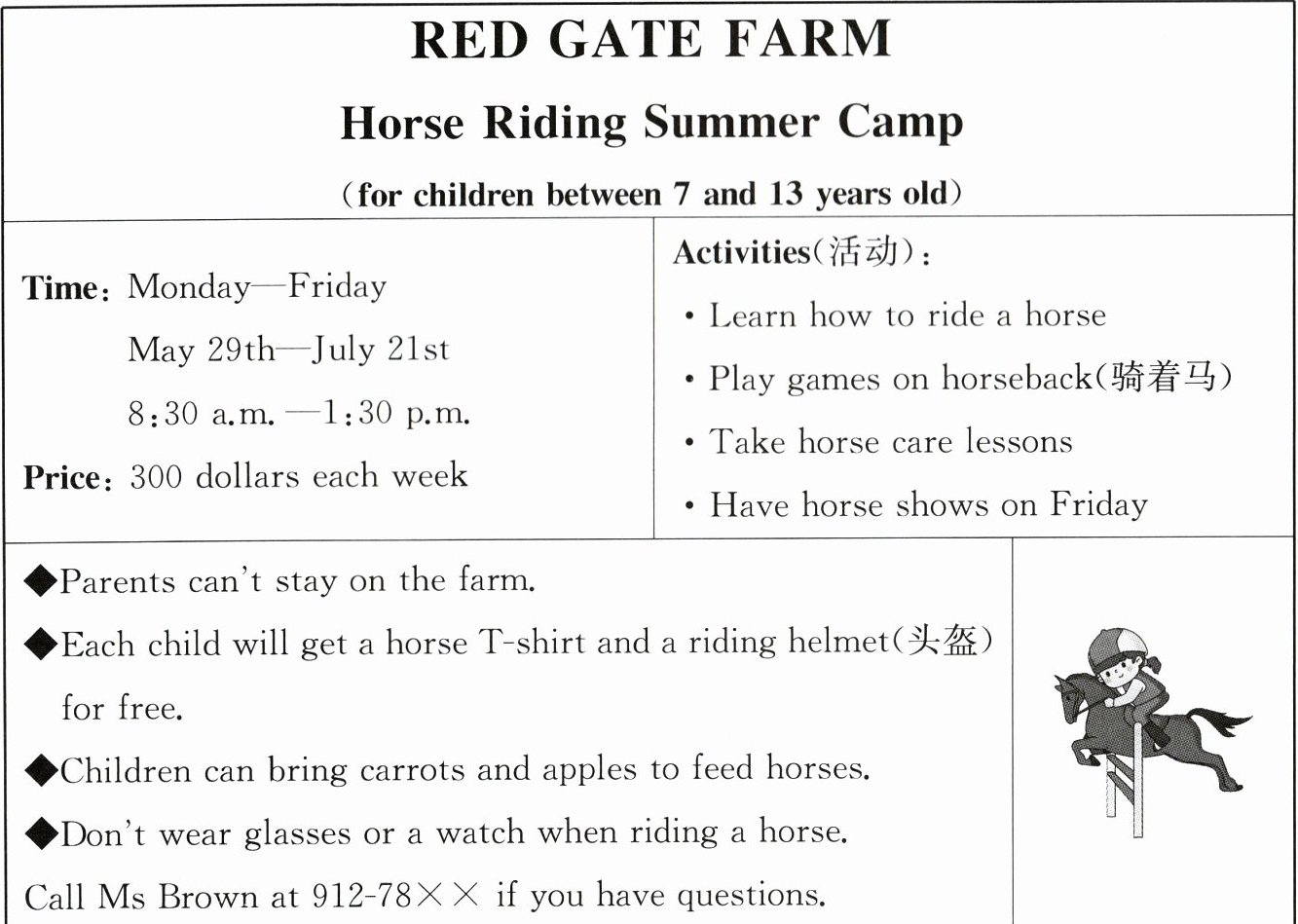
【解析】1. 根据材料中“(for children between 7 and 13 years old)”可知,夏令营面向7-13岁的孩子,A选项6岁、C选项16岁、D选项18岁均不符合,B选项11岁符合,故选B。
2. 材料中Activities部分提到“Play games on horseback”,注意事项提到“Children can bring carrots and apples to feed horses”,故②和④正确;①学画马、③看电影均未提及,故选D。
3. A选项“Parents can't stay on the farm”说明父母不能待在农场,A错误;B选项是“Call Ms Brown”而非邮件,B错误;C选项“Take horse care lessons”说明会教照顾马,C正确;D选项时间是周一到周五,不是每天,D错误,故选C。
【答案】1.B 2.D 3.C
【知识点】阅读理解、细节理解、信息匹配
【点评】本题考查对文本关键信息的提取与判断,难度较低,只要仔细阅读材料,定位对应信息即可选出正确答案。
【难度系数】0.7
【解析】1. 根据材料中“(for children between 7 and 13 years old)”可知,夏令营面向7-13岁的孩子,A选项6岁、C选项16岁、D选项18岁均不符合,B选项11岁符合,故选B。
2. 材料中Activities部分提到“Play games on horseback”,注意事项提到“Children can bring carrots and apples to feed horses”,故②和④正确;①学画马、③看电影均未提及,故选D。
3. A选项“Parents can't stay on the farm”说明父母不能待在农场,A错误;B选项是“Call Ms Brown”而非邮件,B错误;C选项“Take horse care lessons”说明会教照顾马,C正确;D选项时间是周一到周五,不是每天,D错误,故选C。
【答案】1.B 2.D 3.C
【知识点】阅读理解、细节理解、信息匹配
【点评】本题考查对文本关键信息的提取与判断,难度较低,只要仔细阅读材料,定位对应信息即可选出正确答案。
【难度系数】0.7
B(真题·金华金东、婺城)
①Zu Chongzhi was a famous mathematician and an important scientist in China. When he was a little boy, he took an interest in maths and science.
②Zu Chongzhi did something important with circles(圆). For example, he found π was very close to 3.1415926 and 3.1415927. It helps us know how big a circle is. He also wrote a great book on maths called Zhui Shu. Now, we can read this book in Chinese, Japanese, Korean and many other languages.
③Zu Chongzhi always kept thinking when he learnt something new. He didn't just believe what others said. He always wanted to check if they were right. After his hard work, he noticed something not true in the old calendar(日历) so he made a new one called “Daming Calendar”. Also, he loved astronomy. He watched the stars at nights and wrote about his findings carefully, because he wanted to know how the stars moved across the sky.
④Zu Chongzhi holds an important place in the history of Chinese science and maths. His findings make lots of changes in science and maths. He is really a shining example for us.
(
A. By using sayings.
B. By giving examples.
C. By asking questions.
D. By drawing pictures.
(
A. Because he wanted to be a famous scientist.
B. Because he didn't have money to buy calendars.
C. Because he found something wrong in the old calendar.
D. Because he didn't know how to use the old calendar at all.
(
A. A great book on maths.
B. Information on circles and π.
C. A big country with a long history.
D. Science about stars and the sky.
(


①Zu Chongzhi was a famous mathematician and an important scientist in China. When he was a little boy, he took an interest in maths and science.
②Zu Chongzhi did something important with circles(圆). For example, he found π was very close to 3.1415926 and 3.1415927. It helps us know how big a circle is. He also wrote a great book on maths called Zhui Shu. Now, we can read this book in Chinese, Japanese, Korean and many other languages.
③Zu Chongzhi always kept thinking when he learnt something new. He didn't just believe what others said. He always wanted to check if they were right. After his hard work, he noticed something not true in the old calendar(日历) so he made a new one called “Daming Calendar”. Also, he loved astronomy. He watched the stars at nights and wrote about his findings carefully, because he wanted to know how the stars moved across the sky.
④Zu Chongzhi holds an important place in the history of Chinese science and maths. His findings make lots of changes in science and maths. He is really a shining example for us.
(
B
)4. How does the writer introduce Zu Chongzhi in Paragraph 2?A. By using sayings.
B. By giving examples.
C. By asking questions.
D. By drawing pictures.
(
C
)5. Why did Zu Chongzhi make the “Daming Calendar”?A. Because he wanted to be a famous scientist.
B. Because he didn't have money to buy calendars.
C. Because he found something wrong in the old calendar.
D. Because he didn't know how to use the old calendar at all.
(
D
)6. What does the underlined word “astronomy” in Paragraph 3 mean?A. A great book on maths.
B. Information on circles and π.
C. A big country with a long history.
D. Science about stars and the sky.
(
A
)7. Which of the following shows the best structure(结构) of the text?答案
4.B 5.C 6.D 7.A
解析
【分析】
要解答这几道题,需结合原文内容逐一分析:第4题定位第二段,通过标志词判断介绍方式;第5题定位第三段寻找制作大明历的原因;第6题根据画线词后的描述猜测词义;第7题梳理各段内容判断文章结构。
【解析】
4. 细节理解题:根据第二段中“For example, he found π was very close to 3.1415926 and 3.1415927.”可知,作者通过举例子介绍祖冲之的贡献,故选B。
5. 细节理解题:根据第三段中“After his hard work, he noticed something not true in the old calendar so he made a new one called “Daming Calendar”.”可知,祖冲之因发现旧历法有误而制作大明历,故选C。
6. 词义猜测题:根据第三段中画线词后的“He watched the stars at nights and wrote about his findings carefully, because he wanted to know how the stars moved across the sky.”可知,astronomy是关于星星和天空的科学,故选D。
7. 文章结构题:第一段总述祖冲之的身份地位;第二段介绍其数学成就;第三段介绍其天文成就;第四段总结其历史地位,为总-分-总结构,对应选项A,故选A。
【答案】
4.B 5.C 6.D 7.A
【知识点】
英语阅读理解细节题、词义猜测题、文章结构分析
【点评】
本题围绕祖冲之的成就展开,考查学生对英语阅读中细节信息、词义及文章结构的理解,题目难度适中,需学生仔细定位原文关键信息即可解答。
【难度系数】
0.7
要解答这几道题,需结合原文内容逐一分析:第4题定位第二段,通过标志词判断介绍方式;第5题定位第三段寻找制作大明历的原因;第6题根据画线词后的描述猜测词义;第7题梳理各段内容判断文章结构。
【解析】
4. 细节理解题:根据第二段中“For example, he found π was very close to 3.1415926 and 3.1415927.”可知,作者通过举例子介绍祖冲之的贡献,故选B。
5. 细节理解题:根据第三段中“After his hard work, he noticed something not true in the old calendar so he made a new one called “Daming Calendar”.”可知,祖冲之因发现旧历法有误而制作大明历,故选C。
6. 词义猜测题:根据第三段中画线词后的“He watched the stars at nights and wrote about his findings carefully, because he wanted to know how the stars moved across the sky.”可知,astronomy是关于星星和天空的科学,故选D。
7. 文章结构题:第一段总述祖冲之的身份地位;第二段介绍其数学成就;第三段介绍其天文成就;第四段总结其历史地位,为总-分-总结构,对应选项A,故选A。
【答案】
4.B 5.C 6.D 7.A
【知识点】
英语阅读理解细节题、词义猜测题、文章结构分析
【点评】
本题围绕祖冲之的成就展开,考查学生对英语阅读中细节信息、词义及文章结构的理解,题目难度适中,需学生仔细定位原文关键信息即可解答。
【难度系数】
0.7
