

 登录
登录
9. 新考法 翻折法 如图,在平面直角坐标系$xOy$中,点$A(4,0),C(0,4\sqrt{2})$是矩形$OABC$的顶点,点$M,N$分别为边$AB,OC$上的点,将矩形$OABC$沿直线$MN$折叠,使点$B$的对应点$B'$在边$OA$的中点处,连接$BB'$,点$C$的对应点$C'$在反比例函数$y=\frac{k}{x}(k≠0)$的图象上,则$k=$

$-\frac{160\sqrt{2}}{81}$
.答案
9.$-\frac{160\sqrt{2}}{81}$ 【点拨】如图
 ,设 $BB'$ 交 $NM$ 于点 $E$,过点 $C'$ 作$C'H⊥ x$ 轴于点 $H$.$\because$ 四边形 $OABC$ 是矩形,$A(4,0)$,$C(0$,$4\sqrt{2})$,$\therefore∠ ABC=∠ OAB=90°$,$OA=BC=4$,$AB=4\sqrt{2}$.
$\because$ 点 $B'$ 是 $OA$ 的中点,$\therefore OB'=AB'=\frac{1}{2}OA=2$. 在 $\mathrm{Rt}△ ABB'$中,$AB=4\sqrt{2}$,$AB'=2$,$\therefore BB'=\sqrt{(4\sqrt{2})^2+2^2}=6$.$\because$ 矩形$OABC$ 沿直线 $MN$ 折叠,$\therefore∠ C'B'M=∠ CBM=90°$,$BB'⊥$$MN$,$BM=B'M$,$BE=\frac{1}{2}BB'=3$,$B'C'=BC=4$.
$\because∠ EBM=∠ ABB'$,$∠ BEM=∠ BAB'=90°$,$\therefore△ EBM∽$$△ ABB'$.$\therefore\frac{EB}{AB}=\frac{BM}{BB'}$,即$\frac{3}{4\sqrt{2}}=\frac{BM}{6}$,解得 $BM=\frac{9\sqrt{2}}{4}$.
$\therefore B'M=\frac{9\sqrt{2}}{4}$.$\because AB=4\sqrt{2}$,$\therefore AM=AB-BM=\frac{7\sqrt{2}}{4}$.
$\because∠ C'B'M=90°$,$\therefore∠ C'B'H+∠ MB'A=90°$.$\because∠ MB'A+$$∠ B'MA=90°$,$\therefore∠ C'B'H=∠ B'MA$.
又$\because∠ C'HB'=∠ B'AM=90°$,$\therefore△ C'HB'∽△ B'AM$.
$\therefore\frac{C'H}{B'A}=\frac{HB'}{AM}=\frac{C'B'}{B'M}$,即$\frac{C'H}{2}=\frac{HB'}{\frac{7\sqrt{2}}{4}}=\frac{4}{\frac{9\sqrt{2}}{4}}$,解得 $C'H=$$\frac{16\sqrt{2}}{9}$,$HB'=\frac{28}{9}$.$\therefore HO=HB'-OB'=$$\frac{10}{9}$.$\therefore$ 点 $C'$ 的坐标为 $(-\frac{10}{9},\frac{16\sqrt{2}}{9})$.
$\therefore k=-\frac{10}{9}×\frac{16\sqrt{2}}{9}=-\frac{160\sqrt{2}}{81}$.
10. 如图,在$△ ABC$中,$AB=AC=8$,$BC=12$,点$P,Q$分别在$AB,BC$边上,且$∠ AQP=∠ B$.
(1)求证:$△ BQP ∽ △ CAQ$;
(2)若$BP=4.5$,求$∠ BPQ$的度数;
(3)若在$BC$边上存在两个点$Q$,满足$∠ AQP=∠ B$,求$BP$的取值范围.
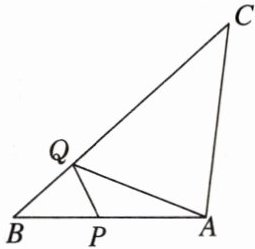
(1)求证:$△ BQP ∽ △ CAQ$;
(2)若$BP=4.5$,求$∠ BPQ$的度数;
(3)若在$BC$边上存在两个点$Q$,满足$∠ AQP=∠ B$,求$BP$的取值范围.
答案
10.(1)【证明】$\because AB=AC$,$\therefore∠ B=∠ C$.
$\because∠ AQP=∠ B$,$\therefore∠ AQP=∠ C$.
又$\because∠ AQB=∠ AQP+∠ PQB$,$∠ AQB=∠ CAQ+∠ C$,
$\therefore∠ PQB=∠ CAQ$.$\therefore△ BQP∽△ CAQ$.
(2)【解】$\because△ BQP∽△ CAQ$,$\therefore\frac{BQ}{AC}=\frac{BP}{CQ}$,
即$\frac{BQ}{8}=\frac{4.5}{12-BQ}$,$\therefore BQ=6$.
$\because BC=12$,$\therefore BQ=CQ=6$.
又$\because AB=AC$,$\therefore AQ⊥ BC$.$\therefore∠ CQA=90°$.
$\because△ BQP∽△ CAQ$,
$\therefore∠ BPQ=∠ CQA=90°$.
(3)【解】设 $BQ=x$,$BP=m(m>0)$.
由(2)知$\frac{BQ}{AC}=\frac{BP}{CQ}$,$\therefore\frac{x}{8}=\frac{m}{12-x}$,
整理,得$x^2-12x+8m=0$.
$\because$ 在 $BC$ 边上存在两个点 $Q$,
$\therefore$ 方程 $x^2-12x+8m=0$ 有两个不相等的正实数根,
$\therefore\Delta=12^2-4×8m>0$,且 $8m>0$,
$\therefore0<m<\frac{9}{2}$.$\therefore BP$ 的取值范围为 $0<BP<\frac{9}{2}$.
$\because∠ AQP=∠ B$,$\therefore∠ AQP=∠ C$.
又$\because∠ AQB=∠ AQP+∠ PQB$,$∠ AQB=∠ CAQ+∠ C$,
$\therefore∠ PQB=∠ CAQ$.$\therefore△ BQP∽△ CAQ$.
(2)【解】$\because△ BQP∽△ CAQ$,$\therefore\frac{BQ}{AC}=\frac{BP}{CQ}$,
即$\frac{BQ}{8}=\frac{4.5}{12-BQ}$,$\therefore BQ=6$.
$\because BC=12$,$\therefore BQ=CQ=6$.
又$\because AB=AC$,$\therefore AQ⊥ BC$.$\therefore∠ CQA=90°$.
$\because△ BQP∽△ CAQ$,
$\therefore∠ BPQ=∠ CQA=90°$.
(3)【解】设 $BQ=x$,$BP=m(m>0)$.
由(2)知$\frac{BQ}{AC}=\frac{BP}{CQ}$,$\therefore\frac{x}{8}=\frac{m}{12-x}$,
整理,得$x^2-12x+8m=0$.
$\because$ 在 $BC$ 边上存在两个点 $Q$,
$\therefore$ 方程 $x^2-12x+8m=0$ 有两个不相等的正实数根,
$\therefore\Delta=12^2-4×8m>0$,且 $8m>0$,
$\therefore0<m<\frac{9}{2}$.$\therefore BP$ 的取值范围为 $0<BP<\frac{9}{2}$.
11. 2025·成都 新考法·变式探究法 如图,在$□ ABCD$中,点E在BC边上,点B关于直线AE的对称点F落在$□ ABCD$内,射线AF交射线DC于点G,交射线BC于点P,射线EF交CD边于点Q.
(1)【特例感知】如图①,当$CE=BE$时,点P在BC延长线上,求证:$△ EFP ≌ △ ECQ$;
(2)【问题探究】在(1)的条件下,若$CG=3,GQ=5$,求DQ的长;
(3)【拓展延伸】如图②,当$CE=2BE$时,点P在BC边上,若$\frac{CQ}{DQ}=\frac{1}{n}$,求$\frac{CG}{DG}$的值.(用含n的代数式表示)
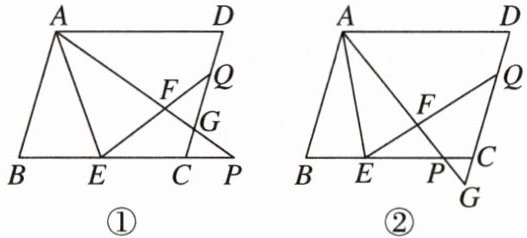
(1)【特例感知】如图①,当$CE=BE$时,点P在BC延长线上,求证:$△ EFP ≌ △ ECQ$;
(2)【问题探究】在(1)的条件下,若$CG=3,GQ=5$,求DQ的长;
(3)【拓展延伸】如图②,当$CE=2BE$时,点P在BC边上,若$\frac{CQ}{DQ}=\frac{1}{n}$,求$\frac{CG}{DG}$的值.(用含n的代数式表示)
答案
11.(1)【证明】由对称的性质,得$∠ B=∠ AFE$,$BE=FE$.
$\because$ 四边形 $ABCD$ 是平行四边形,
$\therefore AB// CD$,$\therefore∠ B=∠ PCG$,$\therefore∠ AFE=∠ PCG$.
$\because∠ AFE=∠ QFG$,$\therefore∠ PCG=∠ QFG$.
又$\because∠ FGQ=∠ CGP$,$\therefore$ 易得$∠ P=∠ CQE$.
$\because CE=BE$,$BE=EF$,$\therefore EF=EC$.
又$\because∠ FEP=∠ CEQ$,$\therefore△ EFP≌△ ECQ$.
(2)【解】$\because△ EFP≌△ ECQ$,$\therefore EP=EQ$.
又$\because EF=EC$,$\therefore FQ=CP$.
$\because∠ FGQ=∠ CGP$,$∠ CQE=∠ P$,
$\therefore△ FQG≌△ CPG$,$\therefore FG=CG=3$,$GQ=GP=5$.
由对称的性质,得 $AF=AB$.
$\because$ 四边形 $ABCD$ 是平行四边形,
$\therefore AB// CD$,$AB=CD$,$\therefore△ CGP∽△ BAP$,
$\therefore\frac{CG}{AB}=\frac{PG}{AP}$,$\therefore\frac{3}{AB}=\frac{5}{AB+3+5}$,解得 $AB=12$,
$\therefore CD=12$,$DQ=CD-CG-QG=4$.
(3)【解】如图
 ,分别延长 $AD$,$EQ$ 交于点 $M$,
设 $CQ=a$,$BE=b$.
$\because\frac{CQ}{DQ}=\frac{1}{n}$,$CE=2BE$,
$\therefore DQ=an$,$EC=2b$,
$\therefore AB=CD=(n+1)a$,$AD=BC=3b$.
由对称的性质,得 $AF=AB$,$∠ AFE=∠ B$,$EF=BE=b$,
$\therefore AF=(n+1)a$.
$\because AD// BC$,即 $DM// EC$,$\therefore△ DQM∽△ CQE$,
$\therefore\frac{DM}{EC}=\frac{DQ}{CQ}$,即$\frac{DM}{2b}=\frac{an}{a}=n$,$\therefore DM=2bn$.
$\because$ 四边形 $ABCD$ 是平行四边形,$\therefore∠ B=∠ ADQ$,
$\because∠ AFQ+∠ AFE=180°$,$\therefore∠ AFQ+∠ ADQ=180°$,
$\therefore∠ DAF+∠ DQF=180°$.
$\because∠ EQC+∠ DQF=180°$,$\therefore∠ EQC=∠ DAF$.
$\because AD// BC$,$\therefore∠ DAF=∠ FPE$,$\therefore∠ FPE=∠ EQC$.
又$\because∠ FEP=∠ CEQ$,$\therefore△ FEP∽△ CEQ$,
$\therefore\frac{EF}{EC}=\frac{FP}{CQ}$,即$\frac{b}{2b}=\frac{FP}{a}$,$\therefore PF=\frac{1}{2}a$.
$\because AD// BC$,$\therefore△ AMF∽△ PEF$,$\therefore\frac{EP}{AM}=\frac{PF}{AF}$,
$\therefore\frac{EP}{(3+2n)b}=\frac{\frac{1}{2}a}{(n+1)a}$,解得 $EP=\frac{3+2n}{2n+2}b$,
$\therefore CP=EC-EP=2b-\frac{3+2n}{2n+2}b=\frac{(2n+1)b}{2n+2}$.
又$\because PC// AD$,$\therefore△ GPC∽△ GAD$,
$\therefore\frac{CG}{DG}=\frac{CP}{AD}=\frac{\frac{(2n+1)b}{2n+2}}{3b}=\frac{2n+1}{6n+6}$.
