

 登录
教材回顾
根据教材Understanding ideas部分的内容及所给提示,填入适当的内容补全短文(每空一词)
Easton LaChappelle, a 14-year-old student, built a robotic arm out of plastic blocks and fishing line. He showed it at a 1. _________ _________ (科学展览会). There he met Jenny, a girl born without an arm. Her 2. _________ _________ (人造手臂) was costly and growing kids always need new arms. Shocked by the cost, Easton wanted to help by 3. _________ _________ _________ (改进他的作品).
He got a 3-D printer for his 16th birthday and used it to invent a brain-controlled artificial arm. But it was 4. _________ _________ (太重) for a child. He kept working on it and at 23, he invented an arm weighing only 0.5 5. _________ (千克) and costing around 500.
Easton kindly shared his design online 6. _________ _________ (免费), enabling people to make such artificial arms with their own 3-D printers.
答案
1. science fair 2. artificial arm 3. improving his work
4. too heavy 5. kilograms 6. for free
4. too heavy 5. kilograms 6. for free
解析
【分析】
本题需根据中文提示、语境及教材内容补全短文,每空一词。解题时先明确每个空对应的中文含义,再结合固定搭配、词性要求(如动名词、名词单复数)及教材所学短语来填写,确保内容准确符合语境。
【解析】
1. 中文提示“科学展览会”,对应固定短语science fair;
2. 中文提示“人造手臂”,对应artificial arm;
3. 介词by后需接动名词,“改进他的作品”为improving his work;
4. 中文提示“太重”,对应too heavy;
5. 数词0.5后接可数名词复数,“千克”的复数形式为kilograms;
6. 中文提示“免费”,对应固定短语for free。
【答案】
1. science fair 2. artificial arm 3. improving his work 4. too heavy 5. kilograms 6. for free
【知识点】
英语固定短语、名词单复数、动名词用法
【点评】
本题考查教材核心短语的运用,结合提示与语境即可完成,侧重基础短语的掌握,难度较低。
【难度系数】
0.8
阅读理解 发明创造
素养:文化意识 难度:中 用时:7分钟
跨学科·历史 [2025沧州任丘部分学校月考改编] Have you ever seen or used a saw, or ju in Chinese? Do you know who invented it?
The inventor was Lu Ban. He was born in the state of Lu in ancient China more than 2,500 years ago. That is where Qufu lies in the northeast of Jining.
Lu Ban was the greatest carpenter(木匠) in his time. Once the king ordered him and his team to build a palace in a very short time. They would be punished if they missed the deadline(最后期限). They had only axes, or fuzi in Chinese, to cut the trees and prepare the wood for the palace, so the work was very slow.
One day Lu Ban rushed up the hill to see how things were going. Suddenly the sharp teeth of a
leaf cut his hand. Then a bright idea came into his head. Soon he made a tool with teeth along the side of a long iron bar(条状物). With this tool, work became much faster, and they completed the work before the deadline.
That is how the saw was invented.
Lu Ban invented many other useful tools for carpenters and interesting toys for children. The Wooden Bird, for example, could stay in the air for three days. That’s why he is regarded as the God of Carpentry.
1. What did the king order Lu Ban and his men to do?
A. To use only axes.
B. To build a palace quickly.
C. To cut the trees.
D. To prepare the wood.
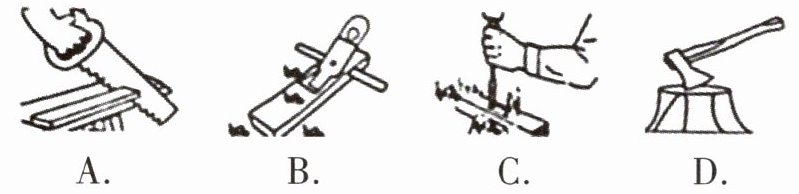
2. 新考法·图文转换题 In which picture can you see a saw?
3. What is Paragraph 4 mainly about?
A. How Lu Ban’s hand was hurt.
B. Why Lu Ban invented the saw.
C. How the saw was invented.
D. How the palace was completed.
4. Which of the following did Lu Ban’s Wooden Bird work like?
A. A bike.
B. A kite.
C. A ship.
D. A car.
5. 新考法·事件脉络题 Which is the right order of the events according to this passage?
a. Lu Ban invented the saw.
b. Lu Ban had a bright idea.
c. Lu Ban was ordered to build a palace.
d. Lu Ban’s team finished the work.
e. Lu Ban’s hand was cut.
A. a-e-b-c-d
B. e-b-a-c-d
C. c-b-a-d-e
D. c-e-b-a-d
素养:文化意识 难度:中 用时:7分钟
跨学科·历史 [2025沧州任丘部分学校月考改编] Have you ever seen or used a saw, or ju in Chinese? Do you know who invented it?
The inventor was Lu Ban. He was born in the state of Lu in ancient China more than 2,500 years ago. That is where Qufu lies in the northeast of Jining.
Lu Ban was the greatest carpenter(木匠) in his time. Once the king ordered him and his team to build a palace in a very short time. They would be punished if they missed the deadline(最后期限). They had only axes, or fuzi in Chinese, to cut the trees and prepare the wood for the palace, so the work was very slow.
One day Lu Ban rushed up the hill to see how things were going. Suddenly the sharp teeth of a
leaf cut his hand. Then a bright idea came into his head. Soon he made a tool with teeth along the side of a long iron bar(条状物). With this tool, work became much faster, and they completed the work before the deadline.
That is how the saw was invented.
Lu Ban invented many other useful tools for carpenters and interesting toys for children. The Wooden Bird, for example, could stay in the air for three days. That’s why he is regarded as the God of Carpentry.
1. What did the king order Lu Ban and his men to do?
A. To use only axes.
B. To build a palace quickly.
C. To cut the trees.
D. To prepare the wood.
2. 新考法·图文转换题 In which picture can you see a saw?
3. What is Paragraph 4 mainly about?
A. How Lu Ban’s hand was hurt.
B. Why Lu Ban invented the saw.
C. How the saw was invented.
D. How the palace was completed.
4. Which of the following did Lu Ban’s Wooden Bird work like?
A. A bike.
B. A kite.
C. A ship.
D. A car.
5. 新考法·事件脉络题 Which is the right order of the events according to this passage?
a. Lu Ban invented the saw.
b. Lu Ban had a bright idea.
c. Lu Ban was ordered to build a palace.
d. Lu Ban’s team finished the work.
e. Lu Ban’s hand was cut.
A. a-e-b-c-d
B. e-b-a-c-d
C. c-b-a-d-e
D. c-e-b-a-d
答案
【解题导语】 本文讲述了中国古代著名的木匠鲁班发明锯子的故事。
1. B 细节理解题。根据第三段中的“Once the king ordered him and his team to build a palace in a very short time”可知,皇帝命令鲁班和他的团队在很短的时间内建造一座宫殿。故选B。
2. A 图文转换题。根据第四段中的“Soon he made a tool with teeth along the side of a long iron bar(条状物)”可知,A项符合题意。
解题通法
双向解锁图文转换题
图文转换题是近两年出现的一种比较新颖的题型,旨在考查学生的词义分析和实物认知能力。此类题目考查学生的综合能力,需要学生既能认识单词,或根据上下文语境推断词义,又要匹配到对应的图片。
3. C 段落大意题。根据第四段中的“Suddenly the sharp teeth of a leaf cut his hand. Then a bright idea came into his head. Soon he made a tool with teeth along the side of a long iron bar(条状物)”可知,鲁班的手被树叶划伤,然后他想到了发明带锯齿的工具这个主意,所以第四段主要介绍了锯子是如何被发明的,故选C。
4. B 推理判断题。根据最后一段中的“The Wooden Bird, for example, could stay in the air for three days”可知,鲁班的木鸟可以在空中停留三天,类似于风筝的工作原理。故选B。
5. D 事件脉络题。通读全文可知,鲁班被命令建造宫殿,然后他的手被割伤,接着他有了一个好主意,发明了锯子,最后团队完成了工作。故选D。
解析
【分析】
本题是一篇结合中国历史人物鲁班故事的英语阅读理解题,包含细节理解、图文转换、段落大意、推理判断、事件脉络5类题型。解题时需先通读全文把握主旨,再针对各题目定位原文关键信息,逐一分析选项,图文转换题需结合工具实物认知匹配对应图片。
【解析】
1. 细节理解题:根据第三段“Once the king ordered him and his team to build a palace in a very short time”可知,国王命令鲁班和团队短时间内建造宫殿,故选B。
2. 图文转换题:锯子是带齿的切割工具,对应图A(锯),图B是刨子、图C是凿子、图D是斧头,故选A。
3. 段落大意题:第四段讲述鲁班手被带齿的树叶划伤→产生发明带齿工具的想法→制作出锯子,核心是锯子的发明过程,故选C。
4. 推理判断题:根据最后一段“The Wooden Bird...could stay in the air for three days”,木鸟能在空中停留,类似风筝的工作原理,故选B。
5. 事件脉络题:通读全文,事件顺序为:被命令建宫殿(c)→手被割伤(e)→产生好主意(b)→发明锯子(a)→完成工作(d),对应选项D。
【答案】
1.B 2.A 3.C 4.B 5.D
【知识点】
英语阅读理解、细节理解、图文转换
【点评】
本文结合中国历史人物鲁班的故事,属于跨学科(历史)阅读题,题型多样,考查学生信息定位、图文匹配、逻辑梳理能力,内容贴近生活且有文化内涵。
【难度系数】
0.6
