

 登录
登录
一、从括号内选择正确的选项补全句子。
1. Lotus plants grow in
2. There are many different ways
3. These are carrots. We eat the
4. Lotus leaves are big and
1. Lotus plants grow in
B
(A. lake B. lakes) around the world.2. There are many different ways
B
(A. cook B. to cook) potatoes.3. These are carrots. We eat the
A
(A. roots B. seeds).4. Lotus leaves are big and
B
(A. long B. round).答案
1. B 2. B 3. A 4. B
解析
【分析】
1. 第1题:考查名词的数。句意为“莲花生长在世界各地的湖泊里”,此处指多个湖泊,需用可数名词复数,据此判断选项。
2. 第2题:考查固定搭配。“做某事的方法”的固定表达为“ways to do sth”,不定式作后置定语修饰ways,据此选择。
3. 第3题:考查常识与名词词义。结合生活常识,胡萝卜是食用植物的根,据此辨析选项。
4. 第4题:考查常识与形容词词义。根据荷叶的外形特征,辨析形容词的含义,选出符合描述的选项。
【解析】
1. 第1题:lake是可数名词,此处表示“世界各地的湖泊”,并非单个湖泊,需用复数形式lakes,故选B。
2. 第2题:固定搭配“ways to do sth”表示“做某事的方法”,此处用不定式to cook作后置定语修饰ways,故选B。
3. 第3题:根据常识,胡萝卜是植物的根,对应选项A;seed(种子)不符合胡萝卜的食用部位,故选A。
4. 第4题:根据常识,荷叶的外形特点是大且圆,round符合描述;long(长的)不符合荷叶特征,故选B。
【答案】
1.B 2.B 3.A 4.B
【知识点】
名词复数、不定式作定语、名词词义辨析
【点评】
本题结合基础语法知识和生活常识,考查学生对英语基础知识点的掌握与应用,题目难度适中,适合巩固英语基础。
【难度系数】
0.6
1. 第1题:考查名词的数。句意为“莲花生长在世界各地的湖泊里”,此处指多个湖泊,需用可数名词复数,据此判断选项。
2. 第2题:考查固定搭配。“做某事的方法”的固定表达为“ways to do sth”,不定式作后置定语修饰ways,据此选择。
3. 第3题:考查常识与名词词义。结合生活常识,胡萝卜是食用植物的根,据此辨析选项。
4. 第4题:考查常识与形容词词义。根据荷叶的外形特征,辨析形容词的含义,选出符合描述的选项。
【解析】
1. 第1题:lake是可数名词,此处表示“世界各地的湖泊”,并非单个湖泊,需用复数形式lakes,故选B。
2. 第2题:固定搭配“ways to do sth”表示“做某事的方法”,此处用不定式to cook作后置定语修饰ways,故选B。
3. 第3题:根据常识,胡萝卜是植物的根,对应选项A;seed(种子)不符合胡萝卜的食用部位,故选A。
4. 第4题:根据常识,荷叶的外形特点是大且圆,round符合描述;long(长的)不符合荷叶特征,故选B。
【答案】
1.B 2.B 3.A 4.B
【知识点】
名词复数、不定式作定语、名词词义辨析
【点评】
本题结合基础语法知识和生活常识,考查学生对英语基础知识点的掌握与应用,题目难度适中,适合巩固英语基础。
【难度系数】
0.6
二、按要求完成下列各题。
1. Would you like some water? (作肯定回答)
2. The green tea comes from Yunnan. (对画线部分提问)
3. I’d like fish and rice. (对画线部分提问)
1. Would you like some water? (作肯定回答)
Yes
, please
.2. The green tea comes from Yunnan. (对画线部分提问)
Where
does
the green tea come
from
?3. I’d like fish and rice. (对画线部分提问)
What would you like (to eat)?
答案
1. Yes; please 2. Where does; come from
3. What would you like (to eat)?
3. What would you like (to eat)?
解析
【分析】
1. “Would you like...?”是常用的委婉请求句型,其肯定回答为固定交际用语,需牢记;
2. 对地点类划线部分提问,需用疑问词Where,原句是一般现在时,主语the green tea为第三人称单数,需借助助动词does,且原句实义动词comes要还原为原形;
3. 对事物类划线部分提问,需用疑问词What,原句主语是第一人称I,转换为第二人称you后调整句式即可。
【解析】
1. “Would you like...?”的肯定回答固定为:Yes, please;
2. 划线部分是地点Yunnan,用Where提问,原句是一般现在时,主语为第三人称单数,所以助动词用does,实义动词come用原形,故结构为Where does the green tea come from;
3. 划线部分是事物fish and rice,用What提问,原句I’d like转换为第二人称you,所以是What would you like (to eat)。
【答案】
1. Yes; please
2. Where does; come from
3. What would you like (to eat)
【知识点】
日常交际用语、特殊疑问句、一般现在时疑问句
【点评】
本题为英语基础句型转换题,考察日常交际固定答语、特殊疑问词的选用及一般现在时疑问句的构成,属于入门阶段的基础题型,需熟练掌握相关句式结构。
【难度系数】
0.8
1. “Would you like...?”是常用的委婉请求句型,其肯定回答为固定交际用语,需牢记;
2. 对地点类划线部分提问,需用疑问词Where,原句是一般现在时,主语the green tea为第三人称单数,需借助助动词does,且原句实义动词comes要还原为原形;
3. 对事物类划线部分提问,需用疑问词What,原句主语是第一人称I,转换为第二人称you后调整句式即可。
【解析】
1. “Would you like...?”的肯定回答固定为:Yes, please;
2. 划线部分是地点Yunnan,用Where提问,原句是一般现在时,主语为第三人称单数,所以助动词用does,实义动词come用原形,故结构为Where does the green tea come from;
3. 划线部分是事物fish and rice,用What提问,原句I’d like转换为第二人称you,所以是What would you like (to eat)。
【答案】
1. Yes; please
2. Where does; come from
3. What would you like (to eat)
【知识点】
日常交际用语、特殊疑问句、一般现在时疑问句
【点评】
本题为英语基础句型转换题,考察日常交际固定答语、特殊疑问词的选用及一般现在时疑问句的构成,属于入门阶段的基础题型,需熟练掌握相关句式结构。
【难度系数】
0.8
三、新趋势 学科融合 阅读向日葵的科普材料,按要求完成下列任务。
Sunflowers are very bright. They have a golden colour. Sunflowers grow in the soil.
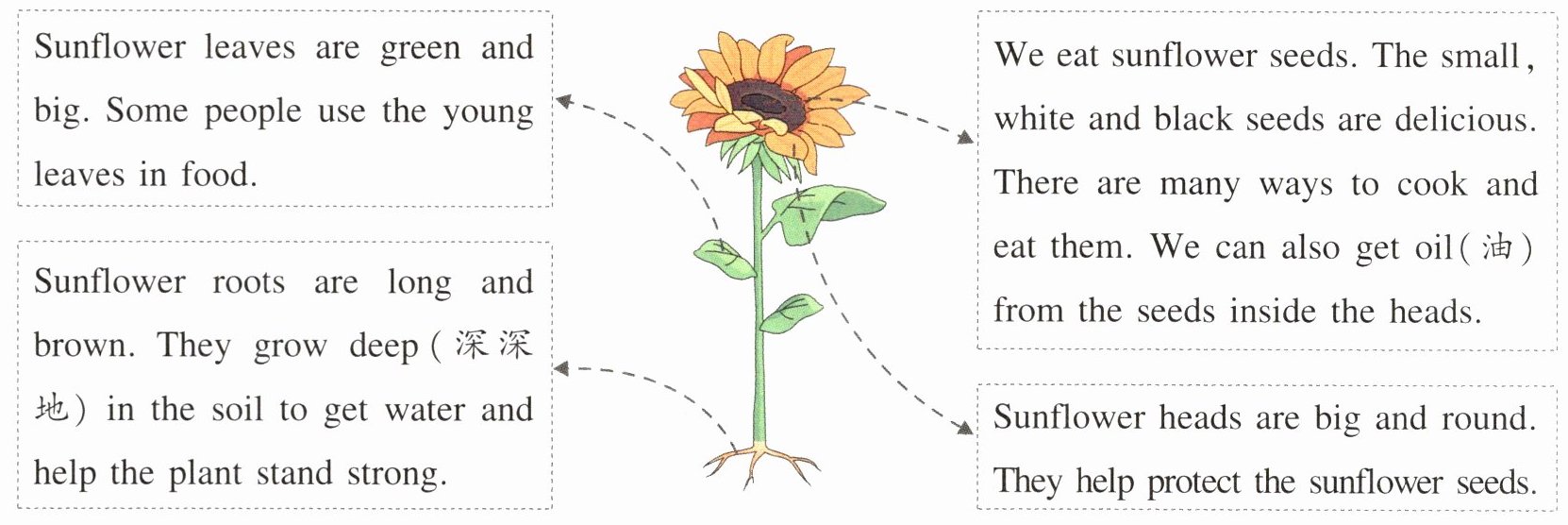
Sunflower leaves are green and big. Some people use the young leaves in food.
Sunflower roots are long and brown. They grow deep(深深地)in the soil to get water and help the plant stand strong.
We eat sunflower seeds. The small, white and black seeds are delicious. There are many ways to cook and eat them. We can also get oil(油)from the seeds inside the heads.
Sunflower heads are big and round. They help protect the sunflower seeds.
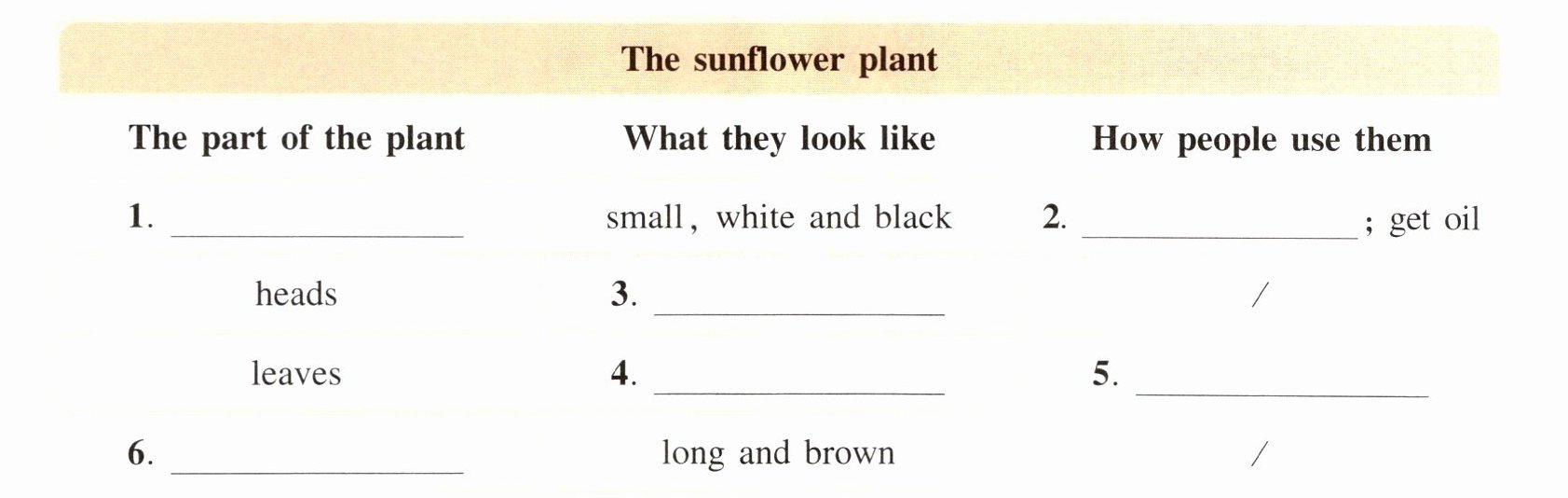
任务一:根据材料内容,完成下面的表格。
任务二:根据材料内容,判断下列句子正(T)误(F)。
(
(
Sunflowers are very bright. They have a golden colour. Sunflowers grow in the soil.
Sunflower leaves are green and big. Some people use the young leaves in food.
Sunflower roots are long and brown. They grow deep(深深地)in the soil to get water and help the plant stand strong.
We eat sunflower seeds. The small, white and black seeds are delicious. There are many ways to cook and eat them. We can also get oil(油)from the seeds inside the heads.
Sunflower heads are big and round. They help protect the sunflower seeds.
任务一:根据材料内容,完成下面的表格。
任务二:根据材料内容,判断下列句子正(T)误(F)。
(
T
)7. Sunflower roots can help the plant stand strong.(
F
)8. People have many ways to cook every part of sunflowers.答案
任务一:1. seeds 2. cook and eat
3. big and round 4. green and big
5. use the young leaves in food 6. roots
任务二:7. T 8. F
3. big and round 4. green and big
5. use the young leaves in food 6. roots
任务二:7. T 8. F
解析
【分析】
本题分为任务一和任务二,均考查英语科普阅读的细节理解能力。任务一需根据材料内容,对应各植物部位的描述提取关键信息完成表格;任务二需回到原文定位句子表述,判断与原文是否一致。解题时需仔细阅读材料,找准对应语句,避免信息混淆。
【解析】
任务一:
1. 对应原文“We eat sunflower seeds...There are many ways to cook and eat them”,可知对应部位为seeds;
2. 同上,对应内容为cook and eat;
3. 对应原文“Sunflower heads are big and round”,可知花盘特征为big and round;
4. 对应原文“Sunflower leaves are green and big”,可知叶子特征为green and big;
5. 对应原文“Some people use the young leaves in food”,可知嫩叶用途为use the young leaves in food;
6. 对应原文“Sunflower roots are long and brown...They grow deep in the soil to get water and help the plant stand strong”,可知对应部位为roots。
任务二:
7. 原文明确提到根的作用是“help the plant stand strong”,与句子表述一致,故判断为T;
8. 原文仅提到种子有多种烹饪食用方式、嫩叶可用于食物,并非“每个部分”都有多种烹饪方法,与句子表述不符,故判断为F。
【答案】
任务一:1. seeds 2. cook and eat 3. big and round 4. green and big 5. use the young leaves in food 6. roots
任务二:7. T 8. F
【知识点】
英语阅读理解、细节信息提取、判断正误题
【点评】
本题为学科融合类英语阅读题,结合向日葵科普内容考查细节理解,需学生精准定位原文对应信息,第8题易因扩大范围判断错误,整体侧重基础阅读能力的应用。
【难度系数】
0.6
本题分为任务一和任务二,均考查英语科普阅读的细节理解能力。任务一需根据材料内容,对应各植物部位的描述提取关键信息完成表格;任务二需回到原文定位句子表述,判断与原文是否一致。解题时需仔细阅读材料,找准对应语句,避免信息混淆。
【解析】
任务一:
1. 对应原文“We eat sunflower seeds...There are many ways to cook and eat them”,可知对应部位为seeds;
2. 同上,对应内容为cook and eat;
3. 对应原文“Sunflower heads are big and round”,可知花盘特征为big and round;
4. 对应原文“Sunflower leaves are green and big”,可知叶子特征为green and big;
5. 对应原文“Some people use the young leaves in food”,可知嫩叶用途为use the young leaves in food;
6. 对应原文“Sunflower roots are long and brown...They grow deep in the soil to get water and help the plant stand strong”,可知对应部位为roots。
任务二:
7. 原文明确提到根的作用是“help the plant stand strong”,与句子表述一致,故判断为T;
8. 原文仅提到种子有多种烹饪食用方式、嫩叶可用于食物,并非“每个部分”都有多种烹饪方法,与句子表述不符,故判断为F。
【答案】
任务一:1. seeds 2. cook and eat 3. big and round 4. green and big 5. use the young leaves in food 6. roots
任务二:7. T 8. F
【知识点】
英语阅读理解、细节信息提取、判断正误题
【点评】
本题为学科融合类英语阅读题,结合向日葵科普内容考查细节理解,需学生精准定位原文对应信息,第8题易因扩大范围判断错误,整体侧重基础阅读能力的应用。
【难度系数】
0.6
